
Autoimmune Drugs For Women: What To Bring To The Clinic
By Fedor Lipskerov, Ph.D., and Bonnie Feldman, DDS, MBA

Autoimmune disease is one of the most sex-skewed categories in medicine. Women are about nine times as likely as men to have lupus.¹ Estimates of the female-to-male ratio in Sjögren’s disease run from 9:1 to 20:1.² Multiple sclerosis and rheumatoid arthritis affect women roughly two to three times as often as men.³˒⁴ Yet drug programs in these diseases often treat sex as a demographic variable rather than as biology.
We analyzed 17,243 autoimmune-related trials registered on ClinicalTrials.gov using the March 2026 snapshot.⁵ In this defined set of trials, 445 (2.6%) enroll women exclusively, compared with 168 that enroll men exclusively.⁵ Only 154 protocols mention the menstrual cycle in their eligibility criteria.⁵ Pregnancy appears in 8,823 protocols, and 7,913 of those list it as a reason to exclude women rather than as a variable to study.⁵
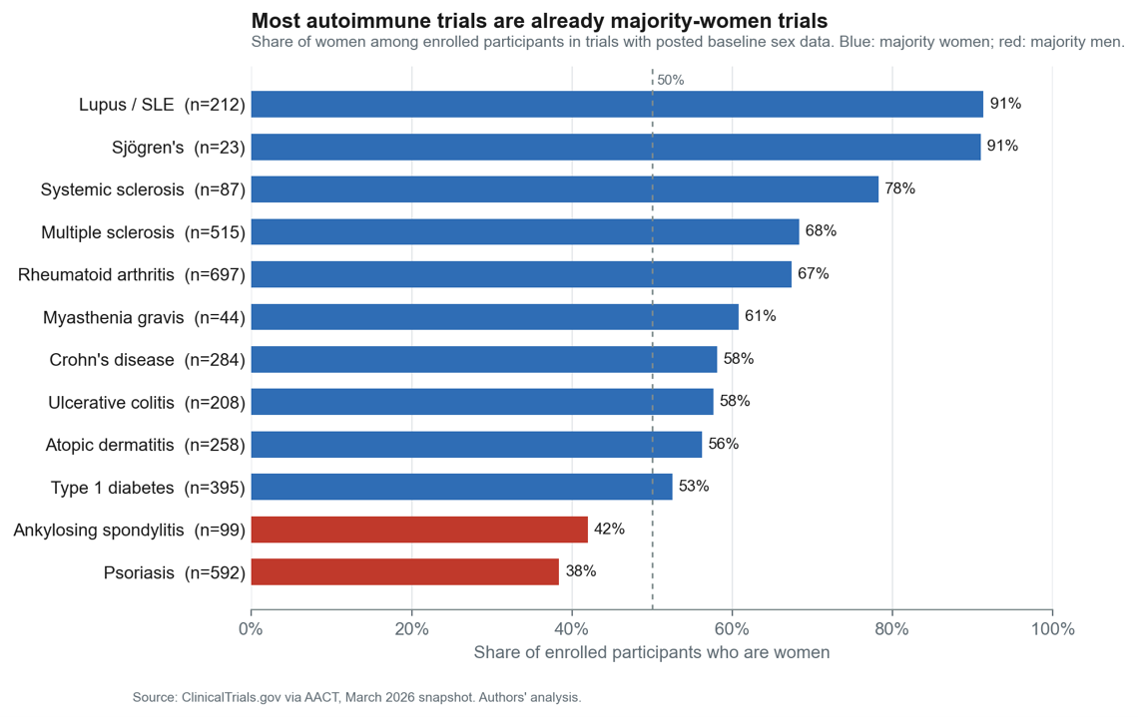
But the issue is not that we need more female-only trials. The more important point is that many autoimmune trials are already effectively women’s health trials. In lupus, Sjögren’s disease, systemic sclerosis, multiple sclerosis, and rheumatoid arthritis, women account for roughly 70%–90% of enrolled participants in trials with posted baseline sex data.⁵
If women make up the majority of your study population, sex, reproductive status, and hormonal state should not be treated as background noise. They are part of the biology of the population you are studying, and trial design should reflect that.
Those trials inherit their assumptions from discovery. The cell lines, animal models, and first-in-human studies that come before a pivotal trial decide which questions about sex the trial is able to ask. Below are four places where autoimmune trials fall short, where each gap starts upstream, and what could be done differently.
Pitfall 1: Enrolling To Prevalence And Calling It Done
Posted data from 697 rheumatoid arthritis trials show that 67.4% of enrolled participants are women, compared with 91.3% across 212 lupus trials.⁵ On the surface, those numbers reflect the underlying epidemiology. But there is a problem: sex is often recorded as a demographic and then left out of the analysis.
NIH has required researchers it funds to consider sex as a biological variable since 2016.⁶ The FDA has asked for sex-specific analyses in drug trials since 1993 and in device trials since 2014.⁷˒⁸ The expectation is not simply to count how many women and men were enrolled. It is to analyze whether sex affects efficacy and safety. That 1993 guideline is now being replaced: FDA’s draft guidance Study of Sex Differences in the Clinical Evaluation of Medical Products, first issued in January 2025 and revised in November 2025, states that when finalized it will replace the 1993 document.⁹
Where it starts: A trial can only prespecify a sex-stratified analysis if someone has predicted a difference. That starts in preclinical pharmacology: testing the drug in both male and female models can reveal differences in efficacy, exposure, pharmacodynamics, toxicity, or immune response that may warrant investigation in the clinic. NIH explicitly recommends considering sex in the design, analysis, and reporting of vertebrate animal studies.
What we can do better: Pre-specify sex-stratified efficacy and safety analyses in the statistical analysis plan. When both sexes are sufficiently represented, consider powering the study to assess whether treatment effects differ by sex. When the study is not powered for a formal interaction test, report sex-stratified estimates and confidence intervals rather than simply presenting pooled results. The protocol should also identify endpoints where sex-related biology may matter, such as pharmacokinetics, immunogenicity, and adverse events, so that meaningful differences are not lost in the overall analysis.
The goal is not to turn every trial into a sex-specific study. It is to make sure that when a trial population is overwhelmingly female, the data collected can tell us whether the drug works, behaves, and remains safe in the population that will actually receive it.
Pitfall 2: Treating Hormonal State As A Nuisance
The female immune system changes across the lifespan. Estrogen can enhance antibody responses, while the TLR7 gene can escape X-chromosome inactivation in immune cells, potentially contributing to the heightened immune activation seen in diseases such as lupus.¹⁰˒¹¹ Pregnancy has a striking effect on multiple sclerosis: relapse rates fall substantially during pregnancy, particularly in the third trimester, before rising again after delivery.¹² Menopause can also alter disease activity in several autoimmune conditions.¹³
Yet a trial that enrolls women aged 18 to 65 without recording menstrual status, hormonal contraception, pregnancy history, or menopausal stage is effectively grouping together very different immune states. The variability may be biology, not noise.
Where it starts: Hormonal state can be modeled before the clinic, in cycling, pregnant, and ovariectomized animals, so the trial team knows which variables to collect. The timing of experiments can matter as well. Both sexes have circadian (~24-hour) biological rhythms, while premenopausal females also experience cyclic changes in reproductive hormones over the menstrual or estrous cycle. These rhythms can influence immune activity, metabolism, pharmacokinetics, and drug response.
What we can do better: Collect a small set of baseline reproductive and hormonal variables: menstrual status, current hormonal contraception, parity and time since last pregnancy, and menopausal status. Where biologically relevant, record cycle phase or hormonal therapy and the timing of dosing and sample collection.
The goal is to recognize when hormonal timing could affect the result and design the experiment accordingly. If a drug target, immune pathway, or pharmacokinetic endpoint is hormone sensitive, that relationship can be tested explicitly rather than being treated as unexplained variability.
Pitfall 3: Excluding The Patients You Most Need To Understand
Of the 17,240 autoimmune protocols with eligibility text, 8,823 mention pregnancy, and 7,913 of those exclude pregnant women. Of the same 17,240, 5,543 exclude breastfeeding women, most of them the same trials.5 Excluding pregnant and breastfeeding women can be appropriate in early-stage trials, when the safety risks are still poorly understood. The problem is when the same exclusions are simply carried forward into later-stage studies and post-marketing research.
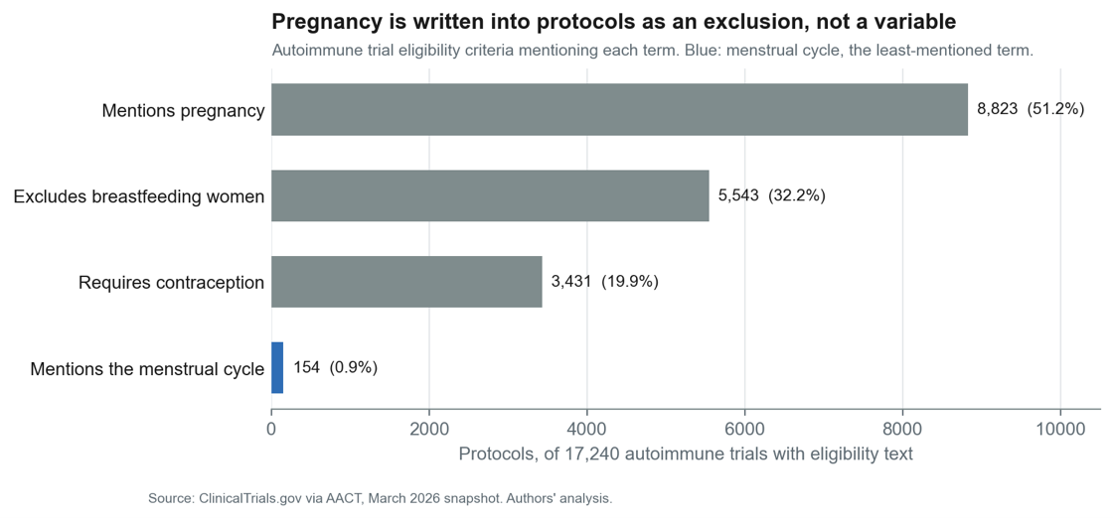
That leaves a major evidence gap around pregnancy and the postpartum period, a time when autoimmune disease activity can change substantially and treatment decisions can be especially difficult.
Where it starts: Reproductive and developmental toxicology should be integrated into the development plan early enough to inform — not simply follow — decisions about pregnancy and lactation. The timing and scope should be driven by the intended patient population, mechanism of action, expected clinical exposure, and stage of development.
What we can do better: Treat pregnancy and lactation exclusions as a development-stage decision, not a default that follows a drug forever. Define when and how pregnancy and lactation data will be generated in the development plan through a pregnancy registry, dedicated cohort, or appropriately designed pharmacokinetic study. FDA guidance on the inclusion of pregnant women in clinical trials (2018) and clinical lactation studies (2019) provides a framework for doing this.¹⁴
Pitfall 4: Letting Sex-Specific Evidence Drift To Academia
Industry sponsors 57.7% of male-only autoimmune trials but only 16.6% of female-only trials, while academic and other nonprofit sponsors account for 77.3% of female-only trials.⁵ The largest single sponsor of female-only autoimmune trials is the Federal University of São Paulo.⁵ Male-only autoimmune trials are mostly Phase 1 healthy volunteer studies: 86 of 168, and 82 of those are industry run.⁵ Female-only trials are mostly observational: 330 of 445 carry no phase.⁵
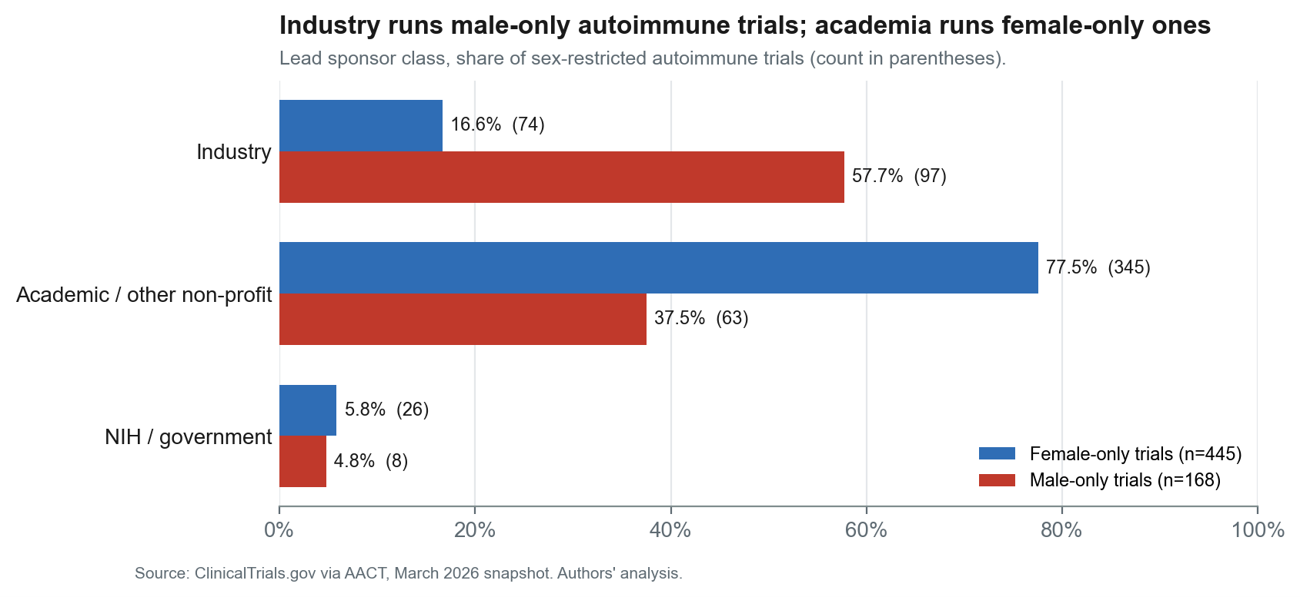
The result is an evidence gap. Questions around female-specific dosing, disease flares, and safety are often left to small, single-center academic studies. The industry programs that could generate this evidence at scale are rarely designed to answer them.
Where it starts: Those male-only Phase 1 studies are where preclinical predictions about exposure and safety are first tested in people. When they enroll only men, sex differences in pharmacokinetics go unmeasured at that point.
What we can do better: If an indication is predominantly female, we need at least one meaningful sex-specific substudy in the development program. This does not necessarily mean running a separate trial; it could mean prospectively collecting and analyzing the relevant data within a pivotal study. The incremental cost is likely modest relative to the cost of a Phase 3 program, while the potential value for dosing, safety, and ultimately the product label is substantial.
From Discovery To The Clinic
Sex-specific immune biology is beginning to yield mechanisms, not just explanations for variance. The clearest example is XIST, the RNA that silences one X chromosome in every female cell. XIST forms complexes that promote female-biased autoimmunity. In a mouse model of lupus, males engineered to express XIST developed more severe disease across multiple organs than unmodified males, and patients with autoimmune disease carry antibodies to several components of these complexes.¹⁵ A 2026 study has since mapped where those antibodies bind.¹⁶ Findings like these point to new targets and biomarkers for selecting patients. They also raise the stakes for trial design: a drug built on a sex-linked mechanism, then tested in a trial that pools women and men, would leave its own central hypothesis untested.
Hormonal state matters as well. In Sjögren’s disease, men make up about 30% of patients in early childhood, about 10% from late puberty through adulthood, and about 14% in older age, a pattern that tracks hormonal transitions across the lifespan.¹⁷ For multiple sclerosis and other neurological disorders, a 2026 research road map describes scientific understanding of how the menopausal transition affects the brain as minimal.¹⁸
Clinical research has been slower to respond. Female-only autoimmune trials rose from about 20 a year in 2015 through 2017 to about 28 a year in 2021 through 2024, then reached 33 in 2025.⁵ That is still a small fraction of the roughly 1,000 autoimmune trials that start each year.⁵ Across immunology more broadly, women make up 53% of trial participants but account for 61% of prevalence and 57% of disease burden.¹⁹
Many of these gaps open before a program ever reaches the clinic. Across 720 papers in nine biological disciplines, 49% of studies published in 2019 used both sexes, up from 28% a decade earlier, and in immunology the share rose from 16% to 46%. But only 42% of those dual-sex studies analyzed their data by sex, and for eight of the nine disciplines, that share had not changed since 2009.²⁰ Among papers claiming a sex-specific effect, the authors usually had not tested statistically whether females and males responded differently.²¹ The NIH policy cited earlier applies at this stage, too, because it covers vertebrate animal and human research, not only trials.⁶
In lupus, Sjögren’s disease, and multiple sclerosis, most patients are women, so preclinical research should reflect female biology from the start. First, record the sex of every cell line, primary cell, and animal — because if it isn’t recorded, it can’t be analyzed later. Then, test both female and male models. If a target is validated only in male cells or animals, we may miss how the drug will behave in the patients most likely to receive it. For diseases influenced by hormonal changes, preclinical studies should also consider hormonal state, which can shape immune activity. Finally, looking early for sex-linked markers, such as antibodies against XIST complexes, could help future trials monitor disease activity, treatment response, and patient subgroups. This approach means entering Phase 1 with a clear hypothesis about sex biology, rather than simply adding sex as a demographic variable.
References
- Izmirly PM, Parton H, Wang L, et al. Prevalence of systemic lupus erythematosus in the United States: estimates from a meta-analysis of the Centers for Disease Control and Prevention National Lupus Registries. Arthritis Rheumatol. 2021;73(6):991-996. PMID 33474834. doi:10.1002/art.41632
- Patel R, Shahane A. The epidemiology of Sjögren’s syndrome. Clin Epidemiol. 2014;6:247-255. PMID 25114590. doi:10.2147/CLEP.S47399
- Wallin MT, Culpepper WJ, Campbell JD, et al. The prevalence of MS in the United States: a population-based estimate using health claims data. Neurology. 2019;92(10):e1029-e1040. PMID 30770430. doi:10.1212/WNL.0000000000007035
- GBD 2021 Rheumatoid Arthritis Collaborators. Global, regional, and national burden of rheumatoid arthritis, 1990-2020, and projections to 2050: a systematic analysis of the Global Burden of Disease Study 2021. Lancet Rheumatol. 2023;5(10):e594-e610. PMID 37795020. doi:10.1016/S2665-9913(23)00211-4
- Trialytic.ai. Clinical trial intelligence and ClinicalTrials.gov data platform. 2026. https://trialytic.ai/
- National Institutes of Health. Consideration of Sex as a Biological Variable in NIH-funded Research. Notice NOT-OD-15-102. June 2015.
- U.S. Food and Drug Administration. Guideline for the Study and Evaluation of Gender Differences in the Clinical Evaluation of Drugs. July 1993.
- U.S. Food and Drug Administration. Evaluation of Sex-Specific Data in Medical Device Clinical Studies: Guidance for Industry and Food and Drug Administration Staff. August 2014.
- U.S. Food and Drug Administration. Study of Sex Differences in the Clinical Evaluation of Medical Products: Guidance for Industry. Draft guidance, revision 1, November 2025; first issued as a draft January 2025.
- Klein SL, Flanagan KL. Sex differences in immune responses. Nat Rev Immunol. 2016;16(10):626-638. PMID 27546235.
- Souyris M, Cenac C, Azar P, et al. TLR7 escapes X chromosome inactivation in immune cells. Sci Immunol. 2018;3(19):eaap8855. PMID 29374079.
- Confavreux C, Hutchinson M, Hours MM, Cortinovis-Tourniaire P, Moreau T. Rate of pregnancy-related relapse in multiple sclerosis. N Engl J Med. 1998;339(5):285-291. PMID 9682040.
- Sammaritano LR. Menopause in patients with autoimmune diseases. Autoimmun Rev. 2012;11(6-7):A430-A436. PMID 22120060. doi:10.1016/j.autrev.2011.11.006
- U.S. Food and Drug Administration. Pregnant Women: Scientific and Ethical Considerations for Inclusion in Clinical Trials. Draft guidance, April 2018. Clinical Lactation Studies: Considerations for Study Design. Draft guidance, May 2019.
- Dou DR, Zhao Y, Belk JA, et al. Xist ribonucleoproteins promote female sex-biased autoimmunity. Cell. 2024;187(3):733-749.e16. doi:10.1016/j.cell.2023.12.037
- Yan B, Lee J, Srinivasan S, et al. Autoantibody hotspots reveal the origin and impact of immunogenic XIST ribonucleoprotein complexes in autoimmune diseases. J Clin Invest. 2026;136(7):e198291. doi:10.1172/JCI198291
- Diggins EC, Weller ML. Hormonal transitions across the lifespan shape susceptibility to Sjögren’s disease. Rheumatology. 2026;65(3):keag087. doi:10.1093/rheumatology/keag087
- Bove R, Dobson R. Menopause and neurological disorders: a roadmap for research. Nat Rev Neurol. 2026;22(9):581-601. doi:10.1038/s41582-026-01244-5
- IQVIA. Quantifying Differences in Female and Male Healthcare. November 18, 2025.
- Woitowich NC, Beery A, Woodruff T. A 10-year follow-up study of sex inclusion in the biological sciences. eLife. 2020;9:e56344. PMID 32513386. doi:10.7554/eLife.56344
- Garcia-Sifuentes Y, Maney DL. Reporting and misreporting of sex differences in the biological sciences. eLife. 2021;10:e70817. PMID 34726154. doi:10.7554/eLife.70817
About The Authors
 Fedor Lipskerov, Ph.D., is the founder of Trialytic and a postdoctoral scientist in drug discovery. A molecular biologist who completed his doctoral research in Nobel Prize-winning Ciechanover’s lab, he currently focuses on drug development and biomarker discovery in neurobiology. His experience spans translational research, biotech, and AI-driven drug discovery.
 Bonnie Feldman, DDS, MBA, is the founder and managing partner of The Autoimmune Fund and the founder of Autoimmune Connect, a patient education and advocacy platform. A former practicing dentist and Wall Street healthcare equity analyst who covered more than 500 companies over 14 years, she has interviewed more than 400 people living with autoimmune disease.