
Beyond RAG: Why Life Sciences AI Workflows Need Better Context, Not Just Better Models
By Sam Awotunde, Director, Biomedical Informatics and Innovation Strategy Lead, AI/ML, Quantitative and Digital Sciences, Pfizer; and Harini Gopalakrishnan, CEO and Founder, TheHGFactor and Chief AI Officer, Streamcare Group Health

Life sciences organizations are moving quickly from generative AI pilots toward agents that can reason across clinical, medical, R&D, and real-world evidence (RWE). Teams want AI systems that can answer complex scientific questions across value chain: to help in target prioritization, synthesize evidence for new launches, compare studies across indications, support medical workflows, and find patterns across fragmented enterprise knowledge. But as these systems move closer to production, a recurring problem is becoming visible — the relevancy of the answers and precision. The model is often not the weakest part of this system; the models have evolved sufficiently, but the missing link is the context.
This is especially true in drug discovery, oncology, safety, and real-world evidence use cases, where an AI agent needs to reason across myriad data: biomarker assay results, metadata definitions, scientific intelligence from journals, clinical trial data, analytical endpoints, protocols and clinical study reports (CSRs), publications, congress abstracts, safety narratives, real world data sets, and controlled terminology. Each source may describe the same concept differently. Some answers are structured facts. Others are buried in tables, figures, PDFs, or narrative text. Some relationships are definitive and should never be left for a language model to infer.
For example, in target prioritization, a question you may ask is, which emerging targets in KRAS-mutant colorectal cancer show the strongest combination of human genetic evidence, disease relevance, tractability, and experimental validation? An answer requires genomic, functional-screening, expression, and assay data combined with publications, internal reports, patents, and experimental observations to be gathered and reasoned together. The value of the AI system therefore lies not simply in identifying these sources but in assembling the right evidence and prior organizational knowledge for the decision at hand with clear attribution.
While retrieval-augmented generation (RAG) systems allow for attribution and hallucination reduction, designing such a system alone is not enough. Life sciences organizations need a governed architecture that combines AI-ready data products, consistent meaning, and precision context selection across structured and unstructured information seamlessly to make it traceable and precise.
The Business Context: Deep Diving The Terms
We will analyze this in detail with two examples: one in gathering evidence from medical/real world observations and another in helping target prioritization.
Imagine a clinical development or medical team asking a question that needs to reconcile internal studies, external literature, and real-world evidence to plan future evidence-generation strategy. For example, across your clinical program, external literature, and real-world evidence, what do you know about outcomes in first-line metastatic non-small cell lung cancer (NSCLC) patients with high PD-L1 expression and baseline brain metastases, and where do the evidence gaps remain? This sounds like exactly the kind of question a sophisticated model should be able to reason through. One could imagine sending it to a large language model (LLM) and expecting it to “figure out the answer.” But before a model can reason well, the enterprise has several other problems to solve.
Structured clinical data sets may contain patient characteristics, treatment arms, response rates, progression-free survival, adverse events, subgroup variables, and study identifiers. Unstructured content contains much of the interpretation layer: Protocols and statistical analysis plans define subgroups, endpoints, and evaluable populations. Clinical study reports may contain analyses not represented in an analytical table. Publications and congress posters provide related trial results. Medical affairs teams may maintain evidence summaries, response documents, and field insights.
Then there is the terminology challenge. Real-world data sets may use different disease codes, treatment definitions, and temporal conventions. They also bring engineering challenges, including harmonization across studies, missingness, and variation in how events are captured.
Even simple concepts can vary:
- What exactly constitutes “high PD-L1”? Is it a tumor proportion score (TPS) ≥50%? Was the assay the same across studies?
- Does “brain metastases” mean active disease, treated and stable disease, or any prior CNS involvement?
- Does “first line” have the same definition in the clinical trial, the RWE data set, and the publication being retrieved?
- Is progression-free survival investigator-assessed or based on independent central review?
These are not language-generation problems. They are problems of data readiness, semantic consistency, and context selection. If an LLM receives inconsistent definitions, poorly governed mappings, or the wrong evidence, a stronger model will simply reason more fluently over unreliable context.
Similarly, let’s assume a drug discovery example where a therapeutic area lead is interested in studying a specific target in cancer, a well-known tumor suppressor PTEN: For PTEN-altered tumors, what evidence tells us about the prevalence of PTEN loss-associated genomic features, pathway activity, dependencies, and available experimental results. What can literature answer about the biological rationale, therapeutic hypotheses, resistance mechanisms, and previous attempts to target this biology?
That decomposes again naturally into two evidence paths:
- Structured question: What quantitative evidence supports PTEN-related therapeutic vulnerabilities?
The response for this could draw from genomic alteration frequencies, transcriptomic/proteomic expression, pathway scores, assay results, compound–target activity, and other experimental measurements that have been generated and captured internally.
- Unstructured question: What is known about why those vulnerabilities may or may not be therapeutically actionable?
This brings in publications, internal research reports, patents, preclinical studies, conference materials, and presentations with figures describing mechanism, resistance, toxicity, selectivity, or previous target-validation efforts.
The key issue again is the semantic resolution and context: A source saying, “PTEN loss” may not mean the same thing as another source saying “PTEN mutation.” PTEN can refer to the gene (HGNC:9588/NCBI Gene 5728), the corresponding protein (UniProt P60484), or a biological state such as loss of protein expression. PTEN also has historical aliases such as MMAC1 and TEP1.
Doing It Better
A better approach starts before the prompt reaches the model.
First, structured data, whether it’s clinical, biomarker, or analytical, must be made AI-ready. That means more than putting tables into Snowflake, Databricks, or another analytical environment. The data need quality controls, provenance, stable identifiers, temporal consistency, access policies, and definitions that an AI system can reliably interpret. A life sciences agent should not have to guess which column represents disease stage, where the transcriptomics studies exist, which data set contains baseline CNS metastases, or which endpoint definition applies to a specific analysis.
Second, unstructured evidence must be made retrievable. A large portion of life sciences knowledge does not live in rows and columns. It lives in documents of varying complexity. A subgroup result may appear only in a forest plot. An endpoint definition may be buried in a protocol. A safety nuance may exist in a CSR table or narrative. A publication may distinguish active from previously treated brain metastases in a way that is critical to interpreting the result.

Similarly, patents, abstracts, papers defining mechanisms of action, or prior studies undertaken on the PTEN target are all critical evidence in target evaluation, not all of which are in easy-to-consume texts. Not all of these documents have the same level of importance. A target prioritization outcome captured in a PowerPoint in the past may have considered not pursuing PTEN based on older assay results, which more recent ones could have invalidated. Therefore, in such cases, temporal validity of the result needs to be included in the ranking and becomes a parameter. For the oncology question, the system may need internal subgroup results, protocol definitions, external evidence, real-world outcomes, and evidence explaining where populations or endpoints are not directly comparable.
This is where an unstructured store and retrieval engine becomes essential. Protocols, CSRs, publications, tables, figures, posters, and scientific documents need to be represented, indexed, filtered, retrieved, and ranked so the system can find evidence most relevant to the question. The role is not simply to vectorize documents. A production-grade retrieval layer should support multiple retrieval strategies, metadata filtering, query decomposition, hybrid retrieval, multimodal representation, relevance tuning, and ranking. Retrieval, therefore, becomes a context-selection problem, not merely a similarity-search problem.
Third, meaning must be governed across sources. Disease concepts, biomarkers, endpoints, drugs, adverse events, treatment lines, patient populations, and study identifiers may need to resolve against common concepts using standards and enterprise terminology.
This is the role of the semantic layer. Life sciences already have a rich ecosystem of controlled vocabularies and standards, including the Medical Dictionary for Regulatory Activities (MedDRA), Systematized Nomenclature of Medicine Clinical Terms (SNOMED CT), Clinical Data Interchange Standards Consortium (CDISC) terminology, Gene Ontology (GO) terms, the National Cancer Institute Thesaurus, drug dictionaries, biomarker taxonomies, and enterprise-specific ontologies. The semantic layer provides governed relationships between those concepts. It can establish that several source-specific disease labels resolve to the same enterprise concept identifier while preserving clinically important distinctions. It can define which adverse-event terms roll up to a MedDRA grouping. It can preserve relationships between studies, arms, endpoints, biomarkers, indications, and patient populations. And importantly, it can define where equivalence does not exist. That last point is critical.
AI is very good at identifying that two terms appear semantically related. That does not mean an enterprise should allow a language model to establish a regulated crosswalk. Where a mapping must be governed and reproducible, the semantic layer should be authoritative.
In the case of an upstream research example, semantic grounding becomes more important because the same biological concept may appear differently across an enterprise, and a regular LLM or simple retrieval will struggle with framing the relevant response. One data set may encode “PTEN_DEL,” another may use “PTEN loss,” a legacy source may refer to “MMAC1,” a pathology system may record “PTEN negative by immunohistochemistry (IHC),” and a paper may describe an “absence of PTEN staining.”
In these cases, ontologies provide the governed meaning of these concepts, while semantic mapping resolves aliases and source-specific representations to common entities. For example:
- recognizing that PTEN, MMAC1, and NCBI Gene 5728 refer to the same gene, without collapsing distinct observations into one
- PTEN genomic deletion, a PTEN sequence loss-of-function variant, and PTEN protein loss by IHC are biologically related, but they are not equivalent measurements.
A knowledge graph can then connect these concepts through explicit relationships, for example:
- linking PTEN loss of function (LOF) to PI3K–AKT pathway activity (e.g., PTEN LOF affects PI3K–AKT signaling)
- a biomarker state to the assay used to measure it (e.g., PTEN LOF measured by IHC)
- or a clinical study to a PTEN-defined population (e.g., Study A evaluates patients with PTEN LOF).
A semantic layer or catalog makes those governed concepts and relationships consistently query-able, so an agent can ask specifically for “patients with PTEN genomic alterations,” separately for “studies involving PTEN protein loss,” or more broadly for “evidence concerning loss of PTEN function.”
The broader query may legitimately expand across several narrower concepts, but that expansion is explicit and governed rather than relying only on embedding similarity.
Table 1: Example Of Semantic, Ontology, And Context Orchestration
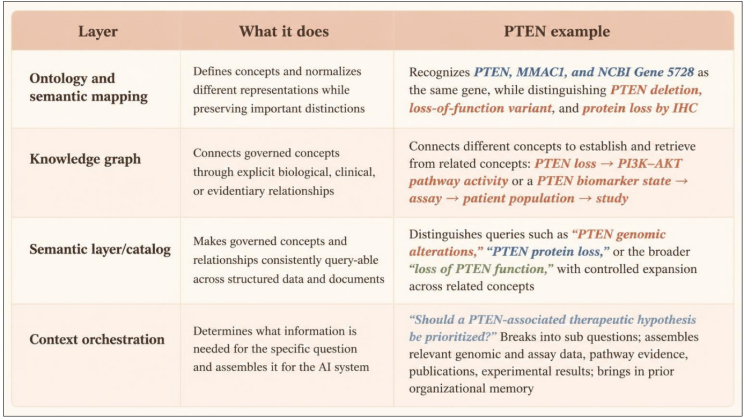
Semantic Mapping Is Not The Same As Context Orchestration
Ontologies define what things mean; knowledge graphs make relationships connected; semantic catalogs or semantic layers make concepts query-able in governed, consistent language; and context orchestration makes the right information available, in the right form, the moment a specific question is asked. In short, while semantic layer provides the meaning, context orchestration determines what the agent needs right now in order to provide the most relevant answer to the user’s scientific question.
None of these constructs fully substitutes for the others. While they are all inter-related, they solve different problems. For example, given a question, such as whether a PTEN-associated therapeutic hypothesis should be prioritized, context orchestration determines which structured genomic and experimental data, scientific literature, pathway relationships, and semantic relationships need to be assembled for answering the question.
In other words, context orchestration determines what evidence is required to answer the target-prioritization question and decomposes the request into subquestions:
- Which structured genomic, expression, dependency, and assay data sets contain relevant PTEN-associated signals?
- Which internal experiments or preclinical studies evaluated PTEN-related vulnerabilities?
- Which publications provide mechanistic or translational evidence linking PTEN loss to potential therapeutic opportunities?
- Which studies used genomic PTEN alteration versus protein loss or other biomarker definitions?
- Which findings should be excluded or interpreted separately because the tumor type, assay, biomarker threshold, model system, or mechanism of PTEN loss differs?
The semantic layer will then establish that the question concerns PTEN biology in a defined tumor context, and distinguish among PTEN genomic deletion, sequence loss-of-function, reduced protein expression, and broader loss of PTEN function. It can map aliases, such as PTEN and MMAC1, to stable identifiers, link the target to relevant pathways such as PI3K–AKT signaling, and preserve the distinction between related but nonequivalent biomarker states.
Similarly, in the medical oncology example, the semantic layer may establish that the query concerns metastatic NSCLC, first-line therapy, CNS metastases, PD-L1 expression, and specific efficacy outcomes. It may map those concepts to stable identifiers and approved terminology and context orchestration then decides how to answer the question.
It may also decompose the request into subquestions:
- Which internal studies contain the relevant population?
- Which structured data sets provide the subgroup outcomes?
- Which documents contain the population definitions?
- Which publications provide comparable evidence?
- Which results should be excluded because PD-L1 thresholds, lines of therapy, or CNS eligibility criteria differ?
The system can then retrieve information from structured data, unstructured evidence, and semantic sources; apply filters and relevance ranking; and package a bounded context for the agent. That distinction becomes increasingly important as life sciences organizations move from simple question-answering chatbots to agents. RAG is an important component of this architecture. It is simply not the whole architecture. Semantic mapping establishes what the evidence means and how related concepts connect, while context orchestration determines which evidence is relevant to the specific R&D question being asked.
We will see more about this distinction in Part 2.
About The Authors
 Sam Awotunde is a transformation solution architect at the intersection of AI, data, and biopharmaceutical R&D. At Pfizer, he builds the systems and teams that turn raw scientific data into decision-grade intelligence — leading cross-functional efforts in AI/ML, data products, and advanced analytics that scale across the enterprise. A strategic advisor to senior leadership, he translates emerging technologies into measurable enterprise impact, accelerating AI adoption across organizations.
 Harini Gopalakrishnan is a life sciences technology strategist with deep expertise in AI, data platforms, and the pharmaceutical/biotech industry. She is the CEO and founder of TheHaze.ai while also providing advisory services and AI strategy for life sciences via TheHGFactor LLC. She is also the chief AI officer at Streamcare Group Health and fractional industry general manager for Vespa.ai, a tech company powering AI search. She previously served as global CTO for life sciences at Snowflake and has held leadership roles at AWS, Sanofi, and Cognizant. She blends technical depth with industry insight, shaping go-to-market and AI solutions for pharma. Harini holds a master’s degree in bioinformatics and an undergraduate degree in computer science engineering.