
Beyond Task Tracking: Why ClinOps Needs Dependency Intelligence
By Tushar Sinkar

Task-based tracking has its limits. It can tell a team whether an activity is complete, delayed, or blocked, but it does not always tell them whether the next step is truly ready to happen.
That is the case for stronger dependency intelligence in clinical trial operations: a clearer view of what is connected, what is waiting, what is quietly becoming risky, and what action will keep the study moving.
Why Task Status Is Not Enough
Task tracking is necessary. Clinical trial teams need to track milestones, risks, issues, documents, training, access, vendor deliverables, data transfers, queries, and database lock readiness. Without this discipline, execution would quickly become fragmented.
The problem is that most task-tracking tools only report where an item stands right now. In real trial execution, teams need to know more: What is this activity waiting on? What will slip if it is not completed? Who owns the next decision? What evidence is still missing? Is the risk increasing even though the status has not changed? Which downstream milestone could be affected?
Unfortunately, many operational risks do not sit neatly inside a task. They sit between tasks: in handoffs, approvals, missing confirmations, unclear ownership, delayed data, unresolved decisions, resource gaps, external constraints, and repeated follow-ups. By the time they show up in a standard tracker, they may already be affecting the timeline.
This is familiar to most study teams. A dashboard may show a milestone as green while the real concern sits in an inbox, meeting note, or local spreadsheet: an unconfirmed input, unresolved reconciliation issue, unavailable skill, country-level disruption, or pending decision. Task status can give teams too much comfort because it shows what has been marked complete but not always what is putting the next step at risk.
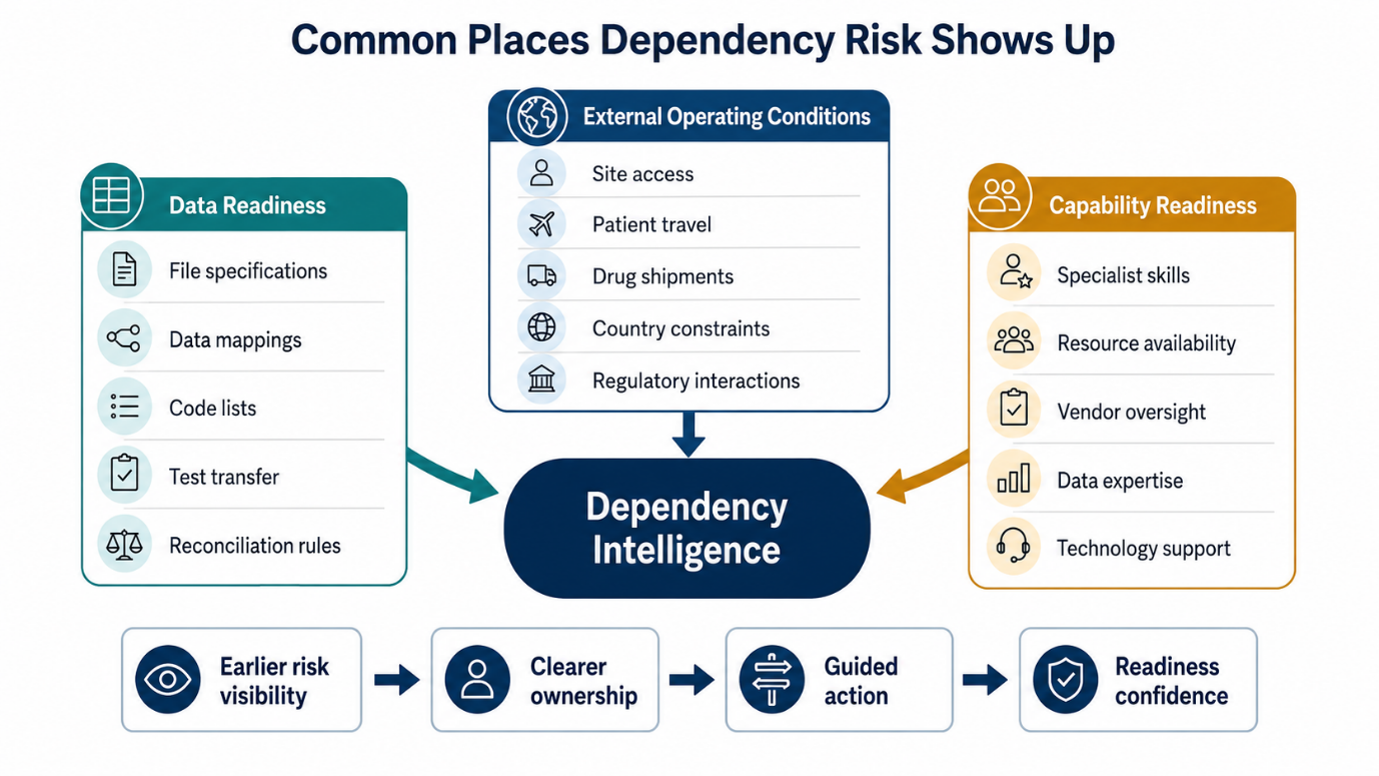
3 Common Places Dependency Risk Shows Up
Dependency intelligence — the ability to detect, understand, and act on dependency risk early — becomes more useful when leaders look beyond simple task-to-task links. Three common areas where hidden dependencies risk — the possibility that work may be delayed because something it depends on is not ready — appear are data readiness, external operating conditions, and capability readiness.
Vendor data transfer is a useful example of data readiness. A central lab vendor may be scheduled to send a data file on a defined date. On the plan, the transfer may look fine. In practice, readiness may depend on file specification approval, data mappings, code lists, test transfer completion, reconciliation rules, acceptance criteria, and clear ownership for issue resolution.
If the file arrives on time but lab test codes are not finalized, units are not harmonized, visit names do not match the EDC visit schedule, subject identifiers are inconsistent, or reconciliation rules are still open, the team still has a problem. The file was delivered, but it may not yet be usable, reconcilable, or ready for review.
The external environment is another common source of dependency risk. A study may look on track until a geopolitical event affects site access, patient travel, drug shipments, vendor logistics, import/export movement, or country-level regulatory interactions. Teams then need to know which countries, sites, vendors, shipments, data flows, or patient-facing activities may be affected, who should assess the impact, and what mitigation should begin before the milestone is missed.
Capability readiness is another important area. A trial may have the right activities on the plan but not the right skills available at the right time. Studies involving complex external data, digital endpoints, decentralized assessments, advanced analytics, or new technology may need specific expertise from clinical data management, biostatistics, vendor oversight, quality, technology, and clinical operations. If those skills are identified only after issues appear, teams can lose time to rework, delayed decisions, and repeated escalations.
The examples differ, but they also show that trial risk often appears when the relationships among data, events, people, decisions, and external conditions are not visible early enough.
What Dependency Intelligence Adds
Dependency intelligence is a practical way to manage execution risk while the work is still unfolding. It helps teams see which inputs are needed, which handoffs are stuck, which owner needs to act, which evidence is missing, which outside signal may affect execution, which capability is needed, and which downstream activity could be affected.
Status reporting usually explains what has already happened, while dependency intelligence helps teams ask what may happen next if a dependency is not resolved. It also reduces informal coordination. When dependencies are not visible, teams compensate with manual follow-ups, extra meetings, local trackers, informal escalation, and individual memory. That may work for a single urgent issue, but it does not scale across a large portfolio.
How This Differs From Process Design Re-Engineering
Process design defines how work should happen. Process re-engineering improves how that work is structured. Dependency intelligence looks at what is happening during execution: which input is ready, which decision is pending, which owner needs to act, which evidence is missing, which skill is needed, and which downstream milestone may be affected.

A process shows the intended sequence, while dependency intelligence shows whether the conditions required to move from one activity to the next are in place. A well-designed process can still slow down if evidence sits in one system, the owner is unclear in another, the required expert is unavailable, and risk is being managed through emails, meetings, or local trackers.
How Organizations Can Start Integrating Dependency Intelligence
Organizations should identify one high-friction process or risk area where delays are already visible. Vendor data transfer readiness, site activation, reconciliation, query closure, database lock preparation, country-level disruption management, and resource readiness are good candidates because they cut across teams, systems, handoffs, decisions, and evidence requirements.
For the selected area, teams can map the readiness chain by asking: What needs to happen first? Which input is required? Who owns it? Where is the evidence captured? What timing is expected? Which signal indicates the risk is increasing? What skill or resource is needed? What escalation should happen before the milestone comes under pressure?
Most organizations already have useful signals in CTMS data, EDC signals, eTMF content, training systems, workflow tools, quality systems, vendor updates, resource plans, risk logs, and analytics platforms. The issue is that these signals often remain scattered.
The practical work is to connect the signals that matter. Process mining can identify waiting points, rework loops, and repeated delays. Workflow or orchestration tools can route actions and escalations. Data and semantic layers can connect events, owners, milestones, evidence, risks, and required capabilities. The aim is a view that changes what teams do next.
Why This Matters Now
Dependency management — the capability of identifying, tracking, assigning, and resolving dependencies — has always mattered in clinical trials but it matters more now because trial execution is more distributed, more data-intensive, and more dependent on multiple teams, vendors, countries, systems, and specialized skills.
Many risks have traditionally been managed through experienced people, meetings, spreadsheets, trackers, and manual follow-ups. But as portfolios scale, data flows multiply, trial designs become more complex, and external disruptions become more common, individual memory and manual coordination become less reliable.
AI can make dependency intelligence easier to scale but not by magically solving dependencies. It is useful only when the right signals, owners, rules, evidence, and context are available. It can summarize issue context, identify missing inputs, detect repeated delay patterns, highlight capability gaps, prepare escalation context, and suggest next-best actions.
Agentic AI may eventually help coordinate follow-ups, prepare escalation notes, identify similar past issues, check whether required evidence is available, and route actions across systems. However, it should not become an uncontrolled autonomous layer. The decision to act, accept risk, escalate, or change direction should remain with accountable clinical, data, quality, or operational leaders.
The shift is from manual chasing to guided coordination. Teams still own the decisions, but they spend less time piecing together status and more time resolving the issue that actually needs attention.
Compliance, Metrics, And Watchouts
This is not only about speed but about making execution more traceable.
Take the vendor data transfer example. If a scheduled transfer is delayed because the test transfer failed, the reconciliation rule was not agreed, or the file specification changed, the tracking organization should see more than a late status. It should know what was missing, who owned the next action, when the issue was escalated, what decision was made, and what evidence supported it.
That matters for inspection readiness and internal quality review. Teams should not have to reconstruct the story after the fact from emails, meeting notes, local trackers, and memory.
Leaders should measure impact in practical terms: cycle time, milestone slippage, dependency resolution time, time from risk signal to owner action, manual follow-ups, avoidable escalations, repeated issue patterns, readiness confidence before major milestones, and reduction in late surprises.
There are watchouts, too. Teams should not map every small task as a dependency. They should not create alerts that people will ignore, automate escalation before ownership is clear, treat an AI recommendation as a decision, build on poor-quality data, or add another dashboard unless it changes how teams act.
The goal is straightforward: fewer surprises, clearer ownership, earlier action, better use of scarce expertise, and a stronger record of why execution decisions were made.
From Reactive Status To Readiness Visibility
Clinical trial operations will always need task tracking, as milestones, plans, trackers, and dashboards are not going away. But they are not sufficient on their own.
Dependency intelligence shifts the focus from asking, “What is late?” to asking, “What is likely to make something late?”
This shift in thinking can help sponsors design clinical trial operations so teams can spot risk earlier, act with better context, bring in the right expertise at the right time, reduce avoidable delays, and strengthen traceability before issues become critical.
Note: This article reflects the author's personal views and are independent of his current or past corporate affiliations.
About The Author:
 Tushar Sinkar is an AI and digital transformation leader with experience across clinical trials, enterprise technology, product delivery, and regulated transformation. He focuses on translating complex operational challenges into scalable digital capabilities across process orchestration, data readiness, governance, and responsible AI adoption.