
Can A Universal Health Screening Help Stop Clinical Trial Dropouts?
By Meghna Rajesh, Senior Research Analyst: Category Specialization, Pharma R&D, Beroe

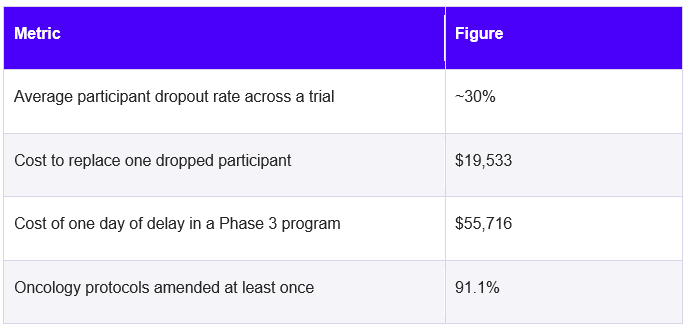
Participant retention is one of the most important levers a sponsor can pull once a trial has begun, yet its budget pales in comparison to the investment in patient enrollment. The scale of the problem is not anecdotal. Table 1 sets out the four metrics that frame the rest of this article: how often participants leave, what it costs to replace them, what delays cost, and how often protocols change underneath them.1,2,6
Table 1. The retention crisis, by the numbers.
Sources: mdgroup, Advara, PubMed Central
The 91.1% amendment rate is particularly noteworthy because of participant burden remaining, because protocol modifications can add visits or procedures that were not included in the first informed consent, increasing the participant's responsibilities throughout the trial, often without increasing their benefit.12 The added visits or procedures could worsen the patient burden and thus cause them to disenroll in the trial. At the same time, the industry's participant retention strategy has not seen a major change over the past 10 years, mostly depending on time stipends, flexible scheduling, and travel compensation.1,6
After participant burden, the second most frequent cause for participant withdrawal is the participant’s belief that they are not benefiting from the experiment, and that impression cannot be substantially addressed by cash compensation.11 A full health scan would be a different and better-aligned lever, and the economics are favorable because a $200 to $600 scan can pay for itself against the $19,533 average cost of the sponsor replacing a participant.1 For participants who have received a serious diagnosis, a personal health readout at the same visit offers something a stipend cannot: a consistent, understandable signal about their own body during a long and uncertain experience.2
The Retention Crisis, By The Numbers
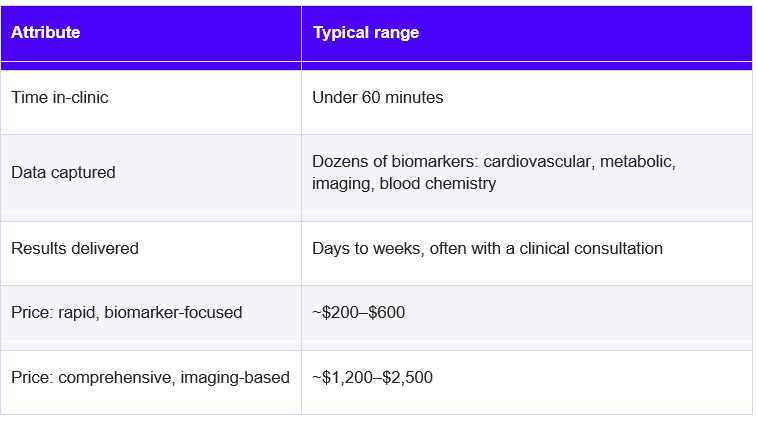
What if the incentive to participate in a clinical trial were personal health insights instead of cash? A newer category of consumer health technology offers a genuinely different lever: comprehensive, same-visit health scanning. Comprehensive health scanning as a retention mechanism in clinical research has received little attention and, to our knowledge, has never been properly explored for this purpose in a published proposal. The basic idea is straightforward: Rather than rewarding participants merely for the time required for a trial, sponsors could provide something that trials rarely do: a clear and rapid assessment of the participant's personal health.
Table 2. What a comprehensive health scan delivers.
Sources: https://prenuvo.com/clp, https://simonmed.com
Evidence suggests that such trades are already popular among participants. A 2026 single-site survey of 506 research participants found that 73% desired access to their individual research results, with particularly strong preferences among participants from historically underserved communities.5,9 A related study further reported that the offer of individual results may facilitate recruitment and retention and increase trust. Participants do not merely tolerate being studied; a substantial proportion expect reciprocity in return.9
Wanting one's own trial results back and valuing a comprehensive health scan are not the same thing, but they share the same underlying driver: participants want personally meaningful health information in return for their time, not just compensation. A health scan can meet that need more directly and far sooner than returning trial results typically can. Many trials are blinded or take months or years to report individual findings, if they report them at all, while a scan can hand a participant an immediate, actionable readout at nearly every visit.9
Why A Scan Could Outperform A Gift Card
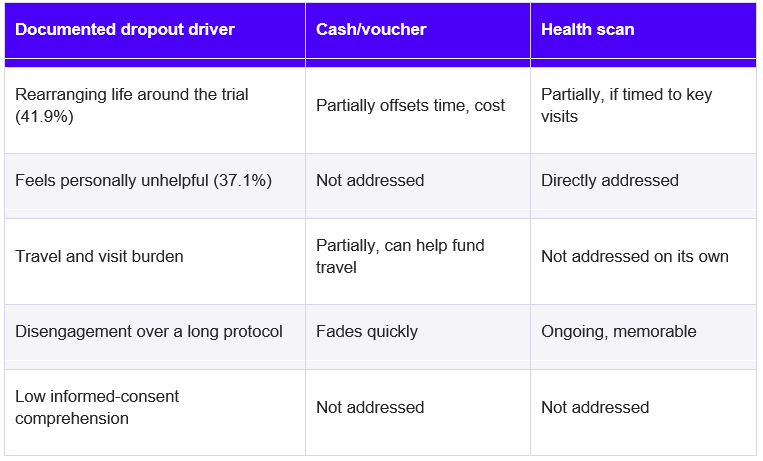
Cash and vouchers are still the industry’s default retention tool, but they are aimed at the wrong part of the problem. Trial length is the most common reason for withdrawal (60% of surveyed coordinators). Close behind is patients not feeling that the trial provides any individual benefit (37.1%).11 The first is somewhat offset by a stipend. It does almost nothing for the second, because money is not evidence of personal benefit but payment for its absence.
That second driver is what a health scan is all about.4,7 It gives the participant something that no reimbursement check can: a direct, personally meaningful readout of their own body, repeatable at intervals over the length of the trial. A comprehensive scan is more likely to be remembered, discussed with one’s own physician, and directly associated with having stayed in the study, whereas a stipend is quickly spent and forgotten.3,7
Table 3. What each incentive fixes.
Sources: mdgroup, Advara, PubMed Central, Asia-Pacific Journal of Oncology Nursing3
Notice what the table doesn't claim: A scan is not a cure-all. It does nothing for consent comprehension, and it doesn't solve travel burden on its own. The case for it is narrower but stronger. It is the best-aligned tool available today for the single largest psychological driver of dropout that money cannot touch.
For Patients Facing Serious Illness, The Payoff Is Personal
The argument sharpens in trials for major diseases like cancer, where participants often endure months of treatment with no immediate sense of whether it's working. A same-visit readout of cardiovascular, metabolic, and other general health markers, repeated across a long protocol, gives someone fighting a serious illness a continuous, personal signal about their own body. This feedback is layered on top of the trial's own disease-specific monitoring, not in place of it. In an experience otherwise defined by waiting for someone else to say how they're doing, that is one steady, comprehensible piece of feedback.4 No population stands to value it more than patients for whom “How is my body doing right now?” is already the most pressing question in their lives.
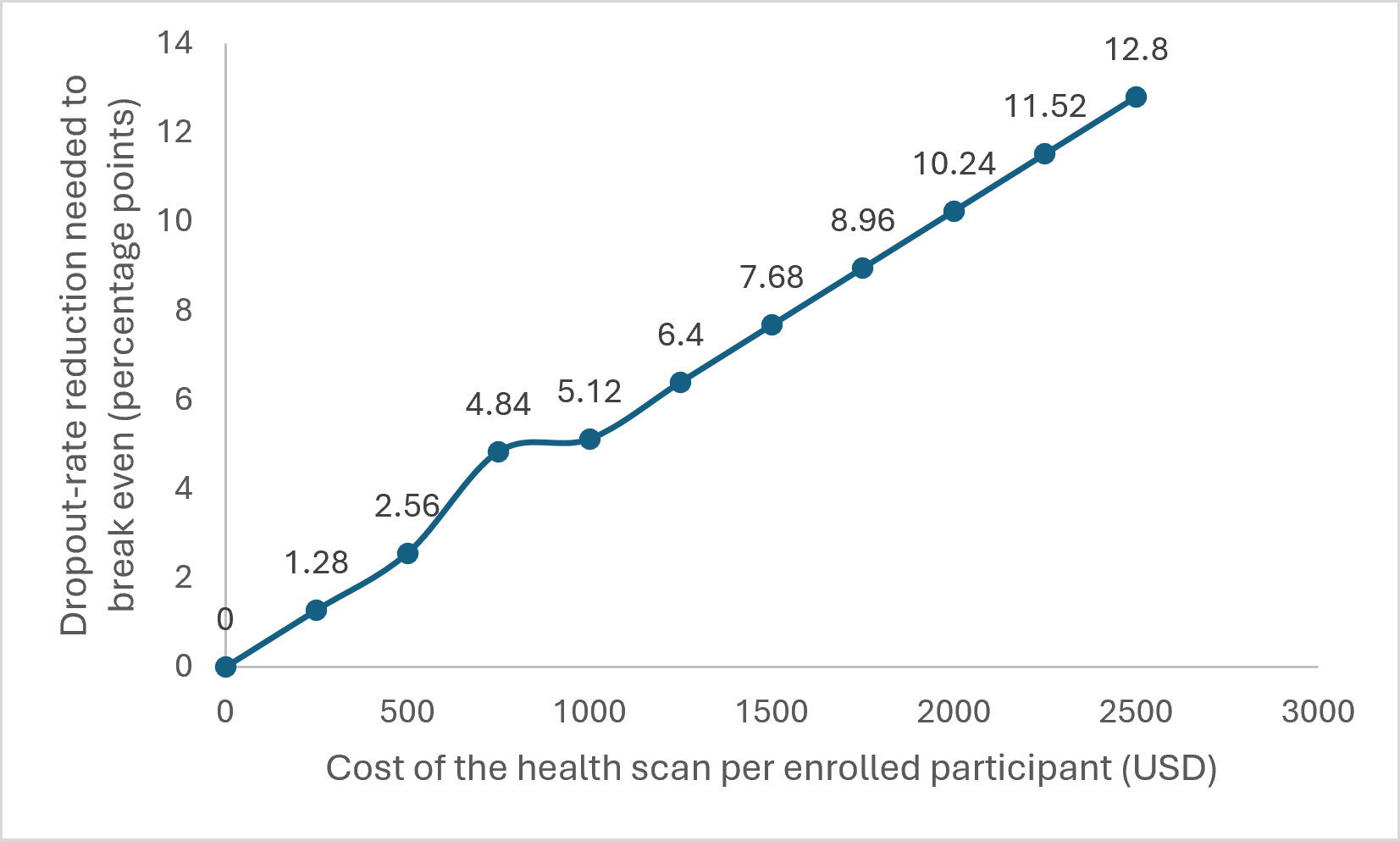
Figure 1. Break-even dropout-rate reduction required, by cost of health scan per enrolled participant.
Sources: mdgroup (replacement cost), author's calculation
Note:
- Break-even = Incentive cost + average cost to replace one dropped participant ($19,533, source: mdgroup)
- A basic scan (~$200–$600) needs a 1.0–3.1 percentage-point cut in dropout rate to break even.
- A comprehensive scan (~$1,200–$2,500) needs a 6.1–12.8 percentage-point cut in dropout rate to break even.

Replacing a dropped participant costs $19,533 as of 2026. This break-even threshold rises with the cost of the scan. For example, a $250 scan pays for itself if it prevents just over one extra dropout for every 100 participants enrolled. A more comprehensive $2,500 scan would need to prevent about 13 extra dropouts for every 100 participants to break even. These dropout-rate reductions are what a scan would need to achieve to pay for itself, not a result it's been shown to produce; no trial has not yet tested this in practice.11
Figure 2. Dropout before and after enhanced, participant-facing retention measures.
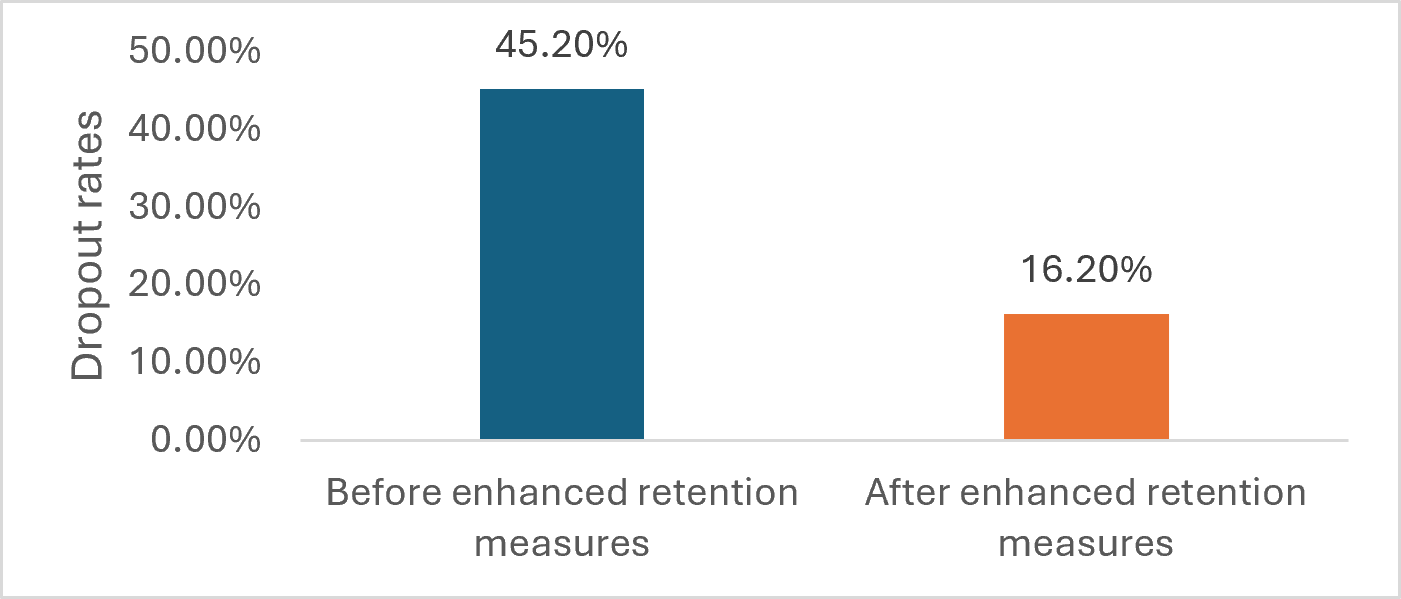
Source: McChrystal et al., Umbrella Review of Trial Attrition Predictors. Note: This figure is specific to a single trial, one of the few published studies to actually test a participant-facing retention measure, and its baseline runs higher than the industry average in Table 1. Therefore, the two are not directly comparable.
The 45.2% baseline dropout rate shown here is specific to a single trial, MemAID, a multi-year cognitive-health study in older adults, a population and protocol length associated with higher-than-typical dropout, so it isn't directly comparable to the ~30% industry-wide average cited in Table 1.
The Hybrid Option
Sponsors can choose more than one lever. Where budget allows, providing both a full scan and regular remuneration captures the entire effect, with the stipend covering the financial and logistical stress and the scan covering the perceived-benefit gap that money leaves unfilled. Where funds are limited, splitting a fixed pool between a smaller basic-tier scan and a partial stipend is a fair middle ground rather than reverting to cash because it’s the easiest line item.1,3,7
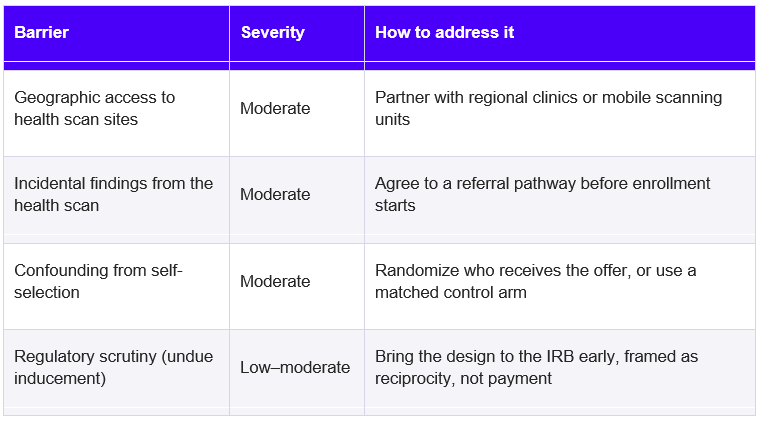
Table 4. Implementation barriers and mitigation pathways
Sources: mdgroup, Advara, PubMed Central, Asia-Pacific Journal of Oncology Nursing3
None of these barriers disqualifies a pilot on its own, but they do need to be addressed before a comprehensive health scan becomes a standard part of a retention playbook. Confounding and IRB scrutiny are the two worth the most care. Confounding is the risk that participants who choose to accept a scan differ systematically from those who don’t. While more health-conscious or more engaged participants might self-select into it, this would make it hard to tell whether better retention came from the scan itself or from the kind of participant who opted in. Sponsors can address this with a randomized or matched approach; IRB scrutiny requires case-by-case ethics review rather than a universal rule, which is exactly why this belongs in a small, well-instrumented pilot before anyone treats it as a default.10
The Next Phase Of Participant Retention
Retention is one of the most expensive, least-innovated problems in clinical research, and the industry has spent a decade treating it as a logistics fix rather than a value proposition. A comprehensive health scan is the most direct, best-aligned answer currently available to the single largest psychological driver of dropout: the sense that a trial isn't giving anything meaningful back to the patient. It is not a guaranteed fix, and it is not a replacement for the basics of good trial design. But of the retention levers available today, it is well matched to the actual reason people leave.
References:
- mdgroup. "The True Cost of Patient Drop-outs in Clinical Trials." Published October 2025. https://mdgroup.com/blog/the-true-cost-of-patient-drop-outs-in-clinical-trials/
- Tufts Center for the Study of Drug Development. "Quantifying the Value of a Day of Delay in Drug Development." White paper, August 2024. https://csdd.tufts.edu/publications/whitepapers
- Kim, J., Kim, M.G., & Lim, K.-M. "Participation in and Withdrawal from Cancer Clinical Trials: A Survey of Clinical Research Coordinators." Asia-Pacific Journal of Oncology Nursing, 2022;9(4). https://doi.org/10.1016/j.apjon.2021.12.015
- Kent, D.A., Villegas-Downs, M., Del Rios, M., et al. "Returning Individual Research Results to Participants: Values, Preferences, and Expectations." Journal of Clinical and Translational Science, January 2024;8. https://doi.org/10.1017/cts.2024.568
- Isaza-Pierotti, D.F., Khan, F., Novak, P., Lioutas, V., Mantzoros, C.S., Ngo, L.H., & Novak, V. "Dropout Risk and Effectiveness of Retention Strategies in the MemAID Clinical Trial." Clinical Therapeutics, 2022. https://pubmed.ncbi.nlm.nih.gov/36539060/
- Botto, E., Smith, Z., & Getz, K. "New Benchmarks on Protocol Amendment Experience in Oncology Clinical Trials." Therapeutic Innovation & Regulatory Science, 2024;58(4). https://doi.org/10.1007/s43441-024-00629-2
- mdgroup. "Why Patients Drop Out of Clinical Trials and How to Improve Retention." Published October 2020 (updated 2026). https://mdgroup.com/blog/why-do-patients-drop-out-of-clinical-trials/
- Prenuvo. "Whole Body Scan" (product page). Accessed September 2026. https://prenuvo.com/clp — and SimonMed Imaging, accessed September 2026. https://simonmed.com
- O'Byrne, S.M., et al. "Return of Results Is Important to Heterogeneous Research Participants: A Single-Site Survey." Journal of Clinical and Translational Science, 2026;10:e67. doi:10.1017/cts.2026.10716
- U.S. Food and Drug Administration. "Payment and Reimbursement to Research Subjects." Information Sheet Guidance for IRBs and Clinical Investigators, January 2018. https://www.fda.gov/regulatory-information/search-fda-guidance-documents/payment-and-reimbursement-research-subjects
- Ulrich, C.M., Ratcliffe, S.J., Zhou, Q., et al. "Association of Perceived Benefit or Burden of Research Participation With Participants' Withdrawal From Cancer Clinical Trials." JAMA Network Open, 2022;5(12):e2244412. https://doi.org/10.1001/jamanetworkopen.2022.44412
- Getz, K., Smith, Z., Botto, E., Murphy, E., & Dauchy, A. "New Benchmarks on Protocol Amendment Practices, Trends and their Impact on Clinical Trial Performance." Therapeutic Innovation & Regulatory Science, 2024;58(3):539–548. https://doi.org/10.1007/s43441-024-00622-9
About the Author:
 Meghna Rajesh is a senior research analyst specializing in category intelligence within pharmaceutical research and development, with over five years of experience in market research and consulting. She has supported global pharmaceutical and life sciences clients, including several Fortune 500 companies, across procurement, sourcing, and market and supply intelligence engagements. Her work includes building category scope assessments, supplier and competitive intelligence, and rate benchmarking that translate complex market data into clear, actionable recommendations for sourcing and R&D strategy decisions. She is passionate about turning fragmented category data into structured insights that help sponsors and their partners make faster, better-informed decisions.