
Can Your Team Coordinate The CRO Model You've Chosen?
By Manu Joshi, Senior Category Specialist, Beroe, and Suzanne Vyvoda, founder and principal, Concordia BioStrategies

For most of the past two decades, a sponsor deciding how to run a clinical program faced what looked like a simple choice: hand the trial to a full-service CRO or support it in-house by funding functional capacity. That choice no longer describes what sponsors do. Industry survey data now place about two-thirds of clinical development outsourcing in functional service provider (FSP) and hybrid arrangements, and the share of sponsors preferring a mixed model rose from 26% to 33% in two years.1,2
Figure 1. Sponsor outsourcing model mix and direction of travel, 2023–2025
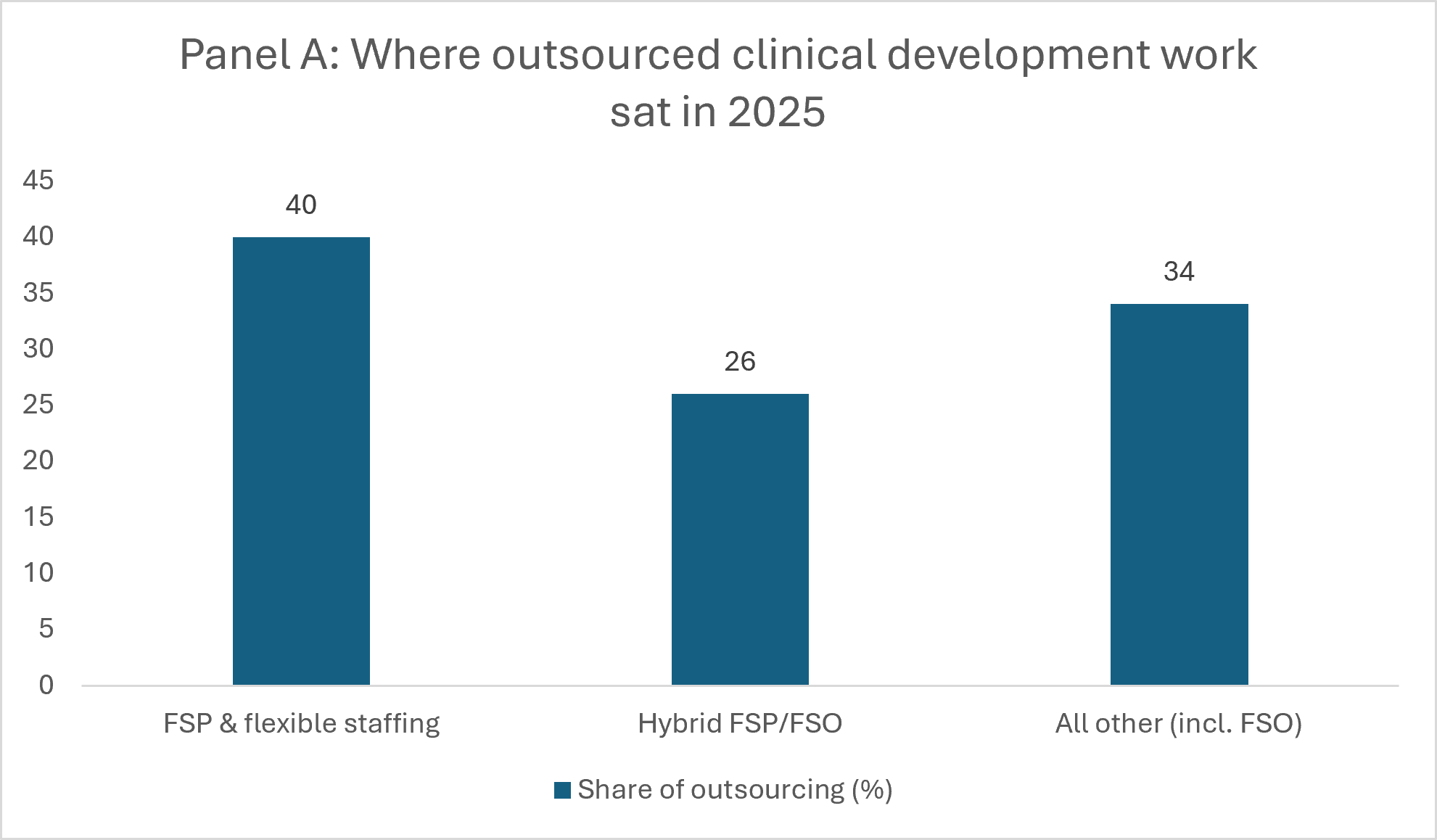
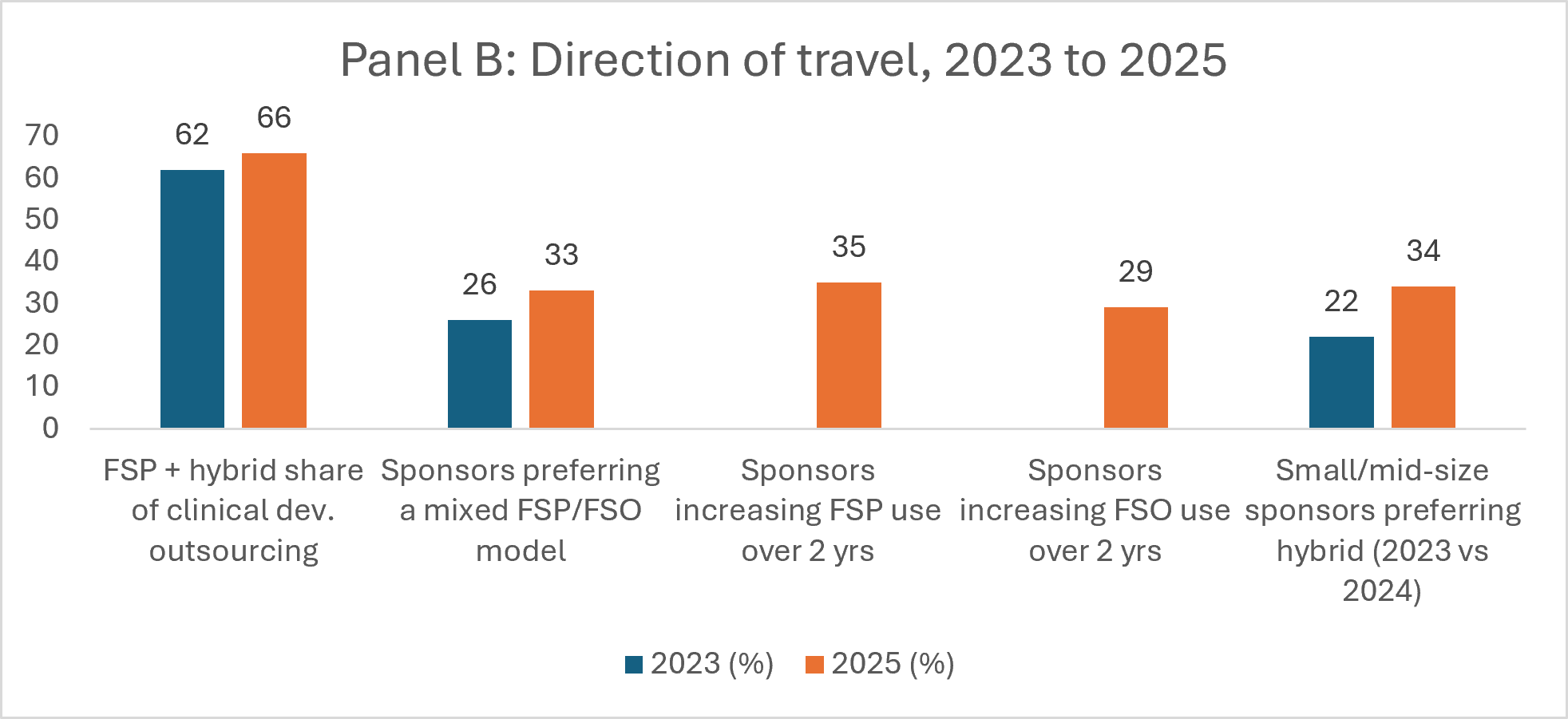
Source: PPD 2025 FSP Trends Report, as reported by pharmaphorum1 and Contract Pharma.2 Note: Upper panel data point “all other” is the remainder; lower panel data point for small and midsize sponsor figures compares 2023 with 2024.
A Tufts CSDD and ICON study of 117 pivotal trials found FSP to be the most commonly used primary model, used for close to half of them, but also found that no model reliably performs better than another. Half the trials finished on time and about a quarter went over budget, and the full-service trials were also the longest and most complex.3 Model use also splits sharply by therapeutic area (Figure 2). Sponsors tend to choose a model to fit the trial in front of them, so differences in results may reflect the trials rather than the models.
Figure 2. Primary outsourcing model in pivotal trials, oncology versus non-oncology (% of trials)
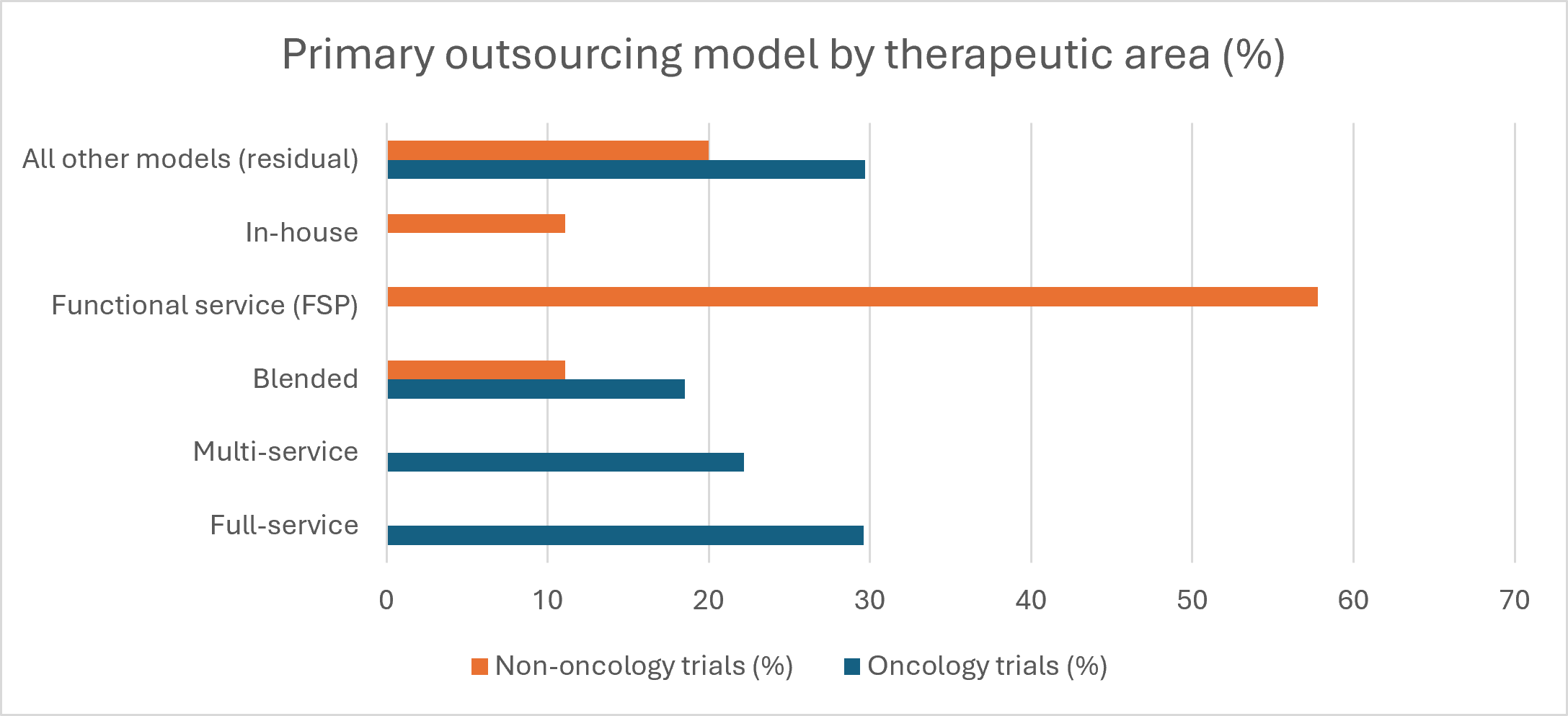
Source: Tufts CSDD and ICON pilot study of 117 pivotal trials.3 Note: Missing bars are models the source does not itemize; “all other models” is the remainder.
Note: Multi-service is defined as a CRO that manages several functions, not the whole trial. Blended (or mixed) models combine CRO and FSP arrangements, which are called hybrid in this paper.
We think sponsors are asking the wrong question. Every sourcing model assumes that somebody is keeping the sponsor, the CRO, and the specialist vendors aligned, and it succeeds or fails on whether that assumption holds. This paper combines the published evidence, a Beroe expert survey, and co-author Suzanne Vyvoda’s operating experience, which ranges from large pharma global programs to seed-stage biotechs.
Coordination Capacity As The Deciding Variable
Call it coordinating work. It is the steady exchange that keeps functions aligned, catches a risk before it becomes a delay, and makes sure the person who needs to know something hears it firsthand. Most of it still runs on calls, email, and someone remembering to bring the right colleague in before a decision. Automation tools are improving that coordination, but real adoption is thin.4
Seen this way, each model answers one question: how much of that work the sponsor keeps. A full-service CRO takes nearly all of it, which is why it costs the most and gives the sponsor the least control. FSP hands most of it back, since the sponsor buys capacity by function and runs the coordination itself. Hybrid arrangements split it and are the hardest to run well, because someone has to own the seam. Sponsors that assemble their own group of niche partners, now common in younger companies, carry all of it.4
That is why the cheapest-looking options are often the riskiest for small sponsors. A large pharmaceutical company can make almost any model work; the capacity already exists. A three-person clinical team at a seed-stage biotech has no such reserve, and FSP or a self-assembled network assumes exactly the capacity it lacks. The shortfall never appears in the contract; it surfaces months later as rework and handoffs that belonged to nobody.4
Lean Operating Models And Unassigned Accountability
I, Suzanne, have seen the same failure in clinical supply. In emerging and midsize biotechs, supply governance tends to evolve rather than be designed. Each function and partner works within its own scope, and nobody holds the alignment between enrollment, inventory, and shipments.5 A hybrid CRO arrangement multiplies that gap, because coordination must now also run across every partner.4
Small teams can run complex sourcing models well, provided they are clear about who holds the handoffs and that person has the authority and time. What fails is a lean team combined with an unspoken assumption that everyone will stay aligned by themselves.4 When enrollment then slips, a coordination failure is often logged as site underperformance.5
ICH E6(R3) lets sponsors delegate trial activities to service providers but not accountability, and expects continuous, risk-based oversight of the delegated work.6 That oversight is a sponsor cost under every model and is heaviest in hybrid ones.

Reassessing Decentralization And AI As Drivers Of Change
The first is decentralization. An analysis of 1,097 trials with decentralized elements found a pandemic-era surge followed by a sharp decline from 2022. Most (78.2%) used only one decentralized element, and completion rates were no better than in conventional trials.7 What decentralization has mostly centralized is data, which favors strong functional partners in data management and clinical monitoring, where FSP is already the most common model.3
The second is AI. Beroe asked four experts in its VOX network, three working mainly in Africa and one in Hungary, about trial execution (Figure 3).8 AI adoption drew the widest spread of any question, from 10%–25% to 40%–60%, consistent with what Suzanne sees in practice: a few organizations doing something substantial, and many using the label with little behind it.4 Three of the four reported only four to eight credible CROs per sourcing event.
Figure 3. Beroe VOX expert panel responses across six sourcing signals (n = 4)
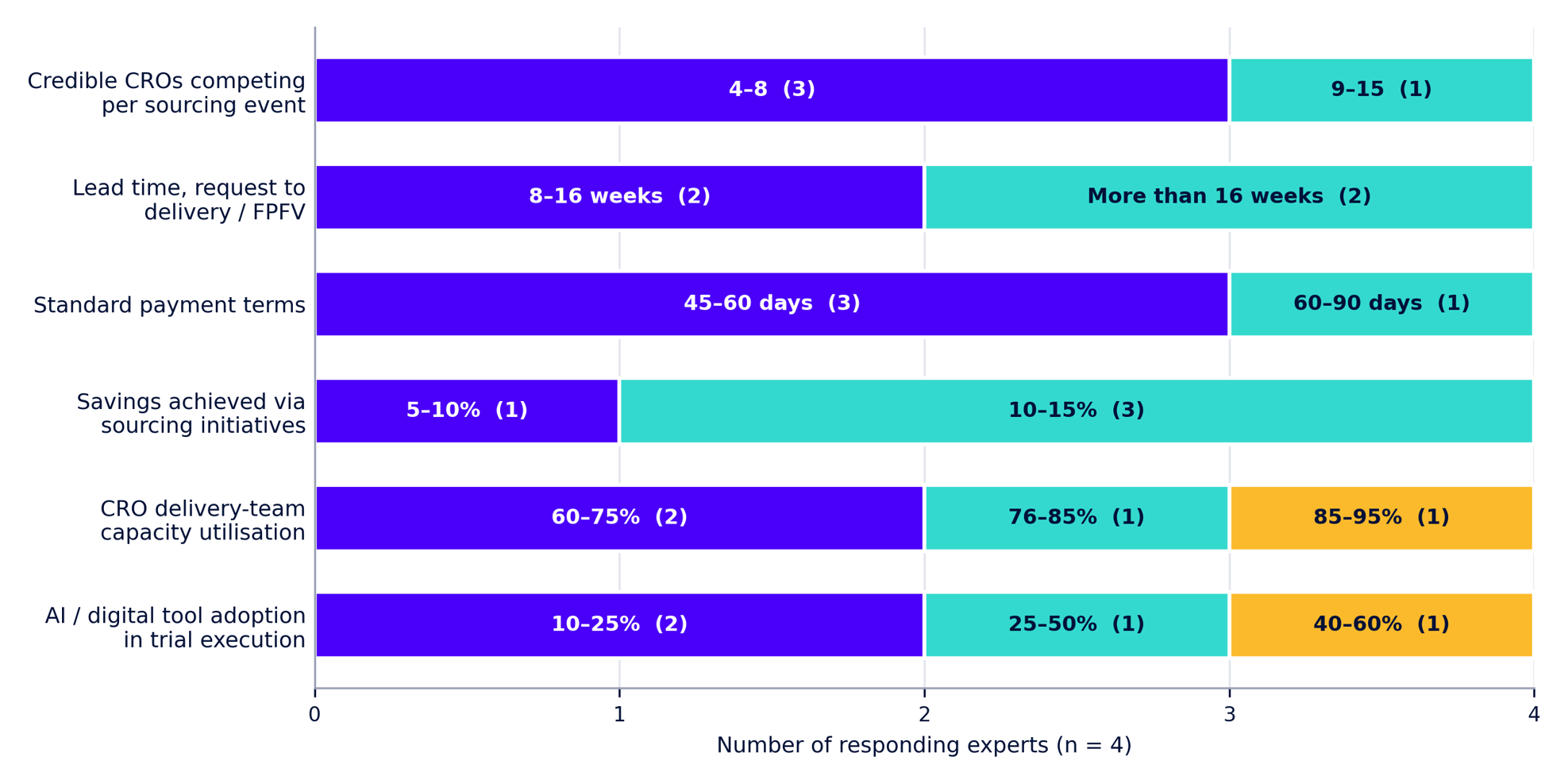
Source: Beroe VOX expert survey.8 Bands are the survey's own answer options.
Matching The Sourcing Model To Sponsor Capability
Figure 4 sets out a default model by sponsor maturity and trial phase. Maturity is the main axis because it measures how much coordinating work the sponsor can already carry.4 Phase stands in for complexity, though imperfectly: a multiregion Phase 2 oncology study can be harder to oversee than a single-country Phase 3 in a familiar indication.4 Adjust the defaults for geography, therapeutic area, and decentralization.
Figure 4. Recommended sourcing model by sponsor maturity and trial phase
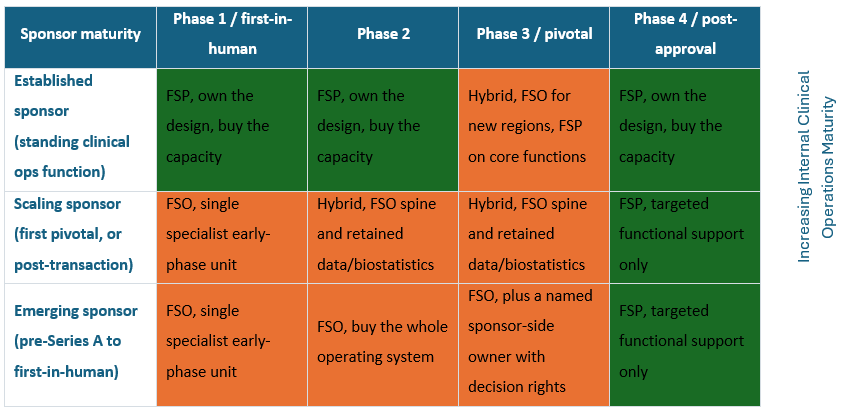
Source: Beroe Inc. analysis, developed with Concordia BioStrategies. An analytical framework, not a survey result.
One cell needs explaining. An emerging sponsor entering Phase 3 should still buy full service, but a single named contact on the sponsor side only relocates the single point of failure. The sponsor needs an owner with real decision rights and enough support that problems reach them directly.4. The same test applies to hybrid models: If a sponsor cannot name and resource the person who owns coordination across partners, full service is the honest choice.
Implications For Procurement And Vendor Selection
Write the operating model into the RFP. State which functions the sponsor keeps and which it delegates, as well as who owns each interface. Otherwise, the unstated assumptions return as change orders.
Make both sides name the owner. Ask bidders for the individual accountable for coordination across functions and partners, treat a blank as disqualifying in a hybrid bid, and hold the sponsor to the same standard.
Price team stability. Annual employee turnover at the largest CROs is reported at around 20%. Ask for functional-lead turnover on comparable studies; rates below 10% point to a real execution advantage.9
Treat inherited contracts as integration projects. After an acquisition, the expensive problems sit between two ways of working that each ran well alone, differing in vendor oversight, data standards, and when a milestone counts as done. None of it is priced at signing, so make reconciliation a deliverable with an owner and a deadline.4
Check how deep the market is. Confirm the number of credible bidders in each geography before designing a panel, and build in change-of-control terms as consolidation continues.10 Where enrollment forecasts are uncertain, pay against enrollment achieved rather than projected, as a VOX panelist proposed.8
Verify AI claims study by study. Confirm which studies, what the model did, what changed, and who owns the data and models when the contract ends.4 We found no credible published data on how far AI or real-world data capability influences CRO selection itself. The market may be buying the story faster than the capability.4
None of this data argues for a particular model. It argues for settling one question before the RFP goes out: Who will do the coordinating work, and do they have the time and authority to do it? Sponsors that can answer it can make almost any model work. Those that cannot tend to find out after the first patient is in.
References:
Authors’ note: Manu Joshi designed and ran the Beroe VOX survey, led the evidence review, and drafted the paper. Suzanne Vyvoda contributed practitioner analysis of sourcing models and acquisition integration through a structured questionnaire,4 shaped the decision framework, and reviewed the manuscript. The authors thank the Beroe VOX experts who took part.
About The Authors:
 Manu Joshi is a senior category specialist in Beroe's Pharma R&D practice, leading primary research on clinical outsourcing and supply.
 Suzanne Vyvoda is the founder and principal of Concordia BioStrategies. She has led clinical operations from Gilead's global programs to seed-stage biotechs and advises DataCompass and Anervea.AI on AI and real-world data.