
Clinical Trial Per-Patient Cost Analytics For Procurement And Sponsor Strategy
By Surya Ponnam, senior analyst, Beroe, Inc.

Clinical trial per-patient cost (PPC) analytics has emerged as a strategic decision-support framework for clinical development, procurement, and supplier management in 2026. The metric quantifies the average expenditure incurred per patient throughout the clinical trial life cycle and serves as a critical indicator of study efficiency, budget performance, and operational effectiveness. Recent industry benchmarks show that per-patient costs vary significantly across phases, therapeutic areas, geographies, and protocol designs, with early-phase and oncology studies typically exhibiting the highest costs. Modern analytics frameworks incorporate recruitment efficiency, screen failure rates, investigator grants, site productivity, monitoring costs, patient retention, and technology investments to provide a holistic view of trial economics.
For procurement and category managers, PPC analytics enables data-driven CRO benchmarking, regional sourcing decisions, forecasting of enrollment related expenditures, and identification of cost optimization opportunities. The industry's focus is gradually shifting from traditional cost per enrolled patient metrics toward more outcome-oriented measures such as cost per completed patient and cost per endpoint achieved.9
As clinical trials become increasingly global, decentralized, and technology-enabled, PPC analytics is evolving into a core capability for balancing cost, quality, speed, and patient outcomes across the clinical development ecosystem.1,2
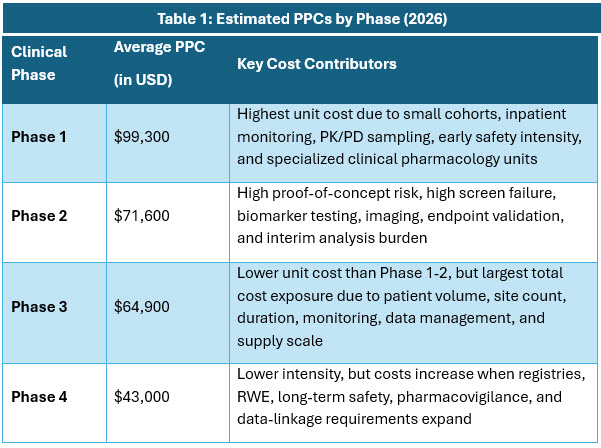
Average PPCs By Phase In 2026
Oncology represented 38% of Phase 1-3 industry-sponsored trial starts, and median enrollment duration increased to more than 16 months in 2025, making it the strongest PPC pressure area for 2026.3
Source: JAMA Network
Here, Phase III trials often exhibit a lower per-patient cost (PPC) than Phase II studies because fixed operational and infrastructure expenses are distributed across a substantially larger patient population. However, clinical trial delays remain a major challenge, with nearly 80% of studies missing planned timelines due to increased trial complexity, equipment supply issues, patient dropouts, slow central laboratory turnaround, and limited automation which leads to increased direct per-day cost across Phase II and III trials. The Tufts CSDD estimated that delay in clinical trial operations can cost upto $55,716 per day for Phase 3 and $23,737 per day for Phase 2.4
Procurement Insights
- The trial can become expensive if enrollment is slow, screen failure is high, or underperforming sites remain active. So, sponsors should track PPC monthly by screened, randomized, and completed patients.
- Category managers should model PPC by phase, country, and protocol burden, not by global average.
Why Is PPC Becoming A Strategic Metric?
Sponsors need a metric that connects clinical execution, procurement sourcing, finance governance, and trial productivity. They’re starting to care more about PPC because of:
- R&D productivity pressure: IQVIA reports that improved clinical program productivity wasn’t sustained over the time. Overall trial durations increased, as gains from faster patient enrolment in oncology studies were offset by the increased proportion of oncology trials reaching enrolment completion. In addition, the average interval between successive clinical trials extended by approximately three months, further impacting development timelines.3
- Higher scientific complexity: Oncology, immunology, cell/gene therapy, rare disease, and biomarker-led trials require more screening, procedures, specialty sites, and data capture.
- A need for scenario budgeting: Geopolitical disruption and supply chain rerouting require sponsors to budget for base, watch, amber, red, and rescue scenarios.
Procurement Insight
PPC has become the closest equivalent to a "total cost of ownership" metric for outsourced clinical development, making it one of the most valuable indicators for supplier selection, negotiation, and performance management.
Are Clinical Trial PPCs Rising In 2026?
PPC continues to rise in 2026 due to increasing protocol complexity, larger data requirements, advanced diagnostics, patient recruitment challenges, and longer follow-up periods. Growth in oncology innovations including cell and gene therapies, antibody-drug conjugates, bispecifics, and radiopharmaceuticals has further increased demand for specialized investigators, imaging, laboratory services, and complex trial logistics.4
Tufts CSDD reported Phase 3 oncology trial budgets rose above $65 million, while non-oncology Phase 3 budgets exceeded $54 million.5,6
Additionally, geopolitical tensions have affected PPC through air cargo disruption (over 4.8% in March 2026), cold chain rerouting, fuel surcharges, insurance, dry ice usage, emergency storage, and missed shipment windows, mostly due to severe disruption at Persian Gulf hubs.7
Procurement Insights
- Clinical trial costs are expected to continue rising, driven by increasing protocol complexity, regulatory requirements, and innovative therapies. Sponsors must focus on effectively managing and optimizing these growing expenditures.
- Sponsors will adopt flexible operating models, prioritize high-value investments, and innovative trial execution approaches to balance cost control, study quality, development speed, and long-term sustainability.
Which Cost Categories And Countries Account For The Largest PPC Increases?
In 2025, the largest PPC increases came from investigator grants, site start-up, patient recruitment, central labs, biomarker testing, imaging, logistics, data management, and CRO change orders.
High absolute PPC increases are most visible in the United States, Germany, the United Kingdom, France, Japan, and Switzerland, because specialist labor, site overhead, imaging, and investigator fees are expensive.
Percentage increases can be sharper in the Middle East, Eastern Europe, and parts of Asia when customs, fuel, insurance, or air freight disruption increase trial delivery costs. Tufts CSDD also found a high positive correlation between the number of countries used in a protocol and clinical trial budget.5
Procurement Insights
- Sponsors should replace flat annual cost escalations with risk-adjusted budgeting models that separately account for inflation, protocol complexity, recruitment challenges, and geopolitical logistics disruptions.
- Middle East conflict disrupted temperature sensitive medicines shipments especially for oncology, vaccines, biologics, and gene therapy trials, forcing pharma companies to reroute shipments through alternatives such as Saudi Arabia, Türkiye, and Oman.

Are CROs Responsible For Rising PPCs?
CROs contribute to rising PPCs, as they are increasingly asked to manage more complex studies, decentralized trial models, advanced therapies, and global logistics, which naturally increases service scope and costs.
CROs such as ICON plc, Parexel, Medpace, and Fortrea are investing heavily in AI-enabled trial execution, risk-based monitoring (RBM), decentralized trial infrastructure, global logistics capabilities, cell and gene therapy expertise, and centralized data analytics platforms to improve productivity and reduce operational burden.
The procurement mistake is to focus only on CRO hourly rates while leaving pass-throughs uncontrolled. A CRO with a higher management fee may still deliver lower PPC if it enrolls faster and avoids rework.2,4
Procurement Insight
Negotiate CROs on cost per randomized and completed patient while maintaining quality, speed, and regulatory compliance, not only hourly rates, to generate greater saving.
PPC Strategy For 2026 And Beyond
PPC analysis has become a strategic procurement tool for controlling complexity, country risk, supplier spend, patient access, and timelines. Its role has become increasingly important as PPC rises due to clinical trials being more specialized, diagnostic-heavy, and exposed to logistics and geopolitical disruption. Sponsors should not rely only on CRO rate negotiation. Leaner protocol design, better site selection, lower screen failures, controlled pass-throughs, bundled central lab and imaging pricing, and resilient logistics planning can achieve ~8%-15% in addressable PPC spend reduction.10,11
The FDA’s 2026 real-time clinical trial initiative also signals that trial operations are moving toward faster data visibility and reduced administrative delay.8
Final Procurement Insight
Sponsors should manage PPC in real time by patient, site, country, and supplier workstream. Sponsors that adopt advanced PPC analytics, benchmark suppliers effectively, and focus on risk-adjusted cost per completed patient will be better positioned to improve clinical trial efficiency, strengthen procurement outcomes, and maximize R&D return on investment.
References:
- “ProRelix Research. Phase-by-Phase Clinical Trial Costs: What Every Sponsor Needs to Know. 2025”. Available: https://prorelixresearch.com/clinical-trial-cost-overview
- Abacum. Clinical Trial Costing: Phase-by-Phase Budget Guide. 2025. Available: https://www.abacum.ai/blog/clinical-trial-costing
- Global R&D Trends 2026. Available: https://www.iqvia.com/insights/the-iqvia-institute/reports-and-publications/reports/global-r-and-d-trends-2026
- IQVIA Institute, “Therapeutic Areas Driving Clinical Trial Growth,” May 2026. Available: https://www.iqvia.com/blogs/2026/05/therapeutic-areas-driving-clinical-trial-growth
- Z. Smith, J. DiMasi, and K. Getz, “Quantifying the Value of a Day of Delay in Drug Development,” Tufts CSDD White Paper, Aug. 2024. Available: https://csdd.tufts.edu/sites/default/files/2025-02/Aug2024%20Day%20of%20Delay%20White%20Paper%20Final.pdf?1744237947
- Tufts Center for the Study of Drug Development, “Clinical Trial Budgets,” Tufts CSDD Impact Report, Mar./Apr. 2022. Available: https://www.clinicaltrialvanguard.com/wp-content/uploads/2024/08/Mar-Apr-2022-Clinical-Trial-Budgets.pdf
- Reuters, “Middle East war disrupts pharma air routes, risks cancer drugs supply,” Mar. 2026. Available https://www.reuters.com/world/middle-east/middle-east-war-disrupts-pharma-air-routes-risks-cancer-drugs-supply-2026-03-16/
- FDA announced major steps in April 2026 toward real-time clinical trials, stating that real-time safety and endpoint visibility could modernize drug development. Available: https://www.fda.gov/news-events/press-announcements/fda-announces-major-steps-implement-real-time-clinical-trials
- TransCelerate BioPharma and Tufts CSDD, “Optimizing Data Collection,” 2025. Available: https://dcricollab.dcri.duke.edu/sites/NIHKR/KR/GR-Slides-11-21-25.pdf
- Parexel: Protocol optimization and design, 2026. Available : https://www.parexel.com/solutions/early-development-and-innovation/protocol-optimization
- Anh Ninh, Yunhong Bao, Daniel McGibney, Tuan Nguyen, Clinical site selection problems with probabilistic constraints, European Journal of Operational Research, Volume 316, Issue 2, 2024, Pages 779-791, ISSN 0377-2217, Available: https://doi.org/10.1016/j.ejor.2024.03.013
About The Author:
 Surya Ponnam is a senior analyst on Beroe’s Pharma R&D team, with almost five years of experience in market intelligence, procurement strategy, and consulting. She specializes in clinical and pre-clinical research, supporting global pharma and biotech clients across toxicology services, early stage of drug development, and some clinical R&D categories, which include primary research, supplier landscaping, category strategy, sourcing optimization, and risk mitigation. She has supported leading Fortune 500 pharma clients with expert validated insights that strengthen procurement decisions and supply chain resilience.