
Digital Twins Enhance Disease Progression Measurements In FSHD
A conversation between Epicrispr Biotechnologies CEO Amber Salzman, Ph.D., and Clinical Leader Executive Editor Abby Proch
One constant in patients with facioscapulohumeral muscular dystrophy (FSHD) is that they progressively lose muscle volume — but when, where, and how quickly that occurs is variable. What’s more, those changes can be hard to measure early, especially when traditional functional endpoints may take longer to reflect what is happening biologically.
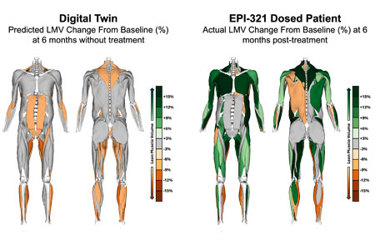
In evaluating its investigational gene therapy, EPI-321, Epicrispr has leveraged digital twin technology to predict muscle volume change by whole-body MRI after a single dose.
In this Q&A, Amber Salzman, Ph.D., CEO and director of Epicrispr, discusses their use of AI-powered digital twin technology and how it allowed them to compare treated patients with their predicted disease trajectories to help quantify muscle-level treatment effects. She explains how digital twins can give sponsors a more individualized, objective way to understand disease progression in small and variable patient populations and what fellow sponsors should consider when evaluating the operational, regulatory, and evidentiary value of digital twins in clinical development.
Clinical Leader: In an earlier interview, you said that traditional functional endpoints often lag behind in capturing biological changes and can fail to capture the variability of disease progression across patients. How has this digital twin technology now shown to improve upon recording those changes accurately but also on a quicker timeline?
Amber Salzman: Traditional functional assessments, such as strength and mobility tests, remain critically important, but effort-based measures can fluctuate day to day, and patients may compensate for the loss of specific muscle function. In diseases with variable progression, this variability can make it difficult to distinguish treatment effects from the disease’s natural course.
Whole body imaging is not subject to the day-to-day effort based variability and compensatory behavior. Digital twin technology allows us to evaluate patients against their own individualized predicted disease trajectory rather than relying solely on comparisons across heterogeneous patient populations. By integrating baseline imaging and clinical characteristics, the model predicts how muscle volume would be expected to change without treatment. We can then compare that prediction with what actually occurs after therapy.
In our interim analysis, patients demonstrated increases in lean muscle volume, while their digital twins predicted continued muscle loss. This provides an objective, quantitative measure of biological activity that may emerge earlier than traditional functional endpoints, allowing us to better understand whether the therapy is modifying the underlying disease process.
How do you connect those changes in MRI-derived muscle volume to outcomes that matter to patients, such as strength, mobility, fatigue, or daily function?
Ultimately, patients care about how they feel and what they can do in their daily lives. MRI-derived muscle volume has the potential to serve as an early indicator of whether a therapy is likely to translate into meaningful improvements in a patient’s function, mobility and overall quality of life.
The idea is that we can use a highly quantitative and sensitive endpoint like MRI to predict feels/function endpoints, which we may not see change for months to years. This allows us to quantitatively track response to treatment and leverage existing natural history datasets to get a drug to more people faster. It does not replace the importance of feels/function endpoints but is a surrogate to show we can impact disease in a clinically meaningful way even at six months post-treatment with EPI-321.
Muscle loss is one of the defining features of FSHD. Preserving or increasing lean muscle volume addresses a fundamental aspect of disease biology, and there has been considerable data collected over the past few years that measures how a patient feels, along with how their lean muscle volume (LMV) has changed over time. In fact, a recent paper shows the correlation between MRI images and the Timed Up and Go measure.
In fact, a recent Scientific Reports publication by Blemker et al. demonstrated that MRI-derived muscle biomarkers, combined with machine learning, can accurately predict changes in the Timed Up and Go (TUG) test, a clinically meaningful measure of mobility and function. These findings further support the potential of MRI-based measures to serve as sensitive predictors of functional outcomes in FSHD.
We intend to leverage the data generated to support the premise that LMV is highly predictive of functional measures. We continue to collect functional assessments and patient-reported outcomes alongside imaging so we can better understand the totality of data. Our goal is to demonstrate both disease modification at the biological level and meaningful clinical benefit for patients.
How did this digital twin technology impact patient recruitment, in terms of number of patients needed but also trial design, including the potential to reduce reliance on traditional placebo groups?
One of the greatest challenges in rare disease research is generating robust evidence with small number of patients with variable disease manifestations. A small placebo arm can be very misleading. Digital twins have the potential to improve trial efficiency by aggregating knowledge gained from studying the natural history of many people and matching participants in the trial to a predictive model reflecting disease progression. It has the potential to decrease the number needed to treat to show a Minimal Clinically Important Difference (MCID) and decreases the need for placebo control in a progressive disease where patients need treatments now.
While regulatory standards continue to evolve, technologies like this represent an important step toward more patient-centric clinical trials, particularly in rare diseases where every patient is incredibly valuable.

In addition to patient recruitment, what other operational impacts did this technology have? And how can its return on investment be measured?
The potential benefits extend well beyond recruitment.
More sensitive endpoints may allow companies to detect biological activity earlier, make development decisions with greater confidence, and optimize dose selection before advancing into larger studies. Reducing variability can also decrease the number of patients required to achieve meaningful statistical conclusions, helping accelerate timelines while lowering overall development costs.
The return on investment should ultimately be measured by whether the technology improves time to detect and understand the therapeutic effect of the treatment. If it enables faster decision-making, more efficient trials, and stronger evidence generation, that has significant value for patients, developers and investors alike.
What are the challenges, if any, in convincing regulators that these digital twins accurately portray FSHD progression? The trial is riding not only on the efficacy of the therapy but also on the validity of the digital twin technology.
Regulators appropriately hold any novel methodology to a high standard, and that is exactly how it should be.
The key is demonstrating that the digital twin model has been rigorously developed and independently validated using high-quality natural history datasets, and that its predictions consistently reflect real-world disease progression. Importantly, we view digital twins as complementary tools that strengthen the overall body of evidence rather than replacing established clinical endpoints.
We believe innovative quantitative approaches like these will become increasingly important as the field continues to evolve. Ultimately, regulators will evaluate the totality of evidence, including safety, biological activity, imaging, functional outcomes and patient benefit. We believe that engaging with regulators early, towards a common goal to leverage robust data analysis will successfully bring much needed therapies to patients with FHSD.
Additionally, how much standardization is required across imaging sites, scanners, protocols, and readers for this approach to be viable in a multicenter clinical trial?
Standardization is essential for any quantitative imaging biomarker.
That includes harmonized imaging protocols, consistent scanner calibration, standardized acquisition procedures, and rigorous quality control across all participating sites. Advanced image processing and centralized analysis further help minimize variability and ensure that measurements remain comparable regardless of where patients are scanned.
As imaging technologies continue to mature, these standardized workflows are becoming increasingly feasible to implement across multicenter global studies.
Finally, if a pharmaceutical company is evaluating whether digital twin technology is appropriate for their disease area or mechanism of action, what factors should they consider?
The first consideration is whether the disease has a measurable biological marker that changes over time and can be captured reliably with quantitative imaging or other objective data. Diseases with predictable progression and high-quality natural history datasets are particularly well suited to digital twin approaches.
Companies should also consider whether conventional endpoints are highly variable, slow to change, or require very large patient populations to demonstrate efficacy. In those settings, digital twins may provide meaningful additional insight.
Ultimately, digital twins are not a one-size-fits-all solution. They are most valuable when they can reduce uncertainty, improve trial efficiency, and provide a clearer understanding of whether a therapy is truly altering the course of disease. We believe FSHD is an excellent example of where this approach has the potential to transform clinical development.
Editor’s note: This transcript has been edited for clarity.
About The Expert:
 Amber Salzman, Ph.D., is Epicrispr’s CEO and director. Before joining Epicrispr, Dr. Salzman served as the president and CEO of Ohana Biosciences, pioneering the industry’s first sperm biology platform. Before Ohana, she served as the president and CEO of Adverum Biotechnologies and was a co-founder of Annapurna, SAS.
Dr. Salzman began her career as a member of the GSK research and development executive team, where she oversaw global clinical trials with over 30,000 enrolled patients, and managed 1,600 employees and a $1.25B budget. Following her time at GSK, Dr. Salzman served as the CEO of Cardiokine, a pharmaceutical company that developed treatments for the prevention of cardiovascular diseases. Dr. Salzman currently serves on the Osler Diagnostics (UK) and AviadoBio (UK) boards.
Dr. Salzman received her bachelor’s degree from Temple University and holds a Ph.D. in mathematics from Bryn Mawr College. Dr. Salzman also leads the Stop ALD Foundation, a non-profit medical research foundation focused on developing novel gene therapies for adrenoleukodystrophy (ALD).