
Get Ready For Regulators With This Speed-Quality-Compliance Framework
By Sapna Rani, Lead Analyst, Beroe Inc., and Shaun Hastings, quality assurance professional

The regulatory environment — in the EU, UK, and U.S. — regarding clinical trial compliance is changing. In part one, we identified the shift in focus toward risk-based oversight, stronger data governance, and greater acceptance of digital innovation. Now, we focus on what those changes mean in practice. How can sponsors, CROs, and procurement teams keep trials moving without losing sight of quality or compliance? This article offers a five-part framework for thinking through study design, risk, governance, oversight, and readiness.
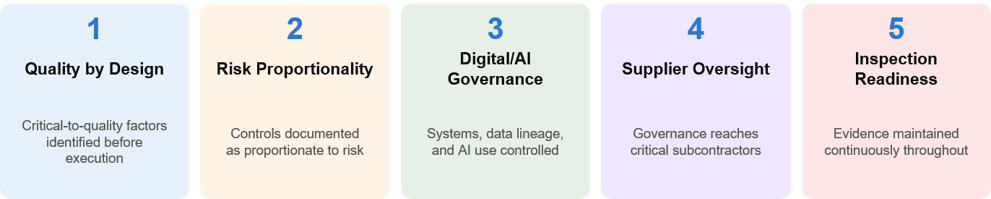
5 Dimensions To Prepare For Regulatory Inspection
A practical readiness model can help address regulatory changes together across five dimensions. Sponsors can use it at study level, during CRO selection, or when qualifying clinical technology, laboratory, and decentralized trial suppliers.
Figure 2. Five dimensions of regulatory readiness
Sources: Beroe Analysis
As clinical trial delivery becomes increasingly dependent on specialist technology providers, data service providers, AI platforms, and outsourced service partners, the greatest oversight challenge for sponsors is no longer managing one CRO but understanding and controlling the wider supplier ecosystem.
A common weakness is limited visibility beyond the primary service provider relationship. Sponsors may have robust governance of their CRO yet struggle to demonstrate oversight of subcontractors, cloud providers, technology service providers, and other third parties supporting critical trial activities. While sponsors can delegate responsibilities, accountability for quality, participant safety, and data integrity must remain with the sponsor.
Another recurring gap is treating service provider qualification as a one-time activity rather than an ongoing process. Qualification audits and contracts are often well established, but continuous oversight of performance, deviations, CAPAs, cybersecurity events, and significant changes is frequently less mature. Regulators increasingly expect sponsors to demonstrate active, risk-based oversight throughout the service provider life cycle.
Technology providers create an additional challenge. Sponsors often rely on service provider assurances regarding system validation, security, or AI performance without fully understanding how those controls operate in practice. Inspectors are increasingly asking sponsors to explain how they evaluate critical systems, how data flows between platforms, and how they manage changes over time. Simply relying on service provider documentation is rarely sufficient.
Data lineage is becoming another key focus area. In modern trials, data may pass through multiple systems before reaching the final study database. Regulators expect sponsors to understand where data originate, how it is transformed, and who has access to it at each stage. A sponsor’s inability to trace critical data end-to-end can quickly become a regulatory concern.
The rapid adoption of AI is creating a new oversight expectation. Sponsors must be able to demonstrate that AI-supported decisions are transparent, validated, monitored, and subject to meaningful human review. Increasingly, regulators want evidence that organizations understand not just what an AI tool does but also its limitations, risks, and governance controls.
In short, the strongest oversight models move beyond service provider management to ecosystem management. The key question is no longer, "Have we qualified the service provider?" but rather, "Can we demonstrate control, visibility, and accountability across every external party that influences participant safety, data integrity, or regulatory compliance?" Sponsors that can answer that confidently are likely to be in a much stronger position during inspection.

Key Recommendations For Sponsors, CROs, And Procurement Teams
1. Move quality into protocol design
Bring clinical operations, statistics, data management, safety, regulatory, quality, participant recruitment, and clinical supply into protocol review early. Identify what must go right for the trial to protect participants and answer the scientific question.
2. Make risk proportionality auditable
Risk-based should never mean undocumented. Record why a control was reduced, automated, or replaced, what evidence supported the decision, and how the residual risk will be monitored.
3. Prepare for structured protocols
Assess whether EDC, CTMS, IRT, eCOA, and downstream systems can consume structured protocol information. ICH M11 will create value only if sponsor architecture can reuse the structured content.
4. Establish formal AI governance
Define intended use, risk classification, approved data, performance criteria, validation, human oversight, version control, change management, and accountability for material AI use cases.
5. Extend governance beyond a primary CRO
Map critical subcontractors and subprocessors. Apply deeper qualification to service providers that control primary endpoints, participant-facing technology, randomization, IMP supply, safety data, or key clinical data.
6. Make inspection readiness continuous
Maintain decision logs, deviations, CAPA, service provider oversight, and computerized system changes throughout the study life cycle. Do not rely on a pre-inspection documentation sprint.
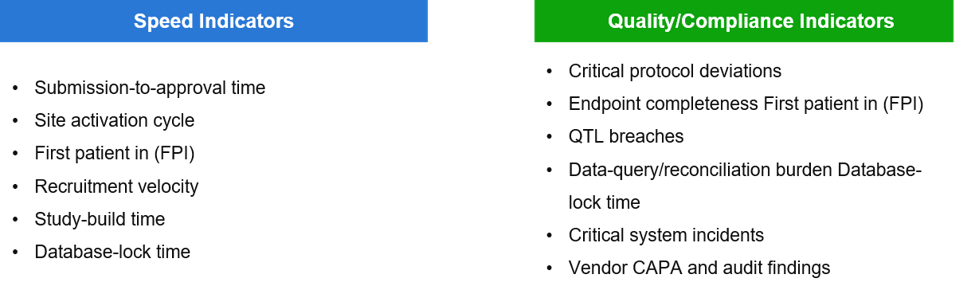
7. Use balanced KPIs
Track speed together with quality. Submission-to-approval, site activation, and database lock metrics should sit beside protocol deviations, endpoint completeness, QTL breaches, service provider quality events, and inspection findings.
Table 2. Balanced Operating Dashboard
Sources: Beroe Analysis
Conclusion
The clinical trial regulatory landscape is shifting toward more risk-based, digital, and continuous oversight. Regulators are placing greater emphasis on whether sponsors identify critical risks to participant safety and data integrity and apply proportionate controls. ICH E6(R3), Annex 2, and ICH M11 support this transition, alongside faster and more digitally enabled regulatory approaches in the U.K., Europe, and the U.S. ICH M11 may also reduce manual re-entry and enable greater automation through structured, machine-readable protocols.1
As regulatory engagement becomes more continuous, sponsors will need review-ready, traceable data throughout the study. Wider AI use, connected platforms, and decentralized technologies will also increase expectations for validation, cybersecurity, auditability, and human oversight.
Oversight will increasingly extend beyond CROs to laboratories, cloud providers, device companies, and decentralized trial partners. Sponsors, CROs, and procurement teams should therefore embed quality, digital governance, risk management, and supplier oversight into trial design and execution from the outset.
References:
- “FDA Actions to Accelerate and Modernize Early and Late-Stage Clinical Development,” [Online]. Available: https://www.fda.gov/industry/fda-actions-accelerate-and-modernize-early-and-late-stage-clinical-development.
Note: Shaun Hastings' view and opinions expressed in this article his own and do not necessarily represent that of the company he works for or the company's practices.
About The Authors:
 Sapna Rani is a category research analyst with over 10 years of experience in market research and consulting. Her insights have enabled top pharma companies in their strategic decisions on supplier outsourcing, category management, and planning. In the past year, she supported more than 20 market sourcing studies, eight supplier data visualizations, and multiple quick reactive analyses across clientele for global and regional requirements.
 Shaun Hastings has over 25 years of experience in clinical research and quality assurance. A graduate of Cranfield University and a member of the Research Quality Association (RQA), he specializes in GCP compliance, quality management systems, inspection readiness, and service provider oversight. His professional interests include digital transformation, AI governance, and advancing quality culture within regulated clinical research environments.