
How Can We Influence Others For Better Outcomes In Clinical Research?
By Kamila Novak, KAN Consulting MON, I.K.E.; Maria Kellner, Virtua Pharma Technology; and Terry Katz, formerly Daiichi Sankyo

This article is not about influence in the way many think today. There will be no social media tips or tricks but, rather, a helpful look into the Delphi method, which aids decision makers in various organizations including regulated ones to gain consensus. Key advantages of this method include:
- Anonymity for the participants to express their opinion freely without fear of criticism or pressure from dominant members
- Iteration when the participants can reconsider their opinion over multiple rounds as they encounter new information and alternative perspectives
- Controlled feedback as the facilitator guides participants’ focus by sharing aggregated results.
This summer, we delivered a DIA DIRECT webinar titled, “The Power of Influence: How can we influence others for better outcomes?” We focused on situations we encounter in our daily lives, such as advancing initiatives in the workplace or motivating family members to do — or not do — something. The interest in this webinar, and the number of people who registered, exceeded our expectations. We, therefore, decided to summarize the key points and further explain the Delphi method — an easy, structured, and practical way to influence and reach consensus.
What Is Influence, And How Does It Work?
Influence is “the capacity to have an effect on the character, development, or behavior of someone or something, or the effect itself.”1 To exercise influence, we need to overcome resistance and encourage people to reconsider their views.
We can imagine influence as an equation where influence equals persuasion divided by resistance. If resistance is high, even strong persuasion yields minimum results, while lower resistance increases influence.
To be persuasive, we need to be credible, build trust, understand reasons of resistance and address them, and use appropriate techniques. It all starts with active listening to people whose views differ from ours. They may have different experiences, interpret supportive data differently, have different interests or values, or simply view the issue from another perspective. Active listening helps understand their position and find common ground. It means listening for total meaning of both the content and underlying feelings, responding to feelings, i.e., validating and supporting the speaker’s emotional state, suspending judgement, and noting all cues including interpretation of nonverbal signals such as facial expressions, posture, and tone.2
Guiding a productive discussion rather than allowing it to become a destructive argument requires increasing the receptiveness of everyone involved. To achieve that, we can:
- Hedge: Present our views as a hypothesis or perspective to be considered rather than as the unquestionable truth.
- Emphasize common ground: Highlight shared values, interests, concerns, or problems.
- Acknowledge others’ perspectives: Demonstrate that we have heard and understood differing opinions, even if we do not agree with them.
- Reframe the proposed change in a positive way: Explain the change in terms of shared objectives and potential benefits.
When a group needs to move beyond discussion toward a collective judgment, a useful technique is the Delphi method. It can be applied with both onsite and remote teams.
The Delphi Method
The Delphi method is a structured communication technique that uses multiple rounds of anonymous questionnaires or polls to gather expert opinions and reach a group consensus. It was developed by the RAND Corporation in the 1950s.3,4 By allowing participants to provide judgments independently and then reconsider them after receiving summarized group feedback, the method can relieve some of the social pressures and group dynamics associated with face-to-face decision-making.
The process has five main steps:
- Select experts: Assemble participants, i.e., a panel of subject matter experts (SMEs) and key stakeholders with diverse views on the topic.
- Conduct round 1: Ask the participants to answer, independently, initial open-ended or broad questions.
- Summarize results and provide feedback: An appointed facilitator collects, analyzes, and anonymizes the responses into a statistical summary.
- Conduct round 2 and beyond: Ask the participants to review the summary and re-confirm or revise their answers.
- Stop at consensus: Repeat the survey loop until opinions stabilize or match a predefined threshold.
Like every decision-making method, the Delphi technique has its pros and cons. Strengths include minimum groupthink, reduction of egos, and enabling geographically dispersed participants to collaborate effectively. Its limitations comprise the time to reach the outcome (multiple rounds), risk of dropouts between rounds, and the quality of the outcome highly depending on the selection of appropriate experts and articulating the questions.
Practicing The Delphi Method
During our webinar, we practiced the method with volunteers from the audience. The practice case and outcomes are described below.
Participants were asked to imagine that they were advising an executive team:
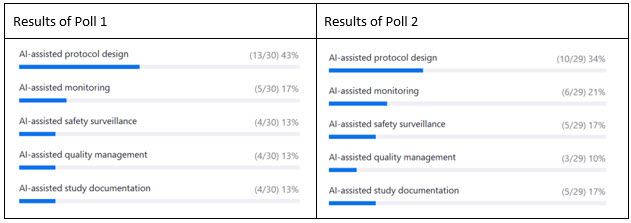
If you could invest in only one AI initiative over the next three years, which would provide the greatest improvement in clinical trial quality? The poll offered five options:
- AI-assisted protocol design
- AI-assisted monitoring
- AI-assisted safety surveillance
- AI-assisted quality management
- AI-assisted study documentation
After the first poll, we displayed the aggregated results and asked participants to explain the rationale for their choice, assumptions that influenced their choice, and evidence or experience supporting their choice. The participants should not tell others what they chose. Then we repeated the poll. Results of both polls are displayed in Figure 1.
After the second poll, we asked our volunteers, again without disclosing their choices, whether they changed their vote and what information or reasoning persuaded them to do so.4
Our Observations
We were surprised by increased conservatism after the first Delphi iteration. While we expected increased support for protocol design and monitoring, the second poll suggested greater interest in initiatives perceived as potentially more suitable for an initial, lower-risk application of AI. Comments during the discussion indicated concerns about issues such as AI hallucinations and model drift, which may have contributed to this shift. Also, participants might have viewed some applications as better suited to a lower-risk proof of concept before AI is applied to more consequential clinical trial activities.
Conclusion
Our practice session was limited to two iterations; thus, we cannot generalize the results. Nevertheless, we found the method easy to use with remote, untrained participants and minimum preparation.
With predefined criteria, a structured approach, careful selection of participants, effective facilitation, and some practice, the Delphi method can be a valuable tool for informed decision-making in regulated organizations.
Authors’ note: The DIA Direct webinar recording is available in the DIA Learning Center. DIA Members have complimentary access to the webinar and all past webinars.
References:
- Oxford Dictionary, definition of influence https://www.oxfordlearnersdictionaries.com/definition/english/influence_1
- Tennant K, Long A, Toney-Butler TJ. Active Listening. [Updated 2023 Sep 13]. In: StatPearls [Internet]. Treasure Island (FL): StatPearls Publishing; 2026 Jan-. Available from: https://www.ncbi.nlm.nih.gov/books/NBK442015/
- RAND Corporation, https://www.rand.org/topics/delphi-method.html
- Jorm, A. (2025). Origins and Uses of the Delphi Method. In: Using the Delphi Method to Establish Expert Consensus. Advancing Methods for Interdisciplinarity in the Social Sciences. Palgrave Macmillan, Singapore. https://doi.org/10.1007/978-981-96-8357-4_1
- The Power of Influence: How can we influence others for better outcomes? DIA DIRECT Webinar, July 7, 2026
About The Authors:
 Kamila Novak, MSc in molecular genetics, has been involved in clinical research since 1995, working in various positions in pharma and CROs. Since 2010, she started working as a contractor and incorporated several years later. Her business activities include auditing, consulting for QMS establishment, clinical risk management, and process improvements, training, and medical writing. Kamila is a certified Lead Auditor for GDPR, six ISO standards and a certified auditor for two more. She is an active member of the DIA, the SQA the CDISC, the Florence Healthcare Site Enablement League, and other professional organisations. She publishes articles, speaks at webinars and conferences. She and her company actively support capacity building programs, access to healthcare and education in Africa.
 Maria Kellner has over 25 years of technology, validation, and process engineering experience in the Biopharmaceutical, CRO and software industries. She owns a consulting company, Virtua Pharma Technology, which is geared to help Biopharmaceutical companies and CROs implement and manage GXP software. She is fluent in all areas of R&D, including the software and processes needed to successfully help them function and flourish.
 Terry Katz is an experienced Leader in Biostatistics, Statistical Programming and Data Management for pharmaceutical development. Most recently, he headed Biostatistics/DM Functional Excellence at Daiichi Sankyo emphasizing processes, compliance and CAPAs. Previously, he headed Biostatistics at Merck Animal Health and ImClone Systems, and was a statistical leader at PRA International and Schering Plough. He was an adjunct professor in Biostatistics and completed a 3-month pro bono fellowship in Kenya to improve capacity and capability for local hospitals to conduct cli