
Is Your Team Burnt Out? Discover The ROI Of Healthy Employees Running Trials
By Rita Birdi, BSc., EMBA

I remember slamming that heavy cast-iron pot onto my glass stove top and watching the pieces fly as tears rolled down my face. With my laptop dinging email notifications past 6 p.m., my kids playfully making a mess, and thoughts of the caregiving appointments I still had to make for my mother-in-law swirling through my head, I was at my rock bottom. I was burnt out.
I’ve been in clinical research operations for over 25 years. I’ve managed complex studies with $2-plus billion budgets, and I’ve witnessed some of the best clinical scientists and study managers work under truly unrealistic timelines and meet impossible deadlines. Words like “accelerated timelines” and “expedited requests” were — and still are — used with a normalized expectation of heroic efforts that will follow. Team members who stay late and work over the weekends are recognized and applauded, but what goes unacknowledged is that, over time, these teams start showing up tired, foggy, and irritable, and slowly take more sick days and, eventually, a leave of absence.
Clinical research and the pharmaceutical and biotech industry at large are very demanding of the people who support them. Many professionals, therefore, operate under continuous stress, sleep deprivation, nutritional gaps, and nervous system overload. And it carries on for years. Consider a VP of operations who moves into an SVP role and then president. They’ve moved up, but at what cost? In an industry built on efficacy and safety, which requires attention to detail and accuracy from the rollout of the first draft protocols to database locks — not to mention a continuous need for metrics reporting — one key variable is often overlooked: the physical, mental, and emotional state of the people behind the science and operations.
When employee retention means retaining team members with valuable experience and capable of optimizing innovation with the goal of developing breakthrough therapies, how do we do that with a burned-out, health-impaired workforce? As timelines shorten and trial complexity increases, what will sustain performance is not just these expected but taxing acts of heroism, but team resilience. And this resilience begins at a much deeper level, at the cellular level: with metabolism, methylation, mitochondrial health, and mindset.
What if the key to faster site activations, stronger team dynamics, and improved retention isn't another project management tool but something far more primal?
The Hidden Crisis In Clinical Operations
Burnout among clinical teams is a measurable statistic. According to a 2023 Medidata report, 68% of clinical trial professionals report signs of burnout, and nearly half considered leaving their roles within 12 months. Across industries, stress-related absences and errors have cost some companies millions of dollars.
These aren't just work-life balance or even mental health issues. They are physical, chemical, and behavioral breakdowns, often misdiagnosed as performance gaps. When a project manager becomes forgetful or emotionally reactive, we call it unprofessional, open an HR case, and follow it up with a corrective action plan. The same goes for when a program lead struggles with motivation. Managers think it's disengagement, but truly, they’ve just run out of energy. But what if these incidents are just a sign that someone is no longer able to cope and their poor physical health is now hampering their emotional state and affecting their ability to fulfill their responsibilities?
Some organizations attempt to address these issues by offering gym memberships and mindfulness apps. Yet they fail to address the root cause: the mismatch between our biological design and our modern working environments. It’s time for a new operational model, one that treats the actual human as part of the strategy for success. As humans, we haven’t genetically evolved much, yet the world around us has evolved at record speed, and this gap is making us sick.
The 4M Framework: The Cellular Blueprint For Human Performance
The 4M framework offers a science-based lens to restore human resilience at work:
Metabolism
When glucose and insulin are unbalanced, we experience energy crashes, mood swings, and decision fatigue. Metabolic regulation enables steady focus and productivity throughout the day.
Methylation
How your body absorbs and processes what you eat and drink is a biochemical process that is vital for detoxification, cognition, hormone balance, and emotional health. Impaired methylation contributes to brain fog and reactive behavior, traits that undermine leadership.
Mitochondria
These are the energy producers in our cells. Our batteries! When mitochondrial function is optimized, people don’t just feel more energetic, they are more resilient at the cellular level.
Manifestation
This is the visible output of internal balance. When the body is nourished and stable, we show up with clarity, calm, and confidence. The quality of a meeting, negotiation, or leadership moment is downstream of biochemistry. Said differently: When you are internally physically healthy, you improve your emotional and mental state, which in turn changes your external reality. Your perception is more positive, and your reactions are controlled — and you make more decisions from a place of kindness.
Modern workplaces either don’t know about this or ignore this reality. But when the workplace culture directly supports metabolic and cellular health, performance transforms naturally and is sustained for the long run.
The HERO Path: From Survival To Strategic Clarity
Biological regulation alone is not enough; we must also navigate the inner emotional landscape of leadership. That’s where the HERO path comes in:
Health
This is the foundation. Without physiological safety, the brain cannot operate in its executive state.
Emotional Agility
With a stable body, emotional regulation becomes accessible.
Resilience
Individuals can recover from stress, take advantage of uncertainty, and maintain internal steadiness.
Output
A leader who operates from clarity, not chaos, produces visible results.
Many clinical professionals unknowingly operate from a chronic fight-or-flight state. While high performers may appear composed, they are often physiologically in survival mode, which dulls creativity, narrows perspective, and drains long-term capacity to be resilient after each major milestone or deliverable. Restoring this internal safety through biological and behavioral alignment allows for sustained leadership growth.
Case Studies: From Internal Shift To External Results
To put the above into perspective and show it in action, below are a handful of real-life ways in which people I’ve known (even managed) have understood the 4M framework and used the HERO path to improve their well-being and work performance.
Accelerated Milestones
It was a start-up study, and the first site ready date had to be met. I observed a lead study manager who had quietly been struggling with poor focus, low stamina, and brain fog. She began making subtle shifts in how she fueled herself, starting with the following:
- Hydration: drinking more water and less coffee
- Nutritionally dense meals: high protein and un-processed lunches and snacks
- Breathing: taking more deep breaths so that her body would stop being in a survival state and understand that she is safe
- Sunlight: getting sun in the morning, and stepping outside at lunch
- Sleep: consistently going to bed and waking up at the same time, and stopping all devices at least one hour before bedtime

Within weeks, she noticed she could think more clearly and complete tasks faster. By month three, she became the first in her region to hit all site activation milestones — two weeks ahead of schedule. The internal upgrade enabled external achievement.
Resilience In A High-Pressure Oncology Trial
A lead study manager was tasked with managing an additional study to her existing workload — without additional team members. Rather than push through on adrenaline, she focused on steadying herself with real food over stimulants and micro-breaks over nonstop meetings. She maintained momentum, had fewer conflicts, and fostered more collaboration. The difference was visible.
Reduced Absenteeism And LOAs
In a clinical operations team of 24, leadership quietly tested and observed a shift when it offered more whole-food options, water challenges, and afternoon walking breaks.
A year later, the results were in:
- 32% fewer short-term sick days
- 66% fewer stress-related leave-of-absence cases
- Estimated savings: $2,100 per employee/year = $88,200 in indirect ROI
This wasn’t a wellness program. It was a biological reboot — with a return on investment.
Why Knowledge Alone Doesn’t Work
The failure of most corporate wellness efforts is rooted in the inaccurate belief that knowing leads to doing. Clinical professionals aren’t short on knowledge, but we are short on bandwidth.
Behavioral science shows us that transformation happens when three things align: identity and belief, biological state, and environmental surroundings.
Real well-being isn’t a campaign; it’s a daily practice. Here are six ways employers can truly support lifelong employee transformation:
- Normalize Movement
Encourage walking meetings, short breaks, even remotely allowing employees to take meetings outdoors while walking, and micro-resets throughout the day so employees aren’t glued to their screens.
- Conduct Shorter, Smarter Meetings
Default to 25- and 50-minute meetings with built-in buffers to reduce cognitive overload and decision fatigue and improve focus.
- Build a Trust-Based Culture
Remove anxiety around being always on and focus on quality of work, not online visibility. This reduces concerns about stepping away for lunch, walks, or required mental rest. It also allows for a grocery run or finding better meal options with more time to eat.
- Offer Year-Round Physical And Emotional Support
Run ongoing monthly group coaching around specific health topics and open health challenge cohorts three times a year. Add reminders in calendars, and have emotional and physical education built into the culture – not one-off wellness events or “we care” posters. This includes health and wellness surveys so that data shows measurable results.
- Avoid Running Teams Too Lean
Investing in proper resourcing reduces stress, prevents burnout, and allows people to take paid time off. The return on this investment is higher retention, lower sick leave, and stronger, happier teams.
The Business Case For Nutritional Anthropology And Clinical Leadership
Nutritional anthropology is simply humans eating, breathing, and moving the way our bodies are meant to.
Most of us get paid for our brain, but our body is the vehicle that carries it around. And if the vehicle breaks down, the brain doesn’t get very far. That means that every business outcome is downstream of how your body is doing. Here’s what that looks like at different levels:
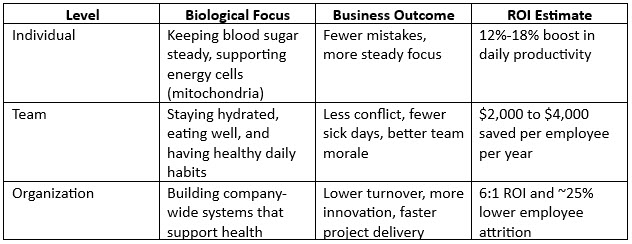
Gallup estimates burnout costs global companies $322 billion annually. Companies with strategic well-being integration outperform their peers by 235% in stock price (HBR). Deloitte reports 94% of top-performing firms track workforce well-being as a leadership KPI.
This isn’t soft science. It’s smart science. The biology of your people is your competitive edge.
A Vision For The Future Of Clinical Leadership
Imagine a workplace where clinical operation executives think clearly under pressure and are calm and kind, where program leads feel emotionally steady, and teams meet deliverables not through sheer effort, but because their bodies and minds are operating in harmony. Imagine fewer errors, shorter timelines, better patient outcomes, and fewer people quietly breaking down behind their screens.
This future is not only possible, it’s necessary. And it begins when we shift the question from “Are our people coping?” to “Are our people fueled?” It’s moving from just surviving to thriving.
In a world of scientific precision, it’s time we bring that same precision to the humans behind the science. Because your next clinical breakthrough may not just be in the pipeline — it may be in the lunch box, the walking break, and the restful sleep.
A note from the author: By the way, I got a new oven, and my rock bottom became the start of my own personal journey to discovering how my health was the key to not only the success of my projects, my teams, and my career but having harmony in my life so that the whole me shows up professionally and personally in full energy.
About The Author:
 Rita Birdi is a clinical operations leader with more than 25 years of experience in trial delivery across many therapeutic areas, including oncology and endocrinology. She is passionate about ROI when employees are at their best physically, emotionally, and mentally. She created the 4M Framework and HERO Path. She is a nutritional anthropology and behavior change specialist and advocate for the well-being of women leaders in pharma, biotech, and health sciences.