
July Update — U.S. Generic Drug Tariffs: Implications For Pharma And Outsourcing
By Mathini Ilancheran, senior delivery lead - research, R&D, Beroe Inc.
Editor’s note: This guest column is a follow-up to “U.S. Drug Tariffs: Implications for Pharma and Outsourcing.”
On July 21, 2026 President Trump announced that imported generic drugs will remain duty-free for two years from August 1, 2026, then face a 100% tariff from August 2028 and 200% from August 2029, to be implemented under Section 232.1–3 This closes the last gap in a framework that already covers patented medicines, tariffed at 100% by executive order on April 2, 2026, with generics, biosimilars, and their ingredients expressly excluded. 4,5 That exclusion now has an expiry date.
Three points that matter:
- It is deferred. Nothing changes at the border for two years. The first duty is only payable in August 2028.
- It is conditional. It is framed as a penalty on companies that do not build manufacturing plants in the U.S. within that window, rather than as a permanent trade barrier.
- It does not apply evenly. Under the U.S.—EU agreement, European generics and their ingredients pay close to nothing from September 1, 2026.6,7 If that stays in place, the tariff falls almost entirely on Asian suppliers, especially India and China.
With generic medicines having a thin margin, a 100% duty may lead to prohibition. Where pass-through is blocked by Medicaid inflation rebates, 340B pricing, and consolidated purchasing, the rational response is discontinuation rather than reshoring. The likely first effect of full implementation is therefore narrower U.S. generic supply, not higher generic prices.
What Was Announced
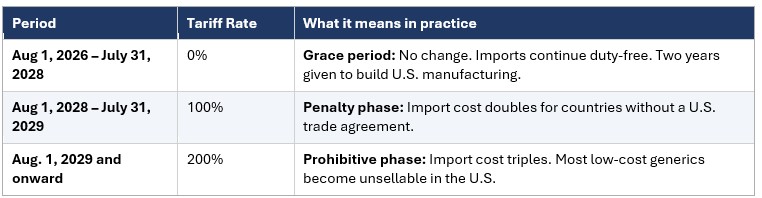
Table 1: The announced schedule1–3
No proclamation, Federal Register notice, or annex of tariff lines have been published.2,8 Four questions remain open, and each one changes who pays:
- Ingredients — whether the tariff covers raw ingredients or only finished medicines
- Biosimilars — whether they are included, having been exempt in April
- Existing trade deals — whether the EU, U.K., Japan, Korea, and Switzerland keep their current terms
- Essential medicines — whether drugs already in short supply are exempt
Why Generics Are A Different Problem
Generic medicines are about nine in 10 U.S. prescriptions but only a small share of drug spending. 9 Twenty years of price competition, under three buying groups that control most U.S. generic purchasing, have pushed standard tablets down to a few cents each. At those prices, a 100% duty turns the profit into a loss, and the cost cannot simply be added to the price: Medicaid rules penalize price increases, 340B requires discounts to safety-net hospitals, and supply contracts are fixed years ahead.
Building in the U.S. is slower than the policy assumes. A new tablet plant takes three to five years to reach FDA-approved commercial supply, and injectable plants take longer. Even then, the active ingredients would still come from China and India. Risk within the category is uneven. The products most likely to be dropped rather than repriced are older injectables, cancer generics, long-established antibiotics, and medicines with only one approved manufacturer — categories that already suffer regular shortages in the U.S.8,10
Countries Most Exposed
Three factors determine how exposed a country is: share of U.S. generic supply, whether a trade agreement shield exists, and how concentrated the country’s own industry is on the U.S. market.
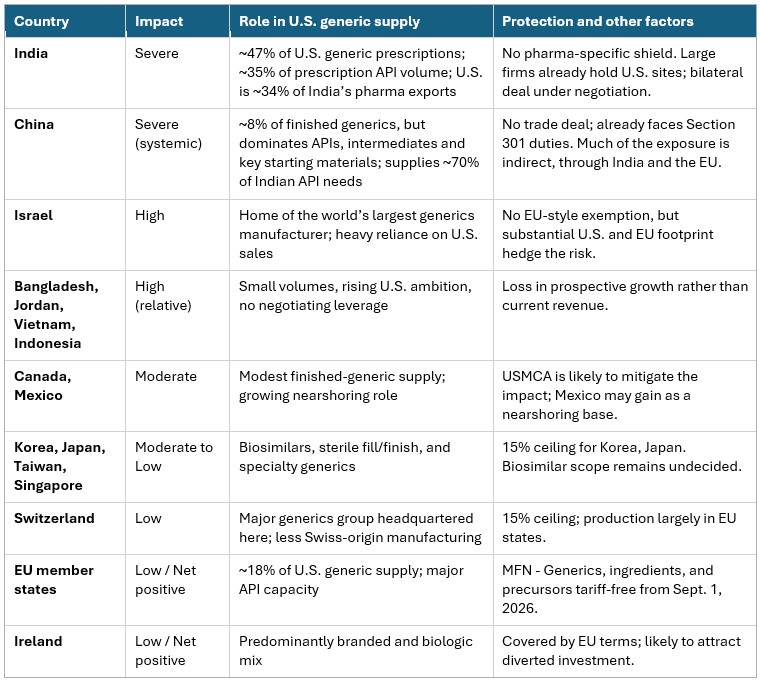
Table 2: Comparative exposure. Shares draw on U.S. Pharmacopeia analysis of 2024 imports 9,11,12 and Indian industry data 13,14; they vary by whether measured by prescription count, volume, or value.
India is the most exposed supplier.18 Its pharmaceutical exports hit a record $31.1 billion in FY2026, with the U.S. taking about a third ($10 billion), mostly generic medicines and APIs. 13,14 Several large Indian firms earn over 40% of their revenue in the U.S.15] But India has time and options: Many firms already own U.S. plants, trade talks are underway, and exports to Europe and Africa grew last year while U.S. shipments fell.13
China's risk does not show up in export figures. It supplies few finished generics but makes most of the chemistry behind them — antibiotics, intermediates, and the key starting materials used to make APIs, including about 70% of what India needs.16 Taxing the country where a medicine is finished does nothing to reduce that dependence. Extending the tariff to ingredients would — at the cost of shortages.
European generics are not being tariffed at all.6,7 Beginning August 2028, a U.S. buyer would pay no duty on an EU-made generic, while the same medicine from India would cost twice as much to import — three times beginning in 2029. A policy meant to move generic manufacturing to America is more likely to move it to Italy and Spain, Europe's largest generic API producers, which already export over 95% of what they make.19

Implications For Pharma And Clinical Research
Contract manufacturing decisions will change before any tariff is charged. A company choosing where to make a medicine must account for the rates that will apply in 2028 and 2029. Changing that choice later is slow and costly, because the manufacturing site is named in the regulatory filing. Most of these decisions will therefore be made in 2026 and 2027, before any tariff applies.
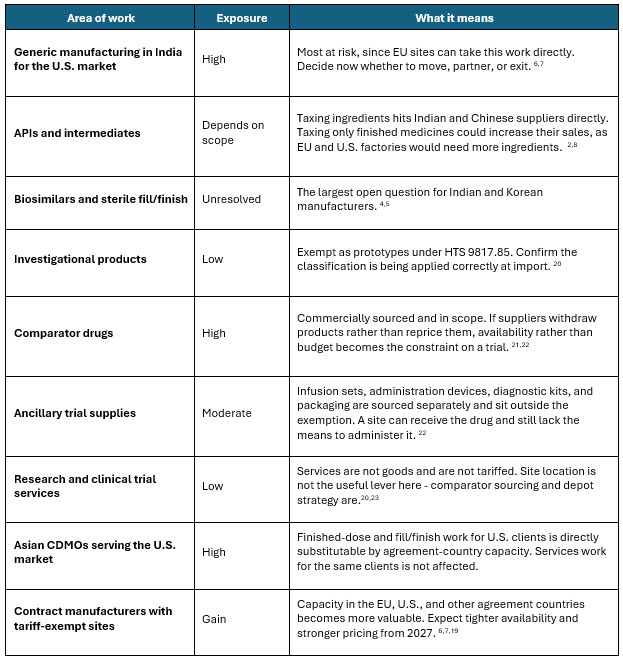
For clinical teams, the investigational product is largely protected while the medicines around it are not. Clinical trial lots enter the U.S. as prototypes under Harmonized Tariff Schedule code 9817.85, and Customs and Border Protection has repeatedly ruled that pre-commercial R&D supplies, including material imported solely for Phase 3 use, qualify for duty-free treatment.²⁰ Comparators do not travel under that exemption. They are commercially sourced marketed products, and in generic-controlled studies they are precisely the low-cost molecules this tariff targets.²¹,²²
The effect differs sharply by type of work:
Conclusion
The tariff may be renegotiated, reduced, or never formally issued. A similar announcement on branded drugs in September 2025 was not implemented in the form first described,17 and August 2028 falls in the closing months of a presidential election. A middle case — proclamation with essential medicine exceptions — is manageable for large groups with U.S. footprints and severe for midsize single-market exporters.
For North American buyers, payers, and health systems, the near-term risk is availability rather than price: The medicines least able to absorb a duty are the older injectables and single-source products already prone to shortage, so the practical step is to identify which molecules have one supplier and qualify an alternate player. For European manufacturers, the tariff-free window is both an opening and a capacity question; Europe can absorb displaced volume only as fast as it can validate sites, and it depends on the same Asian chemistry it would be replacing. For Asian suppliers, the case for building demand beyond a single export market no longer rests on this measure alone. Across these markets, the priority is therefore the same: Use the available window to qualify alternative suppliers, manufacturing sites, and markets before policy uncertainty becomes a supply constraint.
Author’s Note: Supply-share percentages vary by whether they are measured by prescription count, volume, or value, and are indicative. No implementing proclamation or annex of covered tariff lines had been published at the time of writing; all scope-related statements are therefore provisional.
References:
- France 24, “Trump announces 100% tariffs on imported generic pharmaceutical drugs”, 22 July 2026. https://www.france24.com/en/americas/20260722-trump-announces-100-tariffs-on-imported-generic-pharmaceutical-drugs
- CNBC, “Trump plans generic drug tariffs from 2028 with two-year delay testing U.S. onshoring push”, 22 July 2026. https://www.cnbc.com/2026/07/22/trump-generic-drugs-tariffs-medicine-trade-.html
- Fox Business, “Trump’s generic drug tariff plan gives manufacturers 2 years to reshore”, 22 July 2026. https://www.foxbusiness.com/politics/trump-unveils-phased-tariffs-generic-drugs-boost-us-production
- KPMG TaxNewsFlash, “United States announces 100% Section 232 tariff on patented pharmaceuticals and their ingredients”, 2 April 2026. https://kpmg.com/us/en/taxnewsflash/news/2026/04/united-states-section-232-tariff-pharmaceutical-ingredients.html
- Crowell & Moring LLP, “Trump Administration Imposes Section 232 Tariffs on Patented Pharmaceutical Imports; Tiered Rate Structure Takes Effect Beginning July 31, 2026”, 7 April 2026. https://www.crowell.com/en/insights/client-alerts/trump-administration-imposes-section-232-tariffs-on-patented-pharmaceutical-imports-tiered-rate-structure-takes-effect-beginning-july-31-2026
- European Commission and the White House, Joint Statement on a United States–European Union Framework on Trade, 21 August 2025; summarised in DCAT Value Chain Insights, “US, EU Detail Plan for Pharmaceutical Tariffs”. https://www.dcatvci.org/features/us-eu-detail-plan-for-pharmaceutical-tariffs/
- Tariffstool, “EU Tariff Rate 2026: 15% Deal Live as of July 1”, July 2026. https://www.tariffstool.com/guides/eu-us-trade-deal-15-percent-tariff-live
- The American Journal of Managed Care, “Trump Announces Timeline for 100% Generic Drug Tariffs Beginning in 2028, 200% in 2029”, July 2026. https://www.ajmc.com/view/trump-announces-timeline-for-100-generic-drug-tariffs-beginning-in-2028-200-in-2029
- eMarketer, “Trump considers more tariff reprieves for generic drugs”, citing US Pharmacopeia analysis of 2024 imports. https://www.emarketer.com/content/trump-considers-more-tariff-reprieves-generic-drugs
- The Hill, “Trump threatens 100 percent generic drug tariffs beginning in 2028”, July 2026. https://thehill.com/policy/healthcare/5983150-trump-tariffs-generic-drugs/
- U.S. Pharmacopeia, Medicine Supply Map, “Over half of the active pharmaceutical ingredients for US prescription medicines come from India and the European Union”. https://qualitymatters.usp.org/over-half-active-pharmaceutical-ingredients-api-prescription-medicines-us-come-india-and-european
- CT Mirror, “Does the U.S. import a large share of generic drugs from India?”, 1 October 2025. https://ctmirror.org/2025/10/01/us-import-india-generic-prescription-drugs/
- Business Standard, “Drug exports to US fall 10% in FY26 as EU and Africa drive growth”, 1 May 2026. https://www.business-standard.com/industry/news/drug-exports-to-us-fall-10-in-fy26-as-eu-and-africa-drive-growth-126050100811_1.html
- Pharmaceuticals Export Promotion Council of India (Pharmexcil), export statistics, FY2026. https://pharmexcil.com/
- Gulf News, “Indian markets — and pharma stocks — still steady after Trump’s 200% tariff threat”, July 2026. https://gulfnews.com/business/markets/indian-markets-and-pharma-stocks-still-steady-after-trumps-200-tariff-threat-1.500199810
- DNA India, “Trump’s proposed 200% tariff is a wake-up call, but India’s bigger pharma risk lies in China, say experts”, July 2026. https://www.dnaindia.com/world/report-us-proposes-upto-200-tariff-on-generic-medicines-should-india-worry-3216787/amp
- Pharmaceutical Executive, “President Trump Announces Phased Generic Drug Tariff Plan”, July 2026. https://www.pharmexec.com/view/president-trump-phased-drug-tariff
- The New Indian Express, “200% tariff threat on US generic drug imports: what it means for India”, 25 July 2026. https://www.newindianexpress.com/explainers/2026/Jul/25/200-tariff-threat-on-us-generic-drug-imports-what-it-means-for-india
- DCAT Value Chain Insights, "The EU's API Supply Chain Under Focus", citing European Commission data on registered pharmaceutical manufacturing sites. https://www.dcatvci.org/features/the-eu-s-api-supply-chain-under-focus/
- Clinical Leader, "U.S. Tariffs And Their Tenuous Impact On Clinical Trials", citing RSM US LLP analysis of Harmonized Tariff Schedule code 9817.85 and CBP prototype rulings, June 2025. https://www.clinicalleader.com/doc/u-s-tariffs-and-their-tenuous-impact-on-clinical-trials-0001
- European Journal of Hospital Pharmacy, "The Impact of U.S. Tariffs on the Pharmaceutical Industry and Medicine Access in Europe: Challenges, Opportunities, and Future Outlook". https://pmc.ncbi.nlm.nih.gov/articles/PMC12602281/
- Clinical Supply Leader, "Tariffs Threaten Clinical Trial Supply Chains: Preparing For Volatility", February 2026. https://www.clinicalsupplyleader.com/doc/tariffs-threaten-clinical-trial-supply-chains-preparing-for-volatility-0001
- Applied Clinical Trials, "Future-Proofing Clinical Trial Supply Chains Against Tariff Risks", November 2025. https://www.appliedclinicaltrialsonline.com/view/future-proofing-clinical-trial-supply-chains-against-tariff-risks
About The Author:
 Mathini Ilancheran is a research manager with over 13 years of expertise in market intelligence, procurement strategy, and outsourcing decisions across the global pharma R&D landscape. She leads research and expert collaboration initiatives across healthcare and life sciences, connecting clients, service providers, and industry experts to bridge information gaps and support data-driven sourcing decisions. Her expertise includes category strategy, supplier management, make-versus-buy analysis, cost optimization, risk assessment, etc. Mathini has authored more than 45 publications on pharma R&D outsourcing, offering actionable perspectives on procurement, category management, technology transformation, and industry trends.