
Most Patients Learn About A Trial Online, But Is That What They Want?
By Shalome Sine and Annick de Bruin, CISCRP

Sponsors, sites, and CROs routinely invest heavily in patient recruitment initiatives, with many outreach strategies focusing on traditional advertisements and social media campaigns. Despite these investments, recruitment challenges persist.
And, in fact, while most patients continue to report learning about clinical trial opportunities through online channels and advertisements, they overwhelmingly prefer to learn about clinical research from trusted healthcare professionals, particularly their own physicians. These findings from CISCRP’s latest Perceptions & Insights Study illustrate a growing gap in actual and preferred patient recruitment pathways — highlighting an opportunity to build recruitment processes that directly respond to patient needs and preferences.
Patients Want — And Expect — To Learn About Trials From Their Doctors
Across P&I study years, healthcare professionals consistently rank among patients' most preferred sources of information about clinical research opportunities.
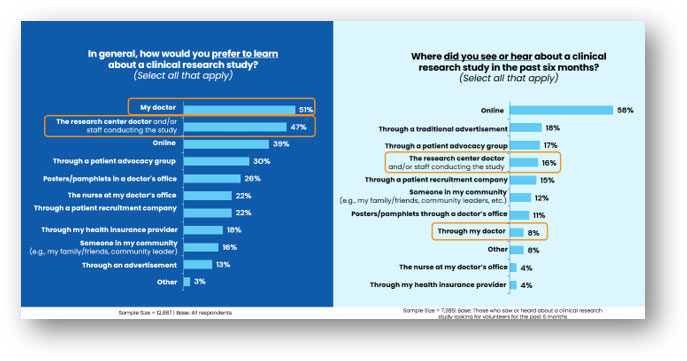
In the 2025 survey, 51% of respondents indicated they would prefer to learn about a clinical research study from their doctor, while 47% preferred learning from research center physicians or study staff. These sources ranked above online resources, advertisements, recruitment vendors, advocacy organizations, and community sources.
Clinical trial participation is a healthcare decision requiring patients to weigh risks, benefits, treatment alternatives, eligibility requirements, and logistical considerations. Patients prefer receiving information about trials from a healthcare professional who understands their unique medical history and can place participation into clinical context.
Despite this strong preference, the actual pathways patients encounter look very different.
The Referral Pathway Patients Actually Experience
When asked where they had seen or heard about recruiting clinical studies during the previous six months, respondents most commonly cited online channels.
In 2025, 58% reported learning about recruiting studies online, compared with just 17% who learned through their doctor. Across Perceptions & Insights study years beginning in 2019 (when this question was first asked), online channels consistently represented the top source of awareness about clinical trials. Traditional advertising represented another consistently significant source of awareness.
These findings suggest that while healthcare professionals remain the preferred source of information, online channels are increasingly serving as the practical gateway into research participation.
The Growing Influence Of Social Media
Reflecting sponsors’ substantial investments in digital outreach channels, the P&I data show that patients and the public most often learn about clinical trials online, particularly through social media.
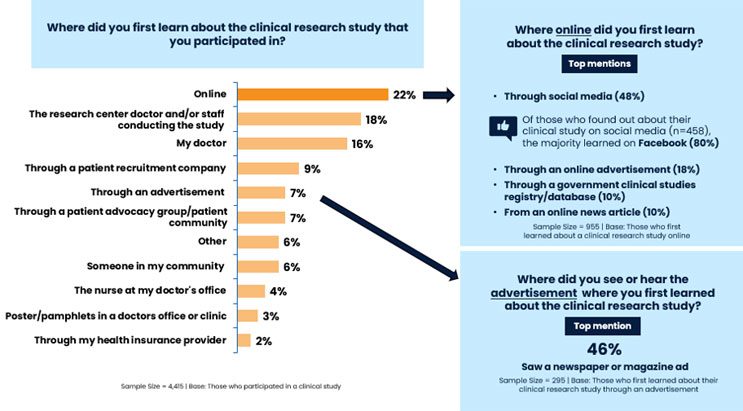
Among 4,415 clinical trial participants surveyed in the P&I Study, nearly one-quarter (22%) reported first learning about their clinical trial online, making it the most frequently cited source of awareness among those with participation experience. By comparison, 18% learned through research center staff and 16% through their physician. This marks a shift from 2017, when research center staff (still 18%) and physician referrals (19%) were more commonly cited than online sources (17%).
Of those who indicated that they first learned about their clinical trial via social media, 80% identified Facebook as the platform where they learned about the study. Facebook’s prominence may reflect the platform’s extensive network of condition-specific communities and patient support groups, where individuals exchange health information, connect with patient organizations, and find research opportunities relevant to their diagnosis. These communities can extend the reach of recruitment efforts by bringing study information into online spaces patients already use for peer support and disease-specific resources.
Why Aren’t Enough Healthcare Providers Referring Their Patients To Clinical Trials?
While further research is needed to fully understand key barriers to healthcare provider referrals, some studies show that the typical referral pathway often asks too much of clinicians who are already managing limited visit time and competing priorities. Providers may not know which trials are open, where investigative sites are located, and/or whether a patient is likely to qualify. Even when a physician identifies an appropriate study, unclear points of contact, cumbersome referral processes, and concerns about travel or other patient burdens can hinder or prevent the referral processes.
Industry’s growing reliance on online outreach strategies may also reinforce this disconnect. Digital campaigns can generate awareness at scale, but they do not automatically equip a patient’s healthcare provider to recognize relevant studies, explain them in clinical context, or make a timely referral. If sponsors want healthcare providers to serve as a stronger bridge to research, they must make the referral process easier by providing current, targeted trial information routinely in an effective manner, establishing simple and transparent referral mechanisms and facilitating clear handoffs to research sites.

What This Means For Industry
The findings suggest several opportunities for industry to improve recruitment efficiency:
- Enable healthcare providers to make timely, high-quality referrals.
- If physicians remain patients’ preferred source of information, sponsors, sites, and CROs must address the practical barriers that keep healthcare providers from discussing and referring patients to studies.
- Providers need timely, targeted information about relevant trials and straightforward eligibility guidance to effectively connect patients with trial participation opportunities that may be appropriate for them.
- Fix broken referral pathways and reduce administrative burden for healthcare providers.
- Healthcare providers managing heavy caseloads and limited visit time should not be expected to navigate complex referral processes, unclear points of contact, or fragmented communication.
- Sponsors and other industry stakeholders should establish clear, efficient referral pathways that enable seamless handoffs/coordination of patients’ care with clinical trial teams.
- Use multifaceted outreach and recruitment strategies while supporting healthcare provider conversations.
- Although healthcare providers remain patients’ preferred source, digital advertising and social media can raise awareness by reaching patients through channels they already use for condition-specific information and support (e.g., patient communities hosted on social media sites such as Facebook).
- Importantly, while digital outreach strategies may help raise awareness among patients more broadly, healthcare providers should be supported in having conversations with their patients about clinical trials and taking the next actionable steps toward participation.
Future Recruitment Must Involve Healthcare Providers
Patients continue to say they want to learn about clinical trials from healthcare professionals, yet the pathways they actually encounter increasingly begin online. Digital advertising, social media, and online patient communities have become important gateways to research awareness, but awareness alone does not replace the patient’s trusted relationship with their doctor.
Improving recruitment performance will require the industry to re-center healthcare providers as key sources of clinical trial information and referrals. Coordinated multifaceted recruitment strategies can meet patients where they are and leverage information sources via online channels, while equipping healthcare providers to have conversations with their patients about participation opportunities and facilitate next steps toward participation. By integrating healthcare providers more directly into recruitment and referral pathways, industry can improve recruitment efficiency while better aligning outreach processes with patients’ needs and preferences.
Stay tuned! CISCRP is currently conducting a Healthcare Provider Referral Pathways Study to explore the factors that influence referral behaviors, the challenges encountered within referral pathways, and the support needed to effectively facilitate patient access to clinical trials. Visit CISCRP.org to sign up for our newsletter and receive updates when study results are available.
About The Authors:
 Annick de Bruin is the chief research and insights officer at the Center for Information and Study on Clinical Research Participation (CISCRP). She is responsible for the design, implementation, analysis, and reporting of a variety of CISCRP research studies, including the Perceptions & Insights studies and numerous patient advisory boards. She has more than 25 years of experience conducting primary and secondary research studies in the healthcare, life sciences, and consumer goods industries. She holds an MBA from the Graduate School of Management at Boston University and a Bachelor of Science degree from Bryant University.
 Shalome Sine is a senior manager and quantitative insights specialist at the Center for Information and Study on Clinical Research Participation (CISCRP), where she leads efforts to elevate the patient voice in clinical research. Shalome believes that patient perspectives are essential to designing inclusive and efficient clinical trials. As part of CISCRP’s research services team, Shalome oversees both quantitative and qualitative patient voice initiatives, with a specialization in survey-based research that captures insights from patients and the public. She holds a Master of Public Health from Tufts University.