
Old Habits, Communication Issues Still Stalling Site Budget Negotiations
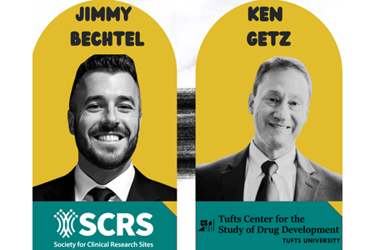
A conversation between Society for Clinical Research Sites (SCRS) Chief Site Success Officer Jimmy Bechtel, MBA, Tufts Center for the Study of Drug Development (CSDD) Executive Director Ken Getz, MBA, and Clinical Leader Executive Editor Abby Proch
Site budgets and contract negotiations have worsened over the past five years — from sluggish timelines and misaligned cost expectations to limited sponsor responsiveness and breakdowns in communication.
Drawing on data from the 2025 SCRS Landscape Survey Report, which incorporates findings from SCRS’s 2025 landscape survey and Tufts CSDD’s research, Ken Getz, executive director of the Tufts CSDD, and Jimmy Bechtel, vice president of site engagement at SCRS, explore the widening gaps in clinical trial budgets and contracting.
Together, the two also unpack how growing trial complexity, inconsistent fair market value benchmarks, and structural disconnects between procurement and clinical teams are reshaping site-sponsor relationships and what can be done to restore balance.
Clinical Leader: You identified the deterioration in budget and contracting dynamics. The majority of Tufts respondents believe that contract budgeting has worsened over the past five years. And then SCRS quantified some of these challenges, like budgetary misalignment, lack of sponsor responsiveness, and the absence of fair market value-based starting points. What does it mean to be worsening, and what were the particular sponsor or site segments that might have been driving this response?
Ken Getz: Usually, what sites are experiencing at that aggregate level is the amount of time and effort that it's taking to fully negotiate a budget, including reviewing the cost and the terms of the contract with the sponsor or CRO. It's just taking longer and longer. And in our experience, it's a direct function of the complexity of the project, where the site has to actually provide its personnel and capacity and all of their talent. And there often are contractual issues around indemnification and intellectual property rights with academic institutions, for example; those can be really sticky areas as well.
But often we see, at a macro level, the biggest challenge is the site has to agree on a budget that may not be commensurate with the work effort required.
Jimmy Bechtel: As the protocols become more complex, the budgets don't seem to be keeping up. And that means that what sites are initially getting from sponsor or CRO partners is so far off from what it actually costs to execute that clinical trial and its protocol, it takes several weeks or months of back and forth to get to a place of mutual acceptance. That really is a major driver for the dissatisfaction.
The sponsor and CRO responsiveness, the fair market value offerings, the budgetary misalignment — all three of these speak to the same solution around if we can just start budgets at a better spot, then we can really shorten the timeline that it takes to negotiate these budgets and, in turn, provide more satisfaction in that portion of the relationship and get things started quicker.
And that might constitute simply going to the sites and trying to get a better understanding of what it takes to execute some of these things. Because my suspicion is that there's a little bit of unknown, and we're operating under some assumptions or lack of information when we are producing these initial budgets.
What do we understand about the reason for the gap or the misunderstanding between the two parties? Is the onus on the sponsor to be more proactive?
Bechtel: When we're talking about budget and contract negotiations, it truly needs to be equally managed because we have to get to a place that works for the sponsors and CROs, but also for the sites that are negotiating on their behalf based on their costs to execute that protocol. From the site perspective, there's an education component that needs to happen. The sites need to make sure that when they are doing the negotiations, they're providing a sufficient level of information to the sponsor and CRO in the form of justification, so the sponsor and CRO can truly start to understand why the site is asking for X, Y, or Z.
And from the sponsor and CRO perspective, we oftentimes start back at square one when it comes to budget and contract negotiations, even within the same therapeutic area. We start back at the basics of that agreement, even though we've worked with that site before and we should know what they're asking for.
So, getting to a place where we have that historical information, make it an iterative process, build upon that budget, and learn as an organization — instead of going back to the same budget template and starting from scratch — can really go a long way to shortening that timeline.
Getz: There are other dynamics in addition to what Jimmy mentioned. Often, procurement is the group that's negotiating the budget when the clinical team established the requirements for the work effort. And procurement's incentive is to get the best price, to haggle and force the service provider to come in at the lowest possible price. There's always that unnatural tension. The site often isn't even dealing with the people it's been speaking with leading up to the budget negotiation.

There's always variation by geographic area, by site type. And some sponsors, when they find a site in Arizona that is at 80% of what a site would charge in the Boston area, there's a sense that if they continue looking, they're going to find a lower-cost offer.
Way back 20 or 25 years ago, there were databases that supposedly benchmarked site costs, which compared sites to the median budget. But, if you're a site that handles a high volume and you're a top performer, a lot of that was not reflected in your costs. Instead, it was purely designed for the sponsor to negotiate down to that median level. So, there's this natural cultural barrier where sites always feel that the sponsor is out of touch with the actual costs and is using metrics and tools that are not grounded in reality. And the sponsor always feels that sites are overcharging, so there's this huge disconnect.
This can have real impacts as far as budget disagreements. The SCRS study found that 21% of sites have reported declining a trial due to budget differences of opinion. What can be done to lessen the odds of that happening?
Bechtel: Site justification, the explanation, is really critical to making sure that the sponsors at least understand. And if we've done everything we can to help them understand that this is a real and true cost of a site conducting this clinical trial for X, Y, and Z reasons, and we still need to decline it, then so be it. It's a business at the end of the day, and they need to be able to keep their doors open to continue to serve patients.
From the sponsor and CRO perspective, going after your initial list of sites that you want to select for a trial and having nearly a quarter of them decline that study simply because you couldn't get somewhere with budget negotiations — how does that ultimately affect the outcome of your clinical trial?
They're the ones that you want for that clinical trial. Premium pay for premium work is really what it kind of boils down to. You might end up paying a little bit more up front, and I would argue most of the time it translates into more efficient clinical trial execution. You're going to get your drug to market faster, even if you had to pay a little bit more up front for those sites.
To Ken's point, the sites oftentimes are not receiving information that's going to affect their resourcing; they're not made aware of it even during the budget and contract negotiation process.
Getz: I remember at the SCRS meeting, someone from a site said they had wished that that percentage was higher, that more sites said no, because at the 20% level, there are some sponsors that won't read that as an indication that they're underpaying. You almost hope that more sites had the ability to say no. Some of them don't, right? They have to take a budget that the site knows is not adequate.
Bechtel: I would make the argument that there are more sites that are educated about the fact that they can turn down a budget or recognize a cost they see all the time and never thought about asking for. The education that Tufts and SCRS provides has led to sites having more buying power, more strength in this equation.
Editor’s note: This transcript has been edited for clarity.
About The Experts:
 Jimmy Bechtel is the chief site success officer for the Society for Clinical Research Sites (SCRS). He is in charge of developing and executing the company's site-facing initiatives and works closely with key industry partners to build out various SCRS partnership programs. Bechtel brings experience from both the site and sponsor sides of the clinical research industry. In his site experience, he served as a data specialist, patient recruiter, and operations manager. In his pharma experience, he worked in innovation project management, encouraging a site-centric environment and creating ease for sites working with a major sponsor company.
 Ken Getz is the executive director of the Tufts CSDD and a research professor at the Tufts University School of Medicine. He is an internationally recognized expert on pharmaceutical R&D management and execution, protocol design, contract service provider and investigative site management, eClinical technology and data usage, and patient engagement. A well-known speaker at conferences, symposia, universities, investor meetings, and corporations, Ken has published extensively in peer-reviewed journals, books, and in the trade press. He holds board appointments in the private and public sectors. He received his MBA from Northwestern University and his bachelor’s degree from Brandeis University. Ken is also the chairman of CISCRP — a nonprofit organization that he founded to educate and raise public and patient awareness of the clinical research enterprise — and the founder of CenterWatch, a leading publisher in the clinical trials industry and one of several businesses that he has sold.