
Research Center Layout Helps Lower Barriers To Cross-Industry Collaboration
A conversation between Providence Swedish’s Paul G. Allen Research Center Director Doug Kieper and Clinical Leader Executive Editor Abby Proch
The Paul G. Allen Research Center at Providence Swedish Cancer Institute doesn’t look, feel, or even operate like your traditional research center. Bolstered by a $20 million bequest by the late cofounder of Microsoft, the center features a unique design and operational model that’s meant to lower the research barriers between healthcare systems, academia, and industry and collocate research activities typically distributed across campuses, even countries. In doing so, the center has enabled rapid and custom specimen and data collection that’s yielded quicker, more robust analysis.
In this interview, the center’s director, Doug Kieper, discusses this translational research extension of the center’s clinical program and explains how its structure and operations enable the collection and analysis of high-quality specimens and data that will fuel both current and future research collaborations.
Clinical Leader: Tell me about the physical structure of the research center and how certain groups are positioned within the center so they can work together.
Doug Kieper: First of all, we're suffering from an embarrassment of riches from a scientific perspective. We're seeing explosive growth in our understanding of basic science — how cancers evolve, how they evade the immune system, and how they evade the effectiveness of therapies.
Subsequently, because we're learning so much about the basic biology of malignancies, we're also inundated with new opportunities for therapeutics — classes of therapies that didn't exist two, three, five years ago, are now even within the recommended treatment guidelines and as accepted practice.
The challenge for everybody in this ecosystem is getting high-quality biospecimens and data that can be readily utilized for research. On the biospecimen side, there are all these new platforms for spatial biology, for multiplexing different types of molecular and genomic features of cancers. But in the clinical pipeline, the tissue goes into fixed formalin slides and is imaged by clinical pathology, but it doesn't meet the input requirements for a lot of these complex tools. To maximize the value of these tools, we needed to optimize the upstream pipeline conditioning of those specimens.
To solve that, our physical space is located across the street from the clinical spaces. The wet lab team can have specimens from the operating room into the research laboratory within 30 minutes, and that speed is really needed if you're looking at things like immunologic responses. Secondly, these very powerful tools are sensitive to how the tissue is processed and handled. What we have is a very rapid, customized specimen handling pipeline that allows us to maximize the value of these new technologies and platforms.
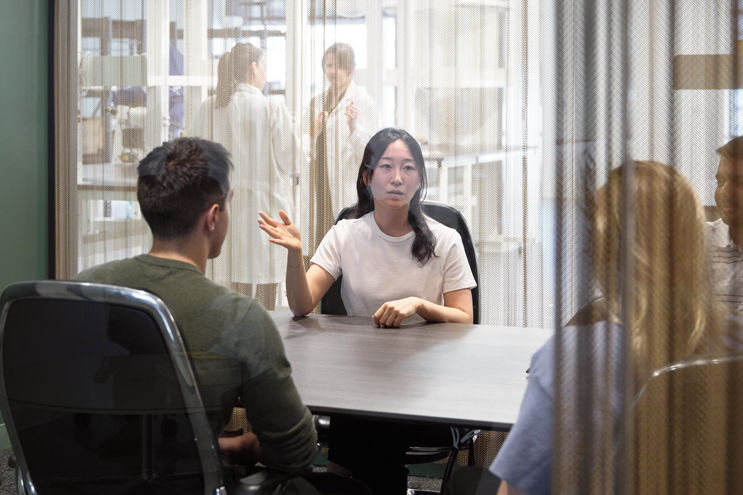
With the output of all those technologies, you get all this incredible new data. Often, those data are very complex to interpret and turn into something meaningfully valuable. So, we've co-located our dry lab group in the same physical space as our wet lab. By co-locating those two lab groups, we minimize the pillar effect you get when these two things are done in different areas.
Additionally, when we ask our bioinformatics folks and our clinical informatics folks to help us analyze the data coming off these complex systems and help put that specimen and those outcomes in the context of clinical care, the teams meet in a conference room that straddles the two laboratories, which really makes it a very efficient model for helping all of our research collaborations.
How would that process exist outside of this system? Why is that problematic?
At the typical regional cancer center or hospital, these resources don't exist for the vast majority of them. If you look at academic centers, the resources are often available but are aligned with a specific disease area, investigator, or department. The challenge is that resources are not easily accessible by folks who are doing research in other areas. The challenge is this pillar architecture. At Paul G. Allen, we’ve embraced an investigator-agnostic research infrastructure. We don't do disease-specific work in any single domain, nor do we do the work for a specific investigator. Our system allows us to evaluate the scientific principles of a project and how that project will relate to patient care.
How does the investigator-agnostic model work, and what are its advantages?
We have a review process to ensure that a project is scientifically sound, and then the same committee determines whether it is translational in nature. We have five standing reviewers. If it's outside our scientific expertise, we bring in other reviewers to help us. We've had reviewers from Harvard, Duke, Fred Hutchinson Cancer Center, and the University of Miami - among others.
Then, if project is translational in nature, we greenlight it for access to our laboratory infrastructure. Some may say we sound like a core lab facility, but in addition to lab work, my team of experts works with the investigators to develop the science, determine the feasibility and the systems necessary to operationalize the project. Often this development work involves identifying physician researchers who can mentor to create scientifically sound, impactful research plans.

Regarding the specimen collection, how do patients consent to specimens and data being collected and managed by the research center?
We'll submit an IRB request, and the patients are consenting to have their data and their biospecimens utilized for biobanking and patient disease history banking. They're collected under the principle that the patient agrees to future research. It all goes into the biorepository and the data repository, and then we have a separate IRB submission that allows researchers and their collaborators to reach in and pull those data or the biospecimens that they're interested in out of that repository.
We're still utilizing the same mechanics that you would use to build a biobank for a specific study, but we're making the patient consent more generalized so we can build a biorepository and a data repository for future scientific use.
In the time the center's been open, tell me about a time when you thought, "This is why we built this place."
CAR-T therapies require preconditioning to prepare the bone marrow space to receive the CAR. In the middle of the pandemic, fludarabine experienced a shortage, and that's the typical conditioning regimen. Out of necessity, a lot of sites pivoted to bendamustine to do the same preparation. People started to notice that patients got less sick from the bendamustine regimen than they did with the traditional fludarabine regimen. This is great — but only if the bendamustine does the same work and kills off part of the bone marrow to make room for the CAR to expand. The fundamental question is: Do they do the same job?
Because we have our own in-house flow cytometry, we were able to do flow cytometry on fresh blood and characterize both the amplitude and the persistence of the CAR-T therapy between bendamustine and fludarabine, as well as the immune system reaction. Within CAR-T therapy, there's solid evidence that the amplitude and persistence of the T cells in your system are the predictors of how likely you are to respond to the therapy.
Because we had all the in-house capabilities, we could do it prospectively with fresh specimens. The findings are that they look like they're pretty comparable. The industry standard for a zillion years has been fludarabine, so it'll be up to the sponsors whether they're willing to shift from fludarabine to bendamustine.
We're not alone in publishing in this space; Stanford did a fair bit of publishing. But the main difference between Stanford and us was that we were able to characterize fresh specimens, where they had done it with frozen specimens and were limited in their characterization of the immune response.
Looking at the center staff and current research, do you believe this type of environment fosters more innovative thinking?
The focus of this center is to remove or minimize traditional barriers that exist between healthcare centers working with academia and commercial partners, and to present collaborators with new opportunities for research.
For example, lots of sponsors have centralized laboratories, but there are scientific things that you can't do or make it very complex to do if you have to take a specimen from a clinical workflow at a healthcare center, then freeze it or fix it, and ship it to a centralized laboratory. We’ve turned the problem on its head. Tell us what analytics you want to do, and we'll figure out a mechanism to provide the specimen quality necessary for those analytics. It's going to shorten the path to innovation and care by minimizing the stuttered nature of the workflow that exists historically.
About The Expert:
 Douglas Kieper is a biomedical research professional with more than 25 years in academic, commercial, and government sectors. He is a recipient of the “Excellence in Technology Transfer” award from the Federal Laboratory Consortium for Technology Transfer (2001) and is recognized as one of the "Top 30 distinguished alumni" of the Old Dominion University School of Health Sciences.
His experience includes the invention, development, regulatory approval, and market launch of medical devices in several countries; clinical trial design for drugs, devices, and changes in practice; intellectual property development/management; proposal strategy for grants, contracts, and philanthropic instruments; and scientific program management. He has proven track record in the development of strong partnerships with key opinion leaders, colleagues, and subordinates while specializing in translating complex clinical, technical, and market data into target-specific communications.