
Site Staffing On The Upswing, But Still A Challenge
A conversation between Society for Clinical Research Sites (SCRS) Chief Site Success Officer Jimmy Bechtel, MBA, Tufts Center for the Study of Drug Development (CSDD) Executive Director Ken Getz, MBA, and Clinical Leader Executive Editor Abby Proch
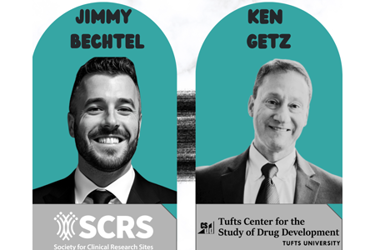
Good help may not be hard to come by, but it can be difficult for clinical research sites to retain. Thankfully, as Jimmy Bechtel, chief site success officer at SCRS, and Ken Getz, executive director of Tufts CSDD, explain, the site workforce is stabilizing after the hit it took during the COVID-19 pandemic.
Still, challenges remain in keeping site staff feeling valued and well paid when competition exists from within the research landscape.
In this final installment of Clinical Leader’s interview series with Jimmy and Ken, the two discuss how workforce pressures have shaped site performance and what’s being done to strengthen retention and career growth.
Clinical Leader: Sponsors are looking for top-tier sites when they're doing their budgeting and selecting their sites, but how does that happen? Tufts and SCRS data show as many as 42% of sites struggle with salary competition and 36% with career progression challenges. What kind of impact is this having on trial execution?
Jimmy Bechtel: As we've come out of the COVID-19 pandemic, which was really the height of this workforce challenge, we're starting to see those numbers trending in the right direction, which is sites are able to maintain a stronger workforce and less turnover. A lot of organizations have put time and effort into bolstering the workforce, so it's great to see that’s what we're seeing.
But the workforce challenges have, in fact, equated to not being able to conduct as many clinical trials and sites having to turn down studies because they did not have the staff to conduct them. We simply don't have the resources from a manpower perspective to execute that clinical trial. So, what do we do? The industry's kind of rallied around that and we're starting to see positive effects of all of that work translate into higher retention rates and lower turnover rates.
Does job competition exist within clinical research, such as competing with CROs or even sponsors, or within the wider healthcare industry?
Ken Getz: There are a wide variety of places where the workforce can be engaged in clinical trials. You have the small mom-and-pop healthcare provider settings that are dabbling in clinical research, and their staff may only be working part time in clinical research. So, they don't really have a good handle on what the typical salary might be. Academia typically pays low salaries for their research personnel. I can speak from direct experience there. But then you have the large site networks, some of which are now private equity funded, and they've really scaled. They're offering more competitive salaries where they can actually benchmark the salaries across the industry with similar sites.
And then you have people who look at the CRO industry; they're starting to see parity or competitive salaries if they were to move from a study coordinator to a study monitor role, for example. We're seeing some movement in personnel between the more mature scaled site and the CRO industry.
Jimmy, can you talk about what opportunities there are for folks working at the site and why they may choose to either stay with a site or seek a career progression elsewhere?
Bechtel: It's been really cool to see sites get creative with what they're able to do for some of their longstanding team members and provide them a career path. But when you look at the structure of a clinical research site, it remains relatively flat. If the organization gets bigger, it becomes more vertical in opportunity, but there are only a few of these multibillion-dollar site corporations. We only have so many roles at a site, and that doesn't really change unless the organization grows. And even then, that's not an overnight endeavor.

But the sites are managing what they can in different ways with this concept of work-life balance, extracurriculars, and other ways in which they can recognize and offer new opportunities to their team members when career progression doesn't exist in the more traditional sense.
How should we understand the relationship between a satisfied workforce and operational performance?
Getz: What we see as the top predictors of trial performance are all related to the complexity of the protocol design and the execution demands of the trial.
Bechtel: You can have these multimillion-dollar site corporations that have a role for every single possible thing, and they've got really buttoned up processes. And we still hear about poorly executed clinical trials from those organizations. And then you contrast that with a small site that has maybe four people and they're able to pull off really miraculous things with clinical trials. And the opposite is true as well. You have small sites that fail, and you have large sites that knock it out of the park with clinical trial execution. We don't have any correlative data that helps us understand what aspects of a clinical trial site make it ideal for executing a clinical trial because there's so much of the human element that goes into how things are ultimately performed.
Getz: And one thing I'll just add: I meet people all the time who are so passionate about clinical research and passionate about the integrity and the quality of the work they do. Even if they feel they're underpaid, even if they feel that the budgets are not adequate, they still set such high standards for themselves. And I think at the site level, you have people who just deeply care about the patient experience and their access to an investigational treatment. So, you have all of those dynamics that are so qualitative in nature but that play such an important role in the workforce in supporting clinical research.
Editor’s note: This transcript has been edited for clarity.
About The Experts:
 Jimmy Bechtel is the chief site success officer for the Society for Clinical Research Sites (SCRS). He is in charge of developing and executing the company's site-facing initiatives and works closely with key industry partners to build out various SCRS partnership programs. Bechtel brings experience from both the site and sponsor sides of the clinical research industry. In his site experience, he served as a data specialist, patient recruiter, and operations manager. In his pharma experience, he worked in innovation project management, encouraging a site-centric environment and creating ease for sites working with a major sponsor company.
 Ken Getz is the executive director of the Tufts CSDD and a research professor at the Tufts University School of Medicine. He is an internationally recognized expert on pharmaceutical R&D management and execution, protocol design, contract service provider and investigative site management, eClinical technology and data usage, and patient engagement. A well-known speaker at conferences, symposia, universities, investor meetings, and corporations, Ken has published extensively in peer-reviewed journals, books, and in the trade press. He holds board appointments in the private and public sectors. He received his MBA from Northwestern University and his bachelor’s degree from Brandeis University. Ken is also the chairman of CISCRP — a nonprofit organization that he founded to educate and raise public and patient awareness of the clinical research enterprise — and the founder of CenterWatch, a leading publisher in the clinical trials industry and one of several businesses that he has sold.