
The New Clinical Trial Regulatory Landscape Balances Speed, Quality, and Compliance — Are You Ready?
By Sapna Rani, Lead Analyst, Beroe Inc, and Shaun Hastings, Quality Assurance Professional

Global clinical trial regulators are shifting their focus toward risk-based oversight, stronger data governance, and greater acceptance of digital innovation. ICH E6(R3) is reinforcing this transition through quality by design, proportional oversight, sponsor accountability, and fit-for-purpose technology. At the same time, decentralized procedures, digital endpoints, AI-enabled tools, and complex service-provider networks are expanding regulatory responsibilities beyond traditional QA functions. Compliance increasingly needs to be embedded in protocol design, technology validation, supplier oversight, and trial operations. What’s more, regulatory reforms are also supporting real-time and accelerated clinical development.1,2
How Compliance Is Changing
Historically, clinical-trial compliance relied heavily on documentation, monitoring, procedural checks, and retrospective evidence. While these controls remain important, they were developed for a simpler clinical environment.
Modern trials now involve CROs, laboratories, eCOA/eConsent, IRT/RTSM, imaging, cloud platforms, decentralized services, wearables, recruitment providers, and subcontractors. As protocols and data flows become more complex, regulatory emphasis is shifting from uniform controls toward identifying and managing risks that materially affect participant safety and data integrity.
ICH E6(R3) reflects this transition by emphasizing quality by design and proportionate, risk-based oversight. Sponsors are expected to identify critical-to-quality factors during planning and apply controls according to their potential impact. Significant risks, such as dosing errors, consent failures, or missing primary endpoint data, therefore require greater attention than minor administrative deviations.3
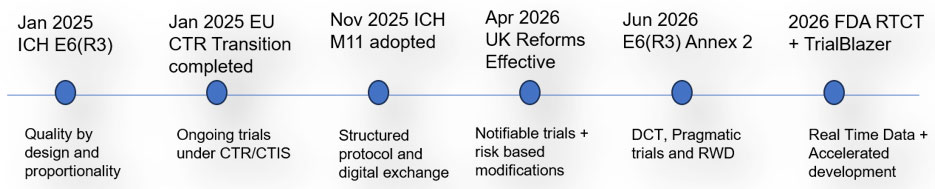
Figure 1. Selected Regulatory Milestones Reshaping Clinical Trials
Sources: Beroe Analysis, ICH, FDA, EMA
Annex 2, adopted at ICH Step 4 on June 3, 2026, extends these principles to decentralized trials, pragmatic approaches, and real-world data, reflecting the growing use of remote assessments, direct-to-patient activities, healthcare-derived data, and digital endpoints.4
ICH M11 CeSHarP, adopted for implementation in November 2025, introduces a harmonized protocol structure and technical specification. Machine-readable protocols could allow information to be reused across EDC, CTMS, IRT, eCOA, safety, and supply systems rather than repeatedly interpreted and re-entered.5
For sponsors, this could accelerate study build, reduce configuration errors, improve interoperability, and support more consistent execution. Over time, M11 could provide a foundation for greater trial automation by connecting clinical intent directly with operational systems.6
Why Traditional Compliance Models Fall Short
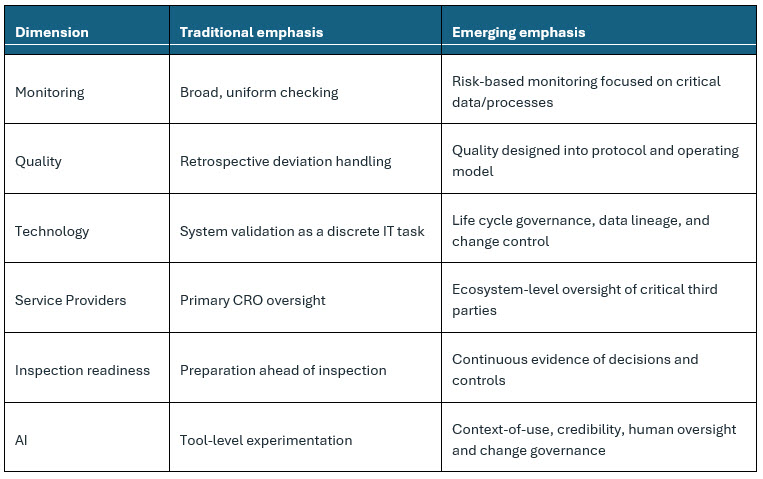
Clinical trial compliance has traditionally relied on documentation, monitoring, and procedural controls. As trials become more complex and digitally enabled, regulatory focus is shifting toward risks that materially affect participant safety and data integrity.
ICH E6(R3) reinforces this change through quality by design and proportionate, risk-based oversight. Sponsors are expected to identify critical-to-quality factors early and apply controls according to their potential impact
Table 1. Traditional versus emerging compliance model
Sources: Beroe Analysis
Digital risk can be easy to overlook because trial data often passes through several systems before it is analyzed. An endpoint may start in a device or site system, move through a service provider platform or application programming interface (API), enter the clinical database, and then reach the analysis environment.
At each step, the data may be mapped, transformed, versioned, or processed automatically. Sponsors therefore need to understand the full data trail where the data originated, how it changed along the way, and where those changes were made.

AI Turns Technology Governance Into Quality Governance
The FDA’s 2025 draft guidance emphasizes context of use and model credibility, while EMA highlights human oversight, fit-for-purpose data, bias, generalizability, and life cycle controls.7,8 AI governance should be embedded within clinical quality systems. Where AI influences eligibility, dosing, endpoints, safety, or regulatory evidence, sponsors need clear controls for intended use, data provenance, validation, human oversight, versioning, and change management.9
As digital technologies and AI become embedded across clinical trial operations, regulatory scrutiny is shifting from the technology itself to the effectiveness of sponsor governance. Inspectors are less interested in whether a platform is innovative and more focused on whether it is validated, controlled, and capable of protecting participant safety and data integrity. The key question is simple: Can the sponsor demonstrate that the system is reliable and fit for purpose?
One of the most common inspection gaps remains system validation. Sponsors often rely heavily on service provider documentation without demonstrating that a system has been appropriately assessed, configured, and validated for its intended use within a specific trial. Regulators increasingly expect validation to be a life cycle activity supported by risk assessments, change control, periodic review, and ongoing monitoring, not a one-time implementation exercise.
The growing use of AI introduces additional expectations around transparency and accountability. Sponsors must be able to explain how AI models are developed, validated, monitored, and governed. Regulatory concern is less about the use of AI itself and more about whether organizations understand its limitations, manage potential bias, and maintain meaningful human oversight of AI-driven decisions.
Data integrity continues to be a major inspection focus. Deficiencies in audit trails, data lineage, and record traceability remain common findings. Regulators expect sponsors to demonstrate who changed data, when changes occurred, why they were made, and how critical trial activities can be reconstructed from the available records. Technology investments alone are insufficient without robust oversight and review processes.
Service provider oversight is another area attracting increased scrutiny. As sponsors rely on a growing network of technology providers, cloud platforms, and specialized service partners, regulators expect clear evidence of qualification, governance, performance monitoring, and change management. While activities can be outsourced, accountability cannot.
Access controls and cybersecurity fundamentals remain critical. Shared accounts, excessive system privileges, and weak access management continue to undermine confidence in electronic records. Inspectors expect robust user life cycle management, role-based access controls, and routine access reviews.
Risk-based quality management and advanced analytics are also creating new expectations. Sponsors must be able to justify how risks were identified, monitored, and mitigated, particularly where algorithms or AI influence monitoring priorities or operational decisions. Increasingly, regulators want evidence that critical decisions are data-driven, documented, and traceable.
Ultimately, inspection readiness comes down to governance. Sponsors should be able to clearly explain how each critical digital system is validated, controlled, monitored, and overseen, and how the integrity of the data it generates is assured. Those that can demonstrate a clear line of accountability, robust controls, and end-to-end traceability are best positioned to meet regulatory expectations in an increasingly digital and AI-enabled clinical trial environment
Speed Is Becoming A Regulatory Objective
In 2026, regulators are increasingly supporting faster clinical development through more risk-proportionate review.
- In the U.K., reforms effective from April 28, 2026 introduced a more flexible approval framework, including automatic authorization for eligible notifiable trials and clearer distinctions between substantial and minor modifications. The MHRA Phase 1 pilot also aims to reduce first-assessment timelines for qualifying lower-risk studies from 28 to 14 days by the end of 2026.10
- Europe is focusing on harmonization through the Clinical Trials Regulation and CTIS, which provide a single digital route for multinational submissions. The 2026–2027 ACT EU workplan further supports more consistent trial execution, patient involvement, and timely disclosure.
- In the U.S., FDA initiatives such as real-time clinical trial programs, Operation TrialBlazer, and the proposed Expedited IND pilot point toward earlier and more continuous regulatory interaction.11
Together, these changes mean sponsors must be continuously review-ready, with high-quality, traceable, and well-governed data available earlier in the trial life cycle.
How Do Sponsors Meet The Challenge?
Exactly how that’s done has been left for sponsors to figure out — until now. In part two of this series on regulatory readiness in modern clinical trial environment, Beroe experts present a framework that balances speed, quality, and compliance.
References:
- https://database.ich.org/sites/default/files/ICH_E6%28R3%29_Step4_FinalGuideline_2025_
0106.pdf - “China’s Trial Advantage: Tracking Nation’s Growth in Pharma Innovation and Global Investment,” June 2025. [Online]. Available: https://www.pharmexec.com/view/china-s-trial-advantage-tracking-nation-s-growth-in-pharma-innovation-and-global-investment. [Accessed 2026].
- https://database.ich.org/sites/default/files/ICH_E6%28R3%29_Annex%202_Guideline_Step%
204_2026_0603_0.pdf - https://database.ich.org/sites/default/files/ICH_E6%28R3%29_Step4_FinalGuideline_2025_
0106.pdf - https://database.ich.org/sites/default/files/ICH%20M11%20Explainer_May2026.pdf
- S. Z. ,. Z. Y. ,. C. Y. ,. G. H. ,. J. Z. ,. J. Z. Ruirong Tan Hua Hua, “Current landscape of innovative drug development and regulatory support in China,” PubMed, 2025.
- https://www.fda.gov/news-events/press-announcements/fda-announces-major-steps-implement-real-time-clinical-trials
- https://www.ema.europa.eu/en/human-regulatory-overview/research-development/clinical-trials-human-medicines/accelerating-clinical-trials-eu-act-eu
- Use of Artificial Intelligence (AI) in the medicinal product lifecycle - Scientific guideline,” [Online]. Available: https://www.ema.europa.eu/en/use-artificial-intelligence-ai-medicinal-product-lifecycle-scientific-guideline
- “Launch of clinical trial reforms,” [Online]. Available: https://www.gov.uk/government/news/launch-of-clinical-trial-reforms.
- “FDA Actions to Accelerate and Modernize Early and Late-Stage Clinical Development,” [Online]. Available: https://www.fda.gov/industry/fda-actions-accelerate-and-modernize-early-and-late-stage-clinical-development.
Note: Shaun Hastings' view and opinions expressed in this article his own and do not necessarily represent that of the company he works for or the company's practices.
About The Authors:
 Sapna Rani is a category research analyst with over 10 years of experience in market research and consulting. Her insights have enabled top pharma companies in their strategic decisions on supplier outsourcing, category management, and planning. In the past year, she supported more than 20 market sourcing studies, eight supplier data visualizations, and multiple quick reactive analyses across clientele for global and regional requirements.
 Shaun Hastings has over 25 years of experience in clinical research and quality assurance. A graduate of Cranfield University and a member of the Research Quality Association (RQA), he specializes in GCP compliance, quality management systems, inspection readiness, and service provider oversight. His professional interests include digital transformation, AI governance, and advancing quality culture within regulated clinical research environments.