
The U.S. Clinical Trial Recruiting Pipeline Report – August 2026
By Andrew Beauchamp, WhichTrial.com

How have the number and type of clinical trials coming in and out of the U.S. pipeline changed over the past few months? To find out, Find Clinical Trials by WhichTrial.com developed the July-August version of its pipeline report. The site also offers a free tool for patients, providers, and researchers to learn more about the current trial landscape as reported by Clinicaltrials.gov.
The following August 2026 report breaks down which drug trials are growing the most and the least, drugs that are no longer being studied, and new drugs into the clinic from July to August.
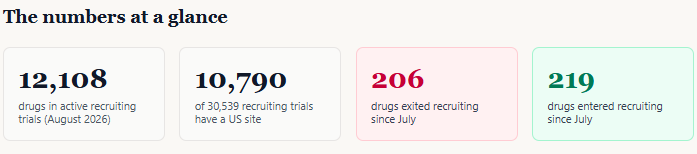
One month of change. The recruiting pipeline grew by 13 drugs on net. One hundred and seventy-four drugs picked up additional recruiting trials, 162 lost ground but kept at least one open study, and 11,553 held flat. That makes this a quiet month by the numbers, so the tables below are followed by two things worth more than the deltas: a spotlight on pumitamig, which has expanded to 21 recruiting trials across 32 conditions while still sitting on only two sponsors, and a continuity check on the drugs we've tracked since Issue 3, where two of the last issue's three calls did not hold.
A scope correction, starting this issue. We track every trial recruiting worldwide for these 17 conditions, but we only record trial sites located in the United States. Those are different populations, and earlier issues reported the worldwide count without saying so. Of the 30,539 trials recruiting for these conditions right now, 10,790 have at least one U.S. site you could enroll in. The remaining 19,749 are running entirely outside the U.S. Drug-level counts throughout this report are worldwide unless stated otherwise; where a drug's U.S. footprint differs sharply from its worldwide one, we now say so.
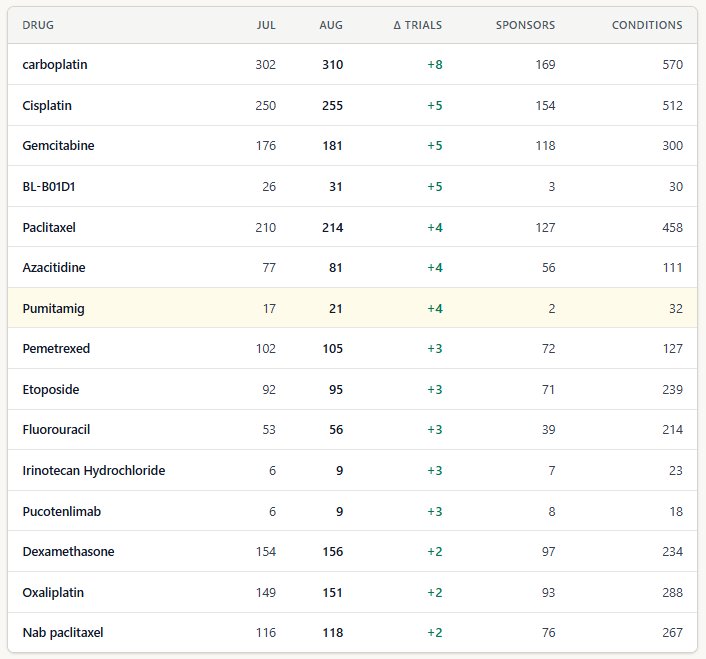
Top Gainers
Drugs that added the most recruiting trials between July and August. Over a single month the moves at the top of this list are small by nature — a few trials each, and much of the top of the table is chemotherapy backbone shifting with combination arms. Pumitamig, highlighted below, is this month's spotlight.
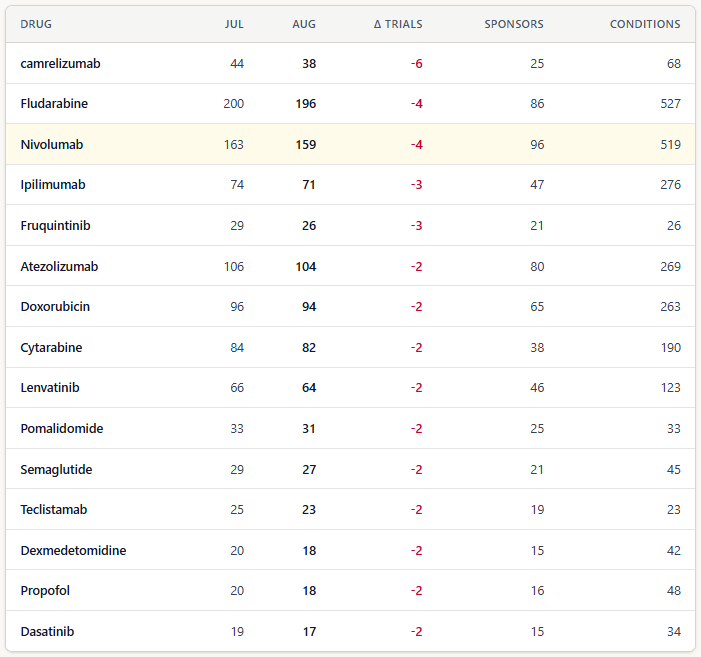
Top Losers
Drugs that lost the most recruiting trials but still have at least one study open. A drop here means trials have moved out of the recruiting phase — either they completed enrollment, were terminated, or moved to active-not-recruiting status. Nivolumab's continued slide (see the continuity check below) shows up here.
Spotlight: This Month’s Mover
Pumitamig is scaling fast on two sponsors, and the split between them has flipped
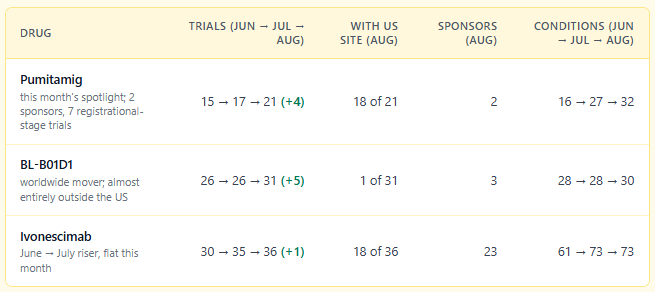
In a month this quiet, the largest single gain in the whole data set is eight trials, and most of the gainer table is chemotherapy backbone moving with combination arms rather than any drug story. Pumitamig is the exception worth reading closely. It has gone from 15 recruiting trials in June to 17 in July to 21 now, and the indications it is being run against have doubled over the same stretch, from 16 conditions to 32. Its sponsor count has not moved at all: two, every month.
That combination is the interesting part. A drug expanding this fast usually picks up investigator-sponsored studies and academic centers along the way, which shows up as sponsor growth. Pumitamig has not. The expansion is happening entirely inside two organizations, and the split between them has inverted. Bristol-Myers Squibb now runs 12 of the 21 recruiting trials to BioNTech's nine. Seven of the 21 are at registrational stage: four in Phase 3 and three in Phase 2/3, with another five in Phase 2 and nine in Phase 1/2.
Two sponsors carrying 21 trials between them, with a third of those already at Phase 3 or Phase 2/3, is the shape of a program being scaled deliberately rather than one drifting outward through investigator interest. Whether that holds is the call we will check next issue: If the sponsor count stays at two while trials keep climbing, this is a two-company push. If sponsors start rising, the program is broadening.
It also matters where those trials are. Eighteen of pumitamig's 21 recruiting trials have a U.S. site, so this is an expansion you can actually see in American hospitals rather than one happening offshore. BL-B01D1 makes the contrast. On the worldwide numbers it is the month's largest mover at plus five (26 to 31), and 29 of those 31 trials are run by Sichuan Baili Pharmaceutical itself, with six in Phase 3. But exactly one of the 31 has a U.S. site. It is a substantial program that is, for now, almost entirely outside the United States, and it would be misleading to file it as movement in the U.S. pipeline.
Ivonescimab, the fast riser in last month's data, has stopped. It added one trial in August (35 to 36) with sponsors and conditions both perfectly flat at 23 and 73, and half its trials (18 of 36) carry a U.S. site.
Note: For anyone tracking the obesity/metabolic space: Ribupatide entered our snapshot in July with a single trial and now has three, all Phase 3, all run by Kailera. It arrives in the same month retatrutide falls to a single recruiting study.
Spotlight: Continuity Check
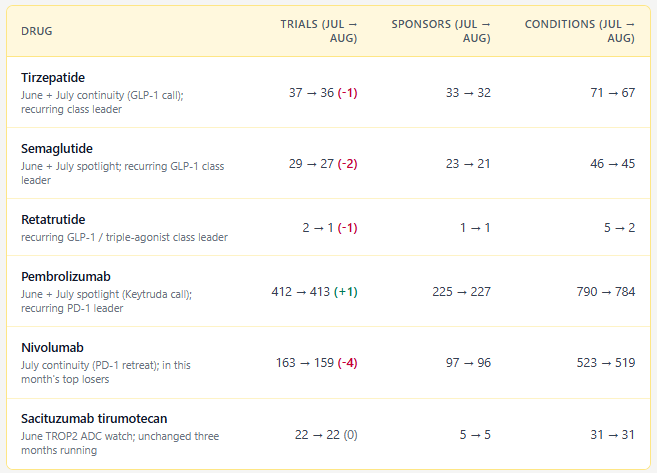
Issue 3 said the GLP-1 class was growing on the back of its two leaders. One month later, that reversed. Semaglutide gave back half of July's gain, falling from 29 recruiting trials to 27, with sponsors back down to 21, exactly where June started. Tirzepatide did the same thing one month later than expected: 36 trials and 32 sponsors, both back to their June levels. The signal that did persist is the one we noted in passing, which is condition breadth. Tirzepatide has been tested against a narrowing set of indications in each of the last two snapshots, 72 to 71 to 67, even while its trial count went up and then back down. Retatrutide is down to a single recruiting study on two conditions, from three studies and seven conditions in June.

The Keytruda call stalled outright. Pembrolizumab added a trial and two sponsors this month after losing 13 and 11 respectively in July. Its condition count kept falling, though, from 790 to 784. That is the fourth consecutive snapshot of narrowing indication breadth, running 851 to 833 to 820 to 790 to 784 since March, and this is the first of those months where the trial count did not fall with it. If a retreat is still underway, it is now in what the drug is being tested against rather than how much of it is being tested. Nivolumab is the cleaner version of that trend and it did keep sliding, down another four trials to 159.
The TROP2 ADC watch has produced nothing at all. Sacituzumab tirumotecan has been frozen at 22 trials, five sponsors, and 31 conditions for three consecutive snapshots. That is worth stating plainly rather than quietly dropping: A watch item that does not move for three months is a finished story until something changes.
Note: A general caution on reading any of this. The largest single monthly move in this issue is eight trials out of a base of 30,539, and 11,553 of the 11,889 drugs present in both snapshots did not move at all. Month-over-month deltas at this magnitude are mostly noise. The multi-month direction of travel, which is what the condition-breadth numbers above are showing, is the part worth acting on.
Drugs That Left Recruiting
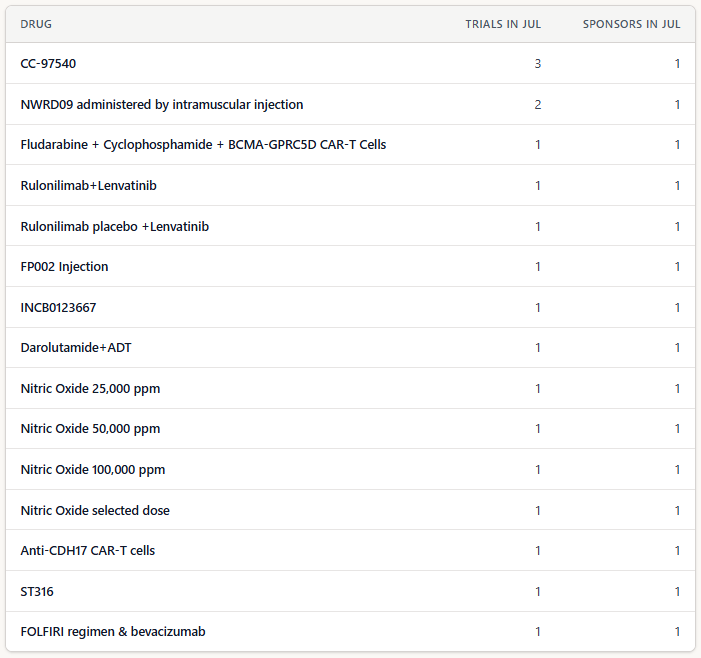
Two hundred and six drugs that had at least one recruiting trial in July no longer do in August. Over a one-month window these are typically long-tail compounds with one or two trials that wrapped enrollment.
New Entrants
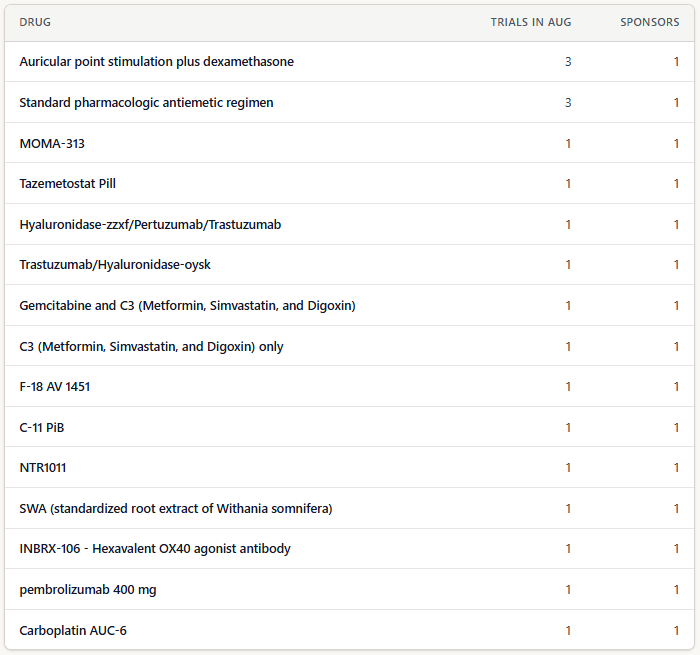
Two hundred and nineteen drugs began recruiting between July and August that hadn't previously appeared in our snapshot. As usual, most are early-phase, single-sponsor studies — first signals of new programs.
NEW: Who Is Actually Running The Trials
Every issue so far has looked at drugs. We have always recorded which organization leads each trial and never once used it, so from this issue we do. One caveat up front: This is a photograph, not a trend. We only began recording sponsor history with this month's data, so there are no month-over-month figures to report yet. Issue 5 will have them.
In the U.S., 2,468 organizations are running the 10,790 trials recruiting at U.S. sites. The field is far more concentrated at the top and far more fragmented at the bottom than the raw count suggests: the 10 largest run 19% of everything open, while 1,660 organizations, two-thirds of all sponsors, are running exactly one trial each.
The composition of that top 10 is the finding. It is almost entirely academic medical centers and government bodies. AstraZeneca is the highest-placed company, in seventh, and it is the only company in the top 10. The percentage below is how much of an organization's work sits in its single biggest condition, which separates the specialists from the generalists. Every one of Memorial Sloan Kettering's 295 trials is a cancer trial, where fewer than half of the University of Colorado's are. Conditions overlap, so a trial can count toward more than one and the percentages do not sum to 100 across a row.
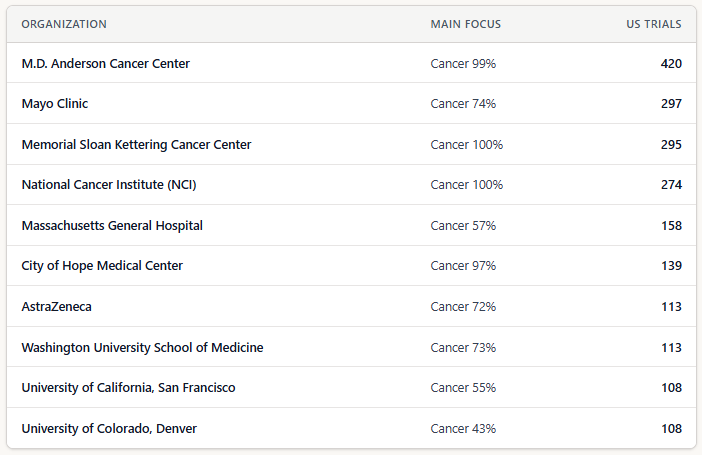
Note: These are lead sponsors only. ClinicalTrials.gov records one lead sponsor per trial and does not let us count collaborators, so every figure here understates how involved an organization really is. The full rankings cover the top 25 and how the whole field is distributed.
About This Report:
Data source. All figures are derived from the public ClinicalTrials.gov registry, queried monthly across 17 condition categories.
Worldwide trials, U.S. sites. Our query is not restricted by country, so the trial counts here cover everything recruiting for these conditions anywhere in the world. We only store site locations that are in the United States, across ~50 metro areas. A trial therefore counts toward our totals whether or not you could enroll in it domestically, and 10,790 of 30,539 currently have a U.S. site. Issues 1 through 3 reported the worldwide figure under a U.S. heading without drawing this distinction; the numbers in those issues were correct as worldwide counts, but the label was not. The condition and city pages elsewhere on this site have always filtered to trials with a U.S. site.
A note on the window. This issue compares consecutive months (July → August), the same one-month cadence as Issues 2 and 3. Deltas over a single month are naturally smaller than the two-month window Issue 1 covered — read the magnitudes here against that shorter window.
What “recruiting” means. A trial is recruiting when ClinicalTrials.gov flags its overall status as RECRUITING. When a trial no longer appears in our monthly fetch, we mark it as “not recruiting” — it may have completed enrollment, been suspended, terminated, or moved to active-not-recruiting status. We don't distinguish between those states in the aggregates above.
What “exited” means. A drug exited recruiting if it had at least one trial flagged RECRUITING in July 2026 and has zero such trials in August 2026. The drug itself isn't gone — its open trial pipeline is.
Limitations. Our extraction filters out generic terms (placebo, chemotherapy, radiation, saline) and intervention names longer than 60 characters, so very long trial-arm descriptions aren't counted as drugs. Some drugs appear under multiple aliases; we deduplicate where we can.
A version of this report first appeared on Find Clinical Trials by WhichTrial.com. It is republished here with permission.