
The U.S. Clinical Trial Recruiting Pipeline Report – July 2026
By Andrew Beauchamp, WhichTrial.com

How have the number and type of clinical trials coming in and out of the U.S. pipeline changed over the past few months? To find out, Find Clinical Trials by WhichTrial.com developed the May-June version of its pipeline report. The site also offers a free tool for patients, providers, and researchers to learn more about the current trial landscape as reported by Clinicaltrials.gov.
The following July 2026 report breaks down which drug trials are growing the most and the least, drugs that are no longer being studied, and new drugs into the clinic from June to July.
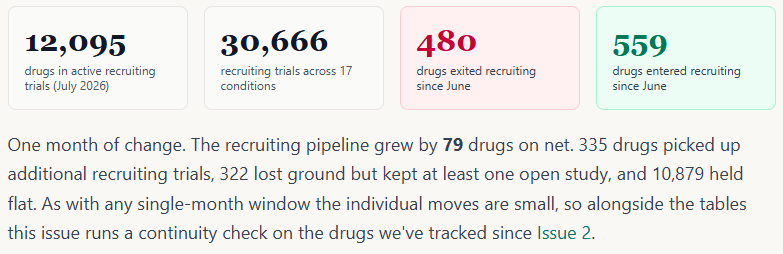
One month of change. The recruiting pipeline grew by 79 drugs on net. Three hundred and fifty-five drugs picked up additional recruiting trials, 322 lost ground but kept at least one open study, and 10,879 held flat. As with any single-month window, the individual moves are small, so alongside the tables, this issue runs a continuity check on the drugs we've tracked since the last report.
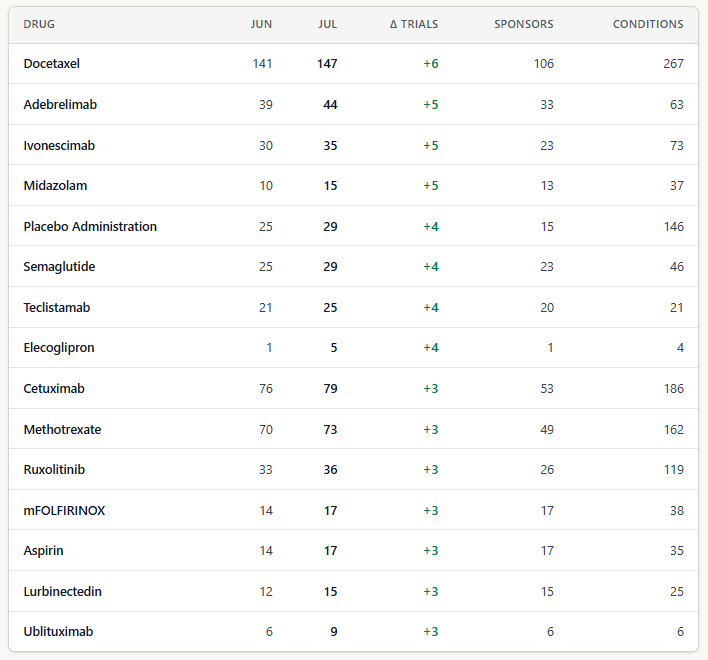
Top Gainers
Drugs that added the most recruiting trials between June and July: Over a single month the moves at the top of this list are small by nature — a few trials each. The continuity check below tests the drugs we've been tracking against the fresh data.
Top Losers
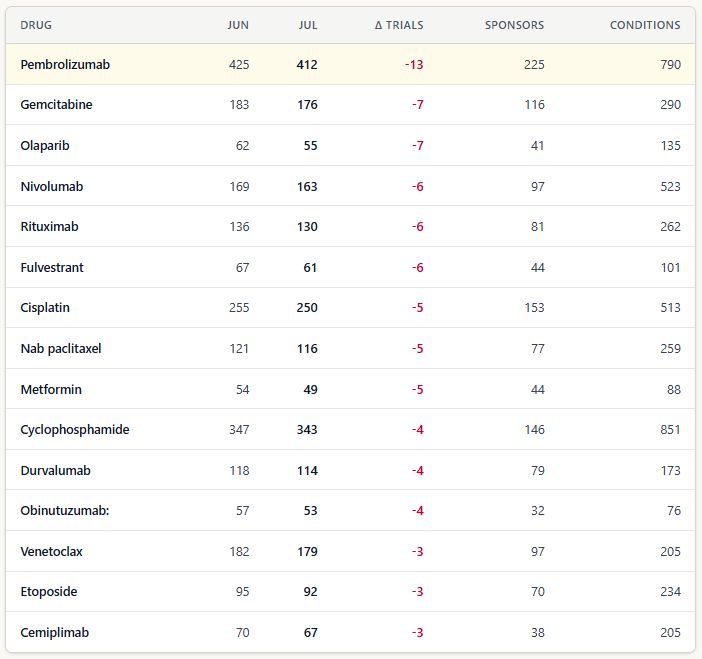
Drugs that lost the most recruiting trials but still have at least one study open: A drop here means trials have moved out of the recruiting phase — either they completed enrollment, were terminated, or moved to active-not-recruiting status. Pembrolizumab's continued slide (see below) shows up here again.
Spotlight: Continuity Check
The drugs we've been tracking, one month on
Last issue’s GLP-1 call holds, with a caveat. Semaglutide added four recruiting trials (25 to 29) and picked up two sponsors and two more conditions, the clearest expansion in the group. Tirzepatide barely moved, up one trial and one sponsor. Retatrutide went the other way, falling from three trials to two and from seven conditions to five, still on a single sponsor. The class is growing on the back of its two leaders rather than broadening out.
The Keytruda call played out again, and the shape of it matters more than the headline. Pembrolizumab lost 13 recruiting trials (425 to 412), but its sponsor and condition counts fell harder: 236 sponsors down to 225, and 820 conditions down to 790. Fewer organizations are running it against a narrower set of indications, which is a wider retreat than the trial count alone suggests. Nivolumab shows the same pattern at smaller scale, down six trials and eight sponsors. This does not look like one program winding down. The PD-1 backbone is contracting across the board.
The TROP2 ADC watch is the quiet one. Sacituzumab tirumotecan sat perfectly still at 22 trials, five sponsors, and 31 conditions, unchanged from June in every column. For a drug we flagged as one to watch, a month of zero movement in either direction is its own kind of signal. Toripalimab kept up its slow climb, adding a trial, a sponsor, and three conditions.
Drugs That Left Recruiting
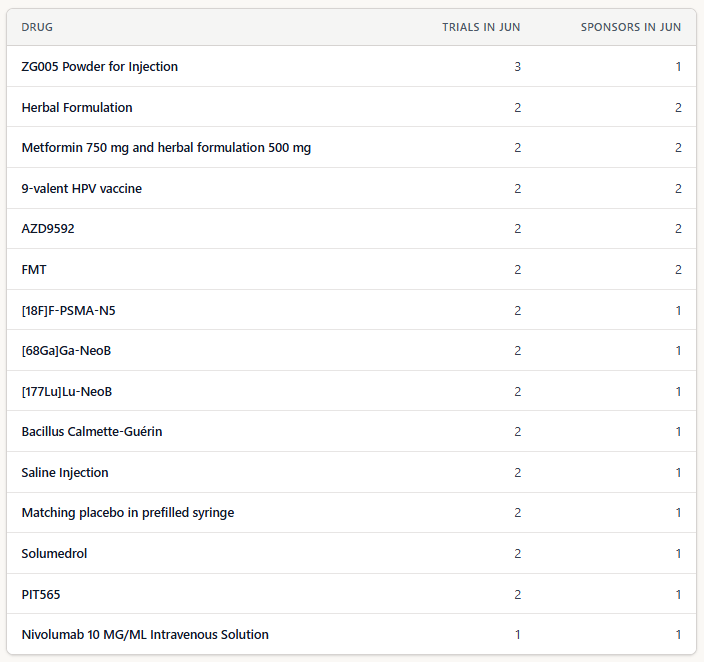
Four hundred and eighty drugs that had at least one recruiting trial in June no longer do in July. Over a one-month window, these are typically long-tail compounds with one or two trials that wrapped enrollment.
New Entrants
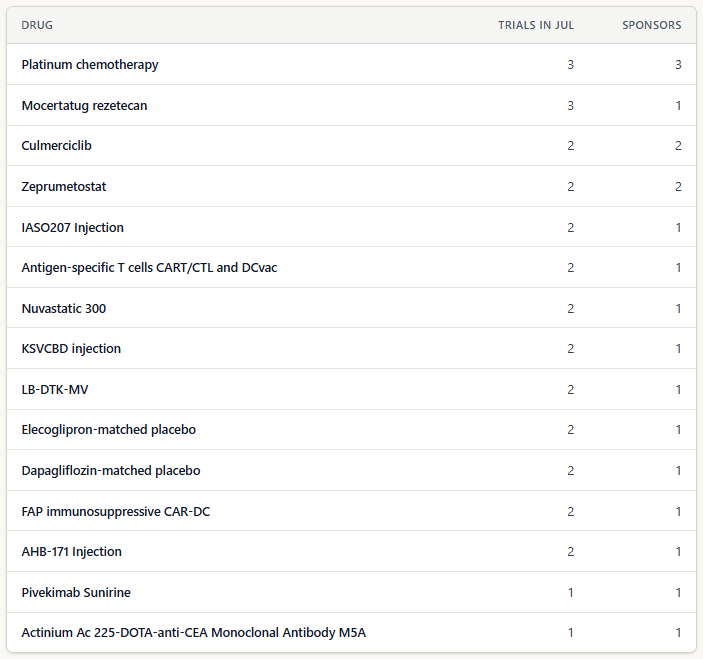
Five hundred and fifty-nine drugs began recruiting between June and July that hadn't previously appeared in our snapshot. As usual, most are early-phase, single-sponsor studies — first signals of new programs.
About this report:
Data source. All figures are derived from the public ClinicalTrials.gov registry, queried monthly. We track U.S.-based recruiting trials across 17 condition categories and ~50 metro areas.
A note on the window. Issue 1 compared two snapshots two months apart (March to May). This issue compares consecutive months (June to July), so the deltas are naturally smaller — a one-month change captures less program turnover than a two-month one. Read the magnitudes here against that shorter window, not against the first issue's.
What “recruiting” means. A trial is recruiting when ClinicalTrials.gov flags its overall status as RECRUITING. When a trial no longer appears in our monthly fetch, we mark it as “not recruiting” — it may have completed enrollment, been suspended, terminated, or moved to active-not-recruiting status. We don't distinguish between those states in the aggregates above.
What “exited” means. A drug exited recruiting if it had at least one trial flagged RECRUITING in May 2026 and has zero such trials in June 2026. The drug itself isn't gone — its open trial pipeline is.
Limitations. Our extraction filters out generic terms (placebo, chemotherapy, radiation, saline) and intervention names longer than 60 characters, so very long trial-arm descriptions aren't counted as drugs. Some drugs appear under multiple aliases; we deduplicate where we can.
A version of this report first appeared on Find Clinical Trials by WhichTrial.com. It is republished here with permission.