
The U.S. Clinical Trial Recruiting Pipeline Report – June 2026
By Andrew Beauchamp, WhichTrial.com

How have the number and type of clinical trials coming in and out of the U.S. pipeline changed over the past few months? To find out, Find Clinical Trials by WhichTrial.com developed the May-June version of its pipeline report. The site also offers a free tool for patients, providers, and researchers to learn more about the current trial landscape as reported by Clinicaltrials.gov.
The following June 2026 report breaks down which drug trials are growing the most and the least, drugs that are no longer being studied, and new drugs into the clinic from May to June.
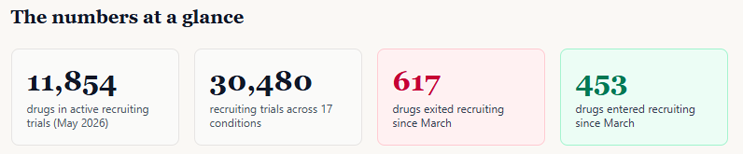
The numbers at a glance
The period included one month of change and a quiet one. The recruiting pipeline grew by 162 drugs on net. Two hundred and forty-two drugs picked up additional recruiting trials, 195 lost ground but kept at least one open study, and 11,236 held flat. Over a single month the individual moves are small — the headline is continuity, not upheaval – so this column revisits the two calls we made in Issue 1.
Top Gainers
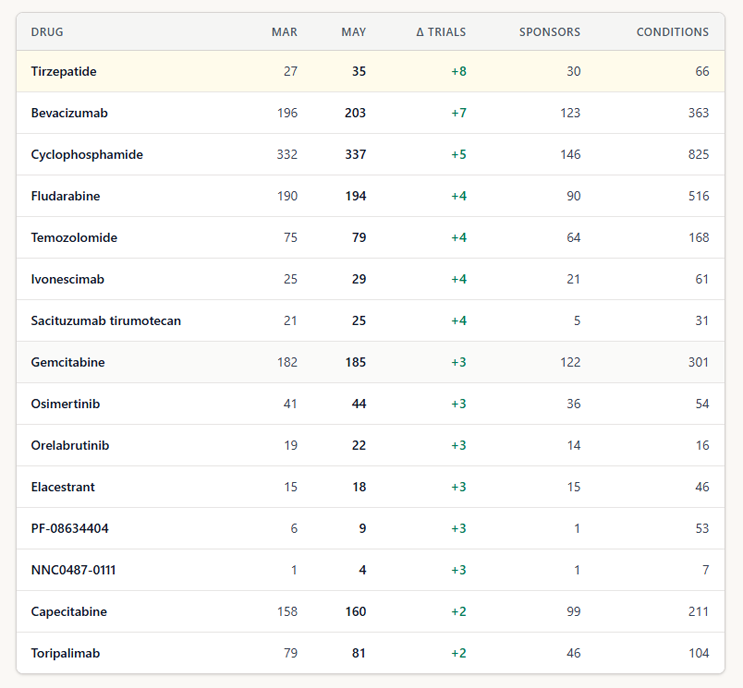
Drugs that added the most recruiting trials in May and June: Over a single month, the top of this list is just cytotoxic backbones drifting up a few trials each — cyclophosphamide, fludarabine, and capecitabine. There's no breakout mover this month; the real story is in the continuity check below, where last issue's two calls get tested against fresh data.
Top gainers
Top Losers
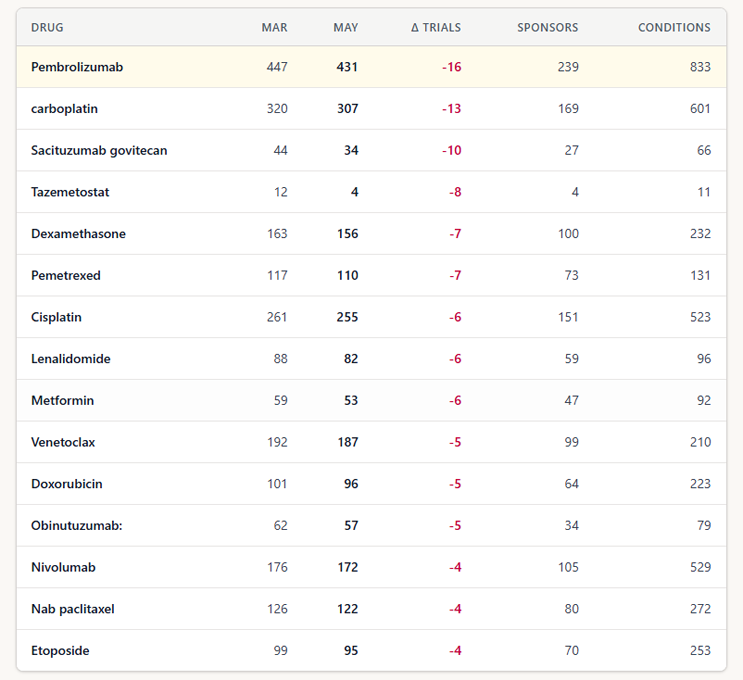
Drugs that lost the most recruiting trials but still have at least one study open: A drop here means trials have moved out of the recruiting phase — either they completed enrollment, were terminated, or moved to active-not-recruiting status. Pembrolizumab's continued slide (see below) shows up here again.
Top losers
Spotlight: Continuity Check
Two calls, one month later: the tirzepatide surge cooled, the Keytruda slide held
In the last issue, we made two specific calls. The first was tirzepatide as mover of the month, surging from 27 actively-recruiting U.S. trials in March to 35 in May. In June it added just one — 35 to 36. The surge has flattened. But the spread underneath it continued: distinct sponsors running tirzepatide studies rose from 30 to 32, and the number of indications attached to those trials widened from 66 to 72. So, the drug is still diffusing into new disease areas even though net new trial starts paused for the month. The rest of the GLP-1 class stayed quiet, too — semaglutide added two (23 to 25) and retatrutide held at three. Read: The March-to-May acceleration looks like a two-month pulse rather than the start of a sustained ramp. Whether July resumes it is exactly the kind of thing a monthly cadence is built to catch.
The second call was a “plateau watch” on Keytruda, down from 447 to 431 recruiting trials across the two-month window. June extends the slide: 431 to 425, another minus 6, with the number of indications attached falling from 833 to 820. At roughly six to eight trials a month, the decline is steady rather than accelerating — consistent with a maturing IV franchise whose investigator-led combination studies are reaching their enrollment caps. Around it, the PD-1/PD-L1 field tilted slightly negative this month: nivolumab minus 3, atezolizumab minus 4, cemiplimab minus 2, and durvalumab flat. The exceptions were the China-origin checkpoint inhibitors, which kept gaining — toripalimab plus 3 (81 to 84) and tislelizumab plus 2 (88 to 90).
One reversal is worth flagging against the last issue. Sacituzumab tirumotecan (sac-TMT), the Merck/Kelun TROP2 antibody-drug conjugate we noted growing at plus 4 in the March-to-May window, gave back three trials this month (25 to 22) on an unchanged five sponsors — a reminder that at these trial counts a single month of ADC movement is well within the noise band. That is the broader takeaway for June: two calls tested, both broadly holding, and a board that otherwise moved no more than registry churn would predict. A quiet month is still a data point.

Drugs That Left Recruiting
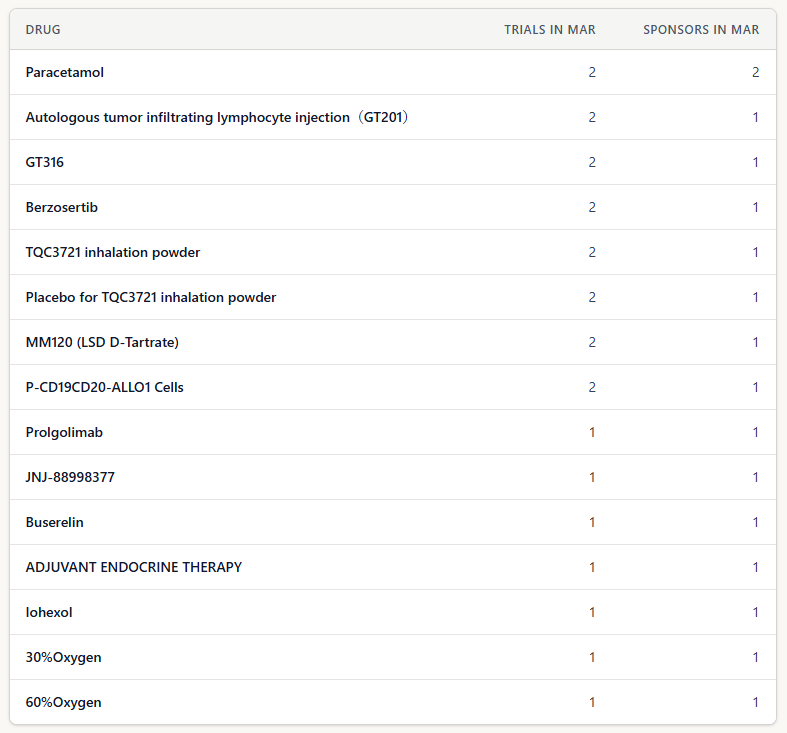
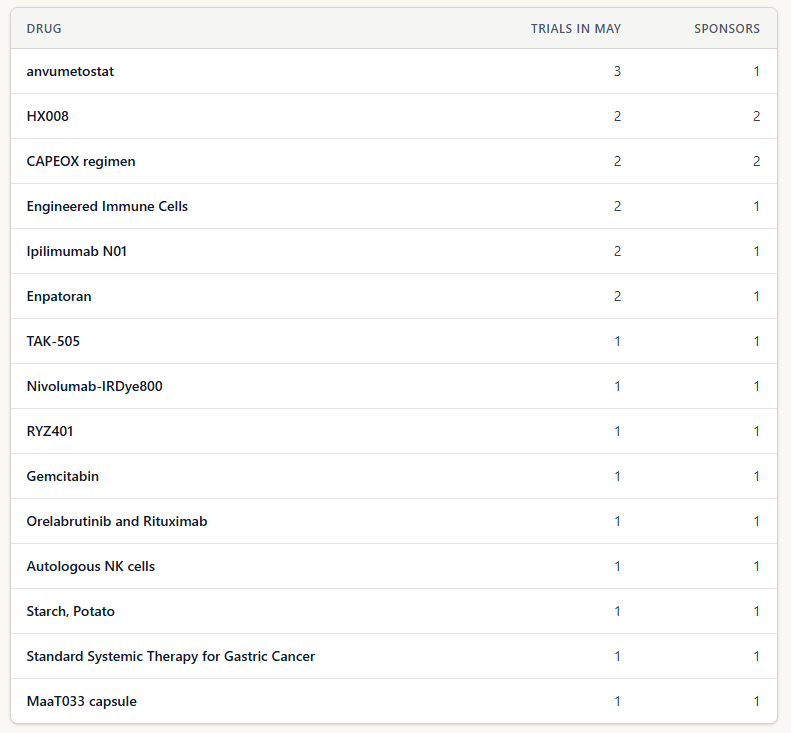
One hundred and eighty-one drugs that had at least one recruiting trial in May no longer do in June. Over a one-month window, these are almost entirely long-tail compounds with one or two trials that wrapped enrollment — no clinically marquee program left the board this month.
Drugs that left recruiting
New Entrants
Three hundred and forty-three drugs began recruiting between May and June that hadn't previously appeared in our snapshot. As usual, most are early-phase, single-sponsor studies — first signals of new programs.
New entrants
About this report:
Data source. All figures are derived from the public ClinicalTrials.gov registry, queried monthly. We track U.S.-based recruiting trials across 17 condition categories and ~50 metro areas.
A note on the window. Issue 1 compared two snapshots two months apart (March to May). This issue compares consecutive months (May to June), so the deltas are naturally smaller — a one-month change captures less program turnover than a two-month one. Read the magnitudes here against that shorter window, not against last issue's.
What “recruiting” means. A trial is recruiting when ClinicalTrials.gov flags its overall status as RECRUITING. When a trial no longer appears in our monthly fetch, we mark it as “not recruiting” — it may have completed enrollment, been suspended, terminated, or moved to active-not-recruiting status. We don't distinguish between those states in the aggregates above.
What “exited” means. A drug exited recruiting if it had at least one trial flagged RECRUITING in May 2026 and has zero such trials in June 2026. The drug itself isn't gone — its open trial pipeline is.
Limitations. Our extraction filters out generic terms (placebo, chemotherapy, radiation, saline) and intervention names longer than 60 characters, so very long trial-arm descriptions aren't counted as drugs. Some drugs appear under multiple aliases; we deduplicate where we can.
A version of this report first appeared on Find Clinical Trials by WhichTrial.com. It is republished here with permission.