
Too Little Info, Too Much Time Wasted: Feasibility Challenges For Sites
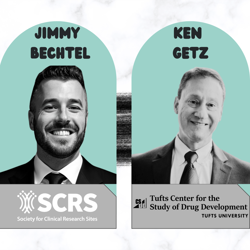
A conversation with Jimmy Bechtel, MBA, chief site success officer, Society for Clinical Research Sites (SCRS), and Ken Getz, MBA, executive director, Tufts Center for the Study of Drug Development (CSDD)
From a site perspective, feasibility challenges still persist — with many pointing to incomplete protocols, lengthy sponsor decision timelines, and uncompensated work being the biggest culprits.
Ready to discuss some of these findings in an article and video series are SCRS Chief Site Success Officer Jimmy Bechtel, MBA, and Tufts CSDD Executive Director Ken Getz, MBA.
Here, they discuss 2025 SCRS Landscape Survey Report findings from SCRS’s 2025 landscape survey and Tufts CSDD’s research to break down these fractures in feasibility.
Clinical Leader: The report said that about 43% of sites received a full protocol at the time of feasibility, yet the majority say they would really want a full protocol when they just get a synopsis. What kind of risks does that create for enrollment timelines and amendments when sites are only getting the little bit of information up front?
Ken Getz, MBA: We started talking about protocol complexity, but we could tell right away that this obviously plays right into the site qualification, the feasibility process, the study start-up timeline, and the downstream challenges as well. It has a huge effect because sites are trying to prepare budgets and respond to a request for information when they don't even have a full understanding of what's expected of them. So, it really plays right into what we were describing earlier in the absence of a near final protocol, which can be hard for sponsors to make available. The site is flying with only partial insight into what's expected, and they may make some miscalculations in terms of manpower and budget. Especially if they're running other trials simultaneously, it can be hard to know how to allocate capacity and resources.
It's a major problem, and it's been one of those chronic issues that sites have raised for a really long time. And as protocols get even more complex, it's even more frustrating. Sites learn after they were already selected for a trial that it's going to involve a wearable device that was not even disclosed at the time they prepared their proposal to participate in the trial. So, it's really amazing sometimes what sites are asked to produce in terms of a response to a request for information when they don't have all the information they need.
Jimmy Bechtel, MBA: That’s exactly correct. Most of the time, we as sites end up in a position where we're unfortunately underestimating the resources that are going to be required for that effort because it's a business and, we can generalize here, you're going to resource and you're going to plan from a business execution perspective based on the information you have at your fingertips. A smart site in this space might build in a little bit of buffer; that's where experience comes in with working with certain sponsors and CROs or in certain therapeutic areas. They know X company usually has X piece of technology on their clinical trial, or we usually execute this using this methodology with them, so it's probably going to happen even though it doesn't say it here.
But again, that comes with experience and knowledge and best practices understanding, which is not going to be everybody, but we can solve some of this by working toward better budget alignment. We find that budget misalignment is really the root of a lot of this issue. By addressing the misalignment and the feasibility process, we can get to better budget alignment and understand what we're going to be asking of our sites and, most importantly, of our patients on that protocol. Even if we don't have complete information, we're going to use this vendor at this time to perform this series of executions. It's going to be done with a piece of electronic technology or it's going to be done based on paper; we can provide just a little bit of information to the sites, even if we don't have all the answers. It positions them much better to be able to not only financially manage that trial a little bit better but also execute it quicker, which is what everyone's here to do. Then they're able to better predict the resources they're going to have to dedicate instead of scrambling as the trial is occurring — and as they're trying to enroll the first couple of patients with added technology and added procedures that they didn't have when they were executing that feasibility and start-up process.
Clinical Leader: Ken, I wanted to move into the feasibility assessment. Your report said that sites report an average of 15 feasibility assessments and 10 qualification visits per year, with selection occurring about two-thirds of the time. Can you tell me more about that data point and what it means in terms of either efficiency or inefficiency in the process?
Getz: There's a lot of inefficiency in the process. And, there were other data points, one of which is the number of sites that are invited to rebid on a project for which they were not selected the first time around. That's actually fairly high, and it varies depending on the site type. That's sort of interesting as well. That's part of the feasibility issue itself and why it's not nearly as effective as it could be.
The other data point is the amount of time the site has to wait for a decision. It was three-fourths of the total feasibility time to receive a decision. The site is waiting because the sponsor is busy hearing from other sites and still going through its selection and qualification process. We provided those statistics because they show how much time has to be dedicated at every site in just keeping the pipeline active. This is actually work. There's no remuneration. You're just trying to keep the pipeline full. And so, there's that added burden at the site level that we often don't think about.
Clinical Leader: Jimmy, just how impactful is the volume of feasibility and qualification work on the site? Is this truly a big pain point for sites, or are we finding things to nitpick?
Bechtel: Great question. And I would say it most certainly is because it serves as the foundation for the business predictability of that organization. If they don't have a clear picture of which trials are going to be placed and what the timelines look like around that placement, it makes it really difficult for them to manage financially, because you don't have a clear picture of what, for example, your assets and liabilities are going to be. And when you don't have a clear picture of trial flow, it makes it really hard. So it wouldn't really be a burden if we had a higher conversion rate; putting work into something that only converts roughly 60% of the time is really challenging because you have a third of your time that may not yield anything, and that's really frustrating. It's also hard not to understand if and when a trial is going to be placed and what the timing of that looks like, which leaves financial question marks all over this work.
Clinical Leader: Is there a place where you can point to and say, “If I had the chance to redesign feasibility from the beginning, this is what should or should not be going on?” Or is it just “communication”?
Bechtel: The age-old fallback for us here as an industry! One of the ways I think we can improve this process is by focusing on only asking the questions you need information for that specific trial. And that can come in a variety of different forms. I don't want to be too prescriptive with that; I've found that's not really effective for our sponsor partners. But maybe it could be something like a generic and a protocol-specific separation of the feasibility process. We know a lot of the generic things; what makes up the site and the site's capabilities aren’t things that change rapidly and we need to continuously ask about. That process and how that's managed should look different than the protocol-specific needs and assessing the site's feasibility to execute that protocol.
We've heard a lot of the sites say, “Assess me on the handful of information pieces you need to help both me and you understand whether or not I can execute this protocol. Because, guess what, I still have a negative 70-degree freezer, and I still have five staff, and I still have a research assistant who does data entry and we have X, Y, and Z with our recruitment processes, etc.” Separating those might be a path we could do.
But the other one that I would like to highlight is being more transparent around status, which harkens back to my previous answer. Not waiting around or sitting on decisions so that sites can be more informed and make effective resourcing decisions can go a long way with your relationship with that site. If we wait too long or we don't effectively communicate with the sites, they're going to move on because they're not going to wait and hope that that clinical trial comes across their plate. You may just then come back to the site and say, “You were selected,” and they say, “We hadn't heard from you in six months. So, we've moved on and we've actually been selected for another trial that's in a very similar therapeutic area, and we're not able to resource or find patients for yours any longer.” That complicates things because the sponsors and CROs were moving down a particular path.
So, I think it's much easier to be transparent at regular intervals around the status of a trial and the site and say, “Site selection is going to conclude in the next number of months. We predict it's going to be done by January 2026. You'll hear from us across the duration of November through January. If you don't hear from us by the end of January, please reach out.” Those small types of timeline transparency conversations can really help a site. It goes a long way with sites being able to predict the amount of work they're going to have.
About The Experts:
 Jimmy Bechtel is the chief site success officer for the Society for Clinical Research Sites (SCRS). He is in charge of developing and executing the company's site-facing initiatives and works closely with key industry partners to build out various SCRS partnership programs. Bechtel brings experience from both the site and sponsor sides of the clinical research industry. In his site experience, he served as a data specialist, patient recruiter, and operations manager. In his pharma experience, he worked in innovation project management, encouraging a site-centric environment and creating ease for sites working with a major sponsor company.
 Ken Getz is the executive director of the Tufts CSDD and a research professor at the Tufts University School of Medicine. He is an internationally recognized expert on pharmaceutical R&D management and execution, protocol design, contract service provider and investigative site management, eClinical technology and data usage, and patient engagement. A well-known speaker at conferences, symposia, universities, investor meetings, and corporations, Ken has published extensively in peer-reviewed journals, books, and in the trade press. He holds board appointments in the private and public sectors. He received his MBA from Northwestern University and his bachelor’s degree from Brandeis University. Ken is also the chairman of CISCRP — a nonprofit organization he founded to educate and raise public and patient awareness of the clinical research enterprise — and the founder of CenterWatch, a leading publisher in the clinical trials industry and one of several businesses he has sold.