
Unlocking AI Value For Clinical Research Associates
By Ranu Carroll, Osefame Ewaleifoh, and Xueying Shang, EY-Parthenon

Biopharma’s AI conversation has lived almost entirely upstream in functions like discovery, translational science, medical and regulatory writing, and commercial analytics. The downstream economics of running a trial have been treated as largely fixed: a function of site count, geography, and headcount. That framing is breaking.
Clinical operations represent roughly $51b of the $261b global clinical services market, with clinical monitoring (~$11.6b) as the largest segment. Within monitoring, full-time employees (FTEs) are ~40% of cost, and clinical research associates (CRAs) are 60%–70% of that FTE base. That means this single role accounts for close to 7% of total clinical operations spend.1,2
For most sponsors and contract research organizations (CROs), that 7% is the largest line item still untouched by serious AI re-engineering, and the one with the most direct line of sight to the clinical trial metrics advisory boards care about: time to first patient in, query cycle time, database lock, and the sponsor experience scores that increasingly drive renewal economics. Optimizing the CRA role with AI can do two things at once. Organizations can streamline the most repetitive, lowest judgment work in clinical operations while also freeing CRA capacity for the highest-judgment work like patient enrollment and performance support, risk identification, safety stewardship, site engagement and relationship building that disproportionately shapes enrollment, retention, and data quality.
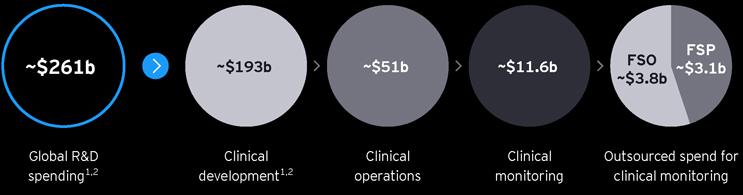
Figure 1: Global 2026 R&D spending breakdown across spend type; clinical monitoring accounts for ~6% (~11.6b) of development spend, presenting opportunity for AI application. Notes: (1). Research spend includes discovery and preclinical spend. Clinical development spend includes spend on phase 1–4 trials and includes spend on eClinical technologies and related services (e.g., clinical data management, analytics, eRegulatory support, IT implementation, and DCT services.
(2). Based on market-informed assumptions, secondary research, and survey data.
Data sources: Evaluate Pharma, Grand View Research, Industry Standard Research, Jefferies, National Institutes of Health, EY-Parthenon eClinical decision-maker survey (n=150), EY-Parthenon interviews and analysis.
Why The CRA Role Has Lagged In AI Adoption
In most clinical functions like pharmacovigilance, data management, and medical writing, AI has moved from pilot to production across roles over the last 36 months. This is not as pronounced for the CRA role. Four main reasons explain why:1
- Regulatory caution, not capability gaps. ALCOA+, 21 CFR Part 11, and inspection readiness concerns push CROs toward conservative, manual-first workflows, even where AI technology is mature.
- Fragmented workflows across sponsors and standard operation procedures (SOPs). Each CRA activity is governed by a different sponsor, system, and SOP, preventing any single AI deployment from scaling cleanly.
- Legacy system perimeter. Mission-critical data lives in electronic data capture (EDC), clinical trial management system (CTMS), and electronic trial master file (eTMF) platforms that lack AI-ready application programming interfaces (APIs), blocking end-to-end automation even where individual use cases are viable.
- Operating model drag. High turnover, overleveraged territories, and an unsettled remote/on-site mix force the function to manage constant disruption rather than redesign how work gets done.
None of these barriers are immovable. But together they explain why a function that should have been an early AI winner has, in practice, been a late one and why the window to lead is brief and crucial.
Reading The CRA Workday The Way An Investor Would
Broken down by activity, the CRA workload yields a tidy strategic map. Two activities, data review (~22%) and documentation and reporting (~17%), combine to nearly 40% of the CRA workday, both with high AI readiness and modest investment requirements. Add query resolution (~13%), and roughly half the CRA workday is highly ready for streamlining.1
The remaining activities like site initiation, regulatory compliance, and the residual judgment layer in source data verification (SDV) are lower in AI readiness but higher in clinical and relational value. This is augmentation territory. AI can draft, pre-screen, or risk-rank while the CRA owns the conversation with the investigator, the site coordinator, and the sponsor’s medical lead.1
The same survey points to a striking five-year future arc: data review shows AI penetration rising from ~20% to ~55% and documentation and reporting from ~20% to ~60%, both at low-to-medium investment levels.1 Site initiation, SDV, and regulatory compliance, by contrast, move more slowly and demand heavier investment. This is a useful signal for sequencing capital and talent.
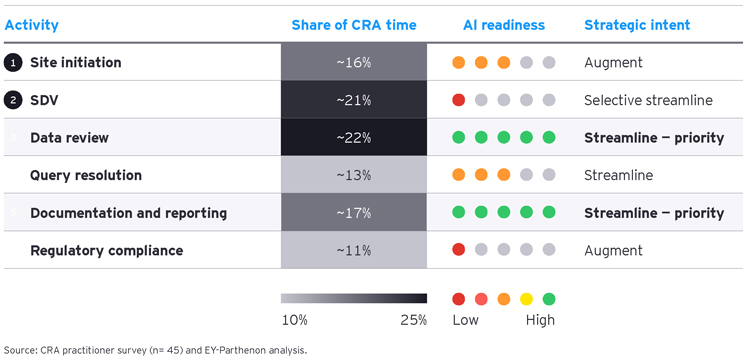
Figure 2: CRA time allocation, AI readiness, and strategic intent across CRA activities; data review and documentation represent the highest-priority areas for applying AI to streamline CRA activities.
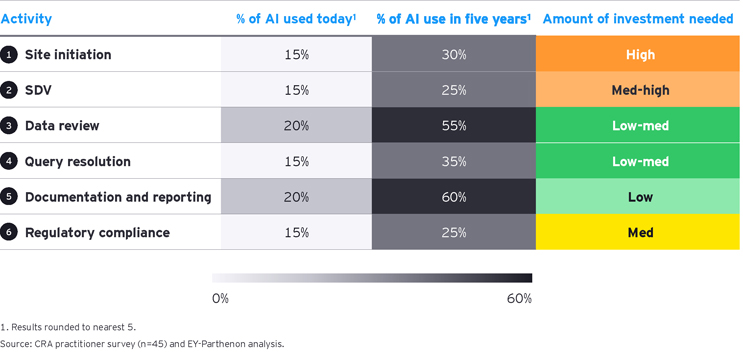
Figure 3: Five-year AI penetration across CRA activities; AI adoption is set to reach ~1.5-3x across CRA activities within five years, with documentation and reporting and data review leading.
The executive implication is sharper than the data suggests. Roughly half of the CRA workday is in scope for AI at modest capex over a five-year horizon. Sponsors and CROs that pace investment to that reality will reset the cost-to-monitor curve; those that don’t will compete on rate card in a market where rate card is no longer the right axis.

What An AI-enabled CRA Workflow Actually Looks Like
Strip away the vendor noise, and the future state of the CRA workflow is concrete. Four AI-enabled options carry most of the near-term economic load:1
- Risk-ranked review queues. AI ingests structured EDC, CTMS, and lab outputs to generate prioritized review lists, replacing chronological or site-by-site review.
- Cross-field consistency and edit-check automation. Machine learning (ML) models validate logical consistency across forms, visits, and labs, surfacing only true exceptions.
- Protocol-to-eCRF mapping. Generative agents parse protocols and auto-map inclusion and exclusion and endpoint criteria to electronic CRF (eCRF) fields, compressing site activation and reducing deviation risk.
- First-pass lab and safety signal review. AI cross references lab values against protocol-defined criteria and patient history, escalating only flagged signals.
Each is operationalized through the same pattern: workflow deconstruction — agent task allocation — human in-the-loop checkpoint design, with ALCOA+ alignment and explicit human sign-off preserved end to end.1
The output is a differentiated CRA role with efficient, judgment-weighted decision-making focused on exceptions and risks, built around sponsor and site relationships rather than line-by-line verification.
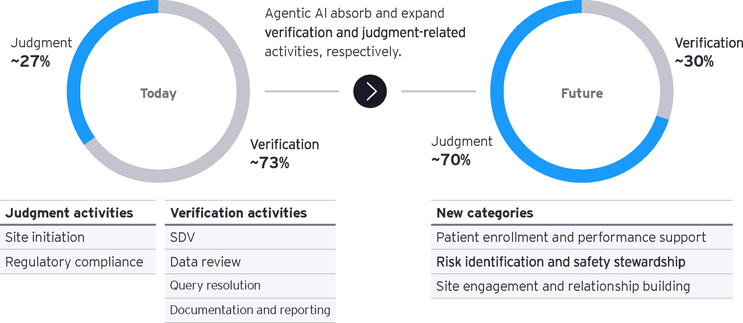
Figure 4: Evolution of CRA activities; from verification operator to strategic site partner
The Strategic Stakes
For sponsors, the CRA conversation has long been about turnover, response lag, and request backlog. AI integration in the CRA role hits all three directly:1,3
- Sponsor experience. Faster query turnaround, more consistent documentation, lower CRA-level variance. These address the top three pain points in most sponsor satisfaction surveys.
- Cost to monitor. Effort reduction across the three priority activities translates into measurable margin uplift or pricing flexibility for CROs.
- Speed. Compressed query cycles and earlier signal detection accelerate database lock and, ultimately, time-to-readout.
- Trial quality. Standardized, audit-ready documentation reduces inter-CRA variance and delays at scale.
- New revenue. Premium tiers, including predictive risk-based monitoring as a service open a category of value that did not previously exist on the monitoring rate card.
For CROs, the stakes are sharper still. AI-native startups are already setting new speed-cost benchmarks, and sponsors are already asking AI-readiness questions in RFPs. The CROs that operationalize AI inside the CRA workflow over the next 24–36 months will reset the margin curve. Those that don’t will face the familiar pattern: margin compression, sponsor defection, and slow commoditization of what was once a differentiated service.
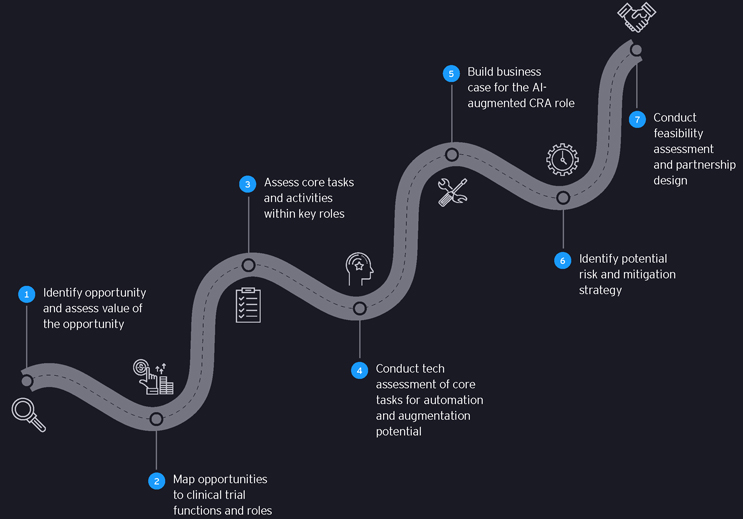
Figure 5: Seven-step framework to unlock AI potential in clinical trials
Beyond Efficiency And Toward Patient Impact
While the quantitative references thus far reflect margin and efficiency opportunity, the scope of potential impact is larger. The role of a CRA in the end is not just a verification function. CRA is the sponsor’s most direct link to the investigator, the site coordinator and the patient experience, which largely determines whether a trial enrolls, retains and reads out cleanly.
Every hour AI reclaims from line-by-line verification is an hour the CRA can spend on the work that moves clinical outcomes: patient enrollment and performance support, risk identification, safety stewardship, site engagement, and relationship building that no AI model will replicate in this decade.3
Leaders will treat an AI-enabled CRA as a reimagining of the clinical monitoring operating model, not a productivity project. Laggards will treat it as a cost-out exercise and find themselves competing on rate cards in a market that has moved on.
CRAs account for ~7% of clinical operations spend, but their influence on clinical and relational outcomes is far greater. Getting the CRA-AI relationship right is not just an efficiency decision, it is a mission-critical choice, and the window to act is open now.
References
- EY-Parthenon. Unlocking AI value in the CRA function — internal analysis and CRA practitioner survey (n=45). 2026.
- EY-Parthenon analysis of global clinical services market sizing and clinical operations cost structure. 2026.
- EY-Parthenon. How AI in biopharma can drive mission-focused growth. ey.com Insights, 2024.
About The Authors:
 Ranu Carroll is a Partner in EY-Parthenon with 20 years of experience in M&A, strategy, and innovation, helping pharmaceutical, medtech and consumer companies drive growth. She has advised clients on multibillion-dollar global M&A transactions, operating model development, go-to-market strategy, sales and marketing, and revenue synergy assessments. She has also guided Fortune 500 companies on corporate and market entry strategies and led end-to-end product development and innovation initiatives. Carroll holds an MBA from Columbia Business School.
 Osefame Ewaleifoh, Ph.D., MPH, is a Senior Director in EY-Parthenon's Strategy and Execution practice, where he advises biopharma, pharma services, and medtech companies on growth strategy, commercialization, and operating model transformation. He works with life sciences organizations to address complex strategic challenges, accelerate innovation, and create long-term value. Ewaleifoh earned a Ph.D. in virology, microbiology and immunology and a Master of Public Health from Northwestern University.
 Xueying Shang, Ph.D., is a Director in EY-Parthenon's Strategy and Execution practice, where she advises life sciences companies on growth strategy, innovation, and business transformation. Combining deep scientific expertise with strategic consulting experience, she works with biopharma organizations to navigate complex market dynamics, advance therapeutic innovation and address evolving healthcare challenges. Before joining EY-Parthenon, Shang earned a Ph.D. in molecular, cellular and developmental biology from Yale University.