
3 Ways To Solve Data Friction In Modern Clinical Data Management
By Shashidar Reddy Abbidi, senior clinical data manager

Clinical trials have become data ecosystems, as single studies now draw information from EDC systems, central laboratories, imaging vendors, wearable devices, electronic health records, safety systems, and specialized external vendors. For clinical data managers, this growth has created an opportunity to generate richer evidence faster. It has also exposed a persistent operational bottleneck: data friction.
Data friction is the resistance that occurs when clinical data must move across systems, teams, formats, standards, and workflows before it becomes usable. It shows up as delayed transfers, manual reconciliation, inconsistent mappings, duplicated review, unresolved queries, unclear ownership, and slow movement from collection to decision-ready data. In today’s decentralized and digitally-enabled trial environment, reducing this friction is a core requirement for timely, reliable trial execution.
Where Data Friction Begins
Data friction begins when clinical data flows through fragmented technology and fragmented accountability. At the trial level, data may originate in the EDC, laboratories, imaging platforms, wearables, EHRs, and other specialized systems, each with different formats, standards, interfaces, and transfer cycles. Before those data can be reviewed together, they often must be mapped, transformed, reconciled, and validated. Every handoff creates an opportunity for latency, inconsistency, or error.
At the organizational level, friction increases when functions work from different tools, assumptions, or definitions of readiness. Data management may focus on completeness and query resolution, while clinical operations may prioritize site follow-up and monitoring. Biostatistics may need analysis-ready data aligned with the statistical analysis plan, but regulatory teams may focus on traceability, explainability, and submission expectations. Even when individual functions operate effectively, misaligned workflows can create repeated checks, duplicated effort, and slow transitions from collection to analysis and submission readiness.
For that reason, data friction should be understood as a system-design issue rather than a data management problem alone. The solution requires shared standards, clearer ownership, fit-for-purpose automation, and workflows designed around how data will be used not just how it is collected.
How Data Friction Perpetuates
Data friction often becomes most visible in external data reconciliation. Data from central laboratories, imaging providers, specialty biomarker vendors, devices, and other partners may arrive on different schedules with different structures and in varying degrees of completeness. When discrepancies appear, teams must determine whether the issue reflects a true clinical data problem, a timing gap, a mapping error, a unit mismatch, or a processing issue. This is a common bottleneck when delayed or imperfect vendor transfers require extensive review to understand the source of discrepancies.
Standards inconsistency compound the problem. CDISC standards support clinical research data consistency and interoperability, and CDISC describes its mission as enabling accessibility, interoperability, and reusability of data for more meaningful and efficient research. However, standards only reduce friction when sponsors and their teams implement them consistently across study design, collection, vendor specifications, transformations, analysis datasets, and metadata. A standard used late in the process may help with submission formatting, but it does not automatically fix upstream ambiguity.
FHIR adds another dimension. FHIR is widely used to represent and exchange health information and is designed to support more connected health data interoperability. CDISC’s FHIR-to-CDISC mapping guide defines mappings between FHIR and CDISC standards including CDASHIG, SDTMIG, and LAB to streamline the flow of EHR data into CDISC submission-ready datasets. This can support more consistent reuse of healthcare data, but only if teams align early on source definitions, traceability, controlled terminology, and intended downstream use.
Manual rework is the third source of friction. Query generation, review, follow-up, and resolution remain essential components of data quality oversight. But when teams must check the same issue in multiple systems, reformat for multiple stakeholders, or reconcile repeatedly across vendors and internal teams, quality work becomes drag. Manual workflows can extend timelines and increase the risk of human error, particularly when issues are reviewed across multiple systems or adapted for different stakeholders.
Why The Impact Is Bigger Than Timelines
The most visible impact of data friction is delay. Lost time during reconciliation and cleaning can affect interim analyses, database lock, and regulatory submission preparation. For clinical data managers, these delays are often caused by late vendor files, unresolved discrepancies, incomplete SDV or review, query backlogs, missing pages, or late-breaking changes to standards or units.
But the larger impact is confidence. Data friction erodes trust when repeated transformations, fragmented validation steps, and inconsistent handoffs create more opportunities for mistakes. This leads to downstream consequences such as additional internal quality reviews, rework, and, in some cases, greater scrutiny during inspections or regulatory reviews. This difference is important for inspection readiness and accountability. Not every data issue becomes a regulatory issue, but poor traceability and unclear process ownership can make it harder to explain what happened, why it happened, and how it was controlled.
The strategic cost is more consequential. If decision-makers receive usable data too slowly, organizations become more reactive. Adaptive trial decisions, safety signal evaluation, endpoint interpretation, and operational risk mitigation all depend on timely, trusted data. In an environment where trial execution is increasingly digital, global, and externally sourced, the ability to reduce friction can influence how quickly organizations act on trial data.

3 Ways To Reduce Data Friction
Reducing data friction requires coordinated action across technology, standards, and process design. Technology alone is insufficient unless standards, ownership, and workflows are aligned. The goal is to create a smoother path from source data to insight.
1. Design automation around bottlenecks not buzzwords.
Automation is most valuable when it targets specific friction points. Examples include automated data ingestion, file checks, reconciliation rules, real-time validation, anomaly detection, and exception-based review. Automation can streamline ingestion, apply validation checks earlier, and surface anomalies before they require large-scale rework. Automation should not replace expert review; it should reduce avoidable manual effort so experts can focus on interpretation, risk, and decisions.
For example, external lab reconciliation can benefit from automated checks for subject identifiers, visit windows, collection dates, units, missing results, and expected versus received records. Imaging data reconciliation can similarly benefit from exception-based tracking of missing scans, assessment dates, and adjudication status.
These use cases are practical and immediately relevant to study teams. They are practical workflow improvements that reduce avoidable cycle time.
2. Apply standards early and consistently.
Standards reduce friction when they are built into the study from the beginning. CDASH thinking can improve collection design. SDTM and ADaM awareness can inform downstream traceability. Define-XML and metadata planning can support reviewability. FHIR mappings can help bridge healthcare and research data when EHR-derived sources are in scope. CDISC and FHIR-to-CDISC work aims to reduce barriers to using clinical information for research by making conversion between FHIR and CDISC standards easier.
Standards should not be treated as a late-stage programming exercise. They should influence protocol data strategy, CRF design, vendor data transfer specifications, edit checks, review plans, external data expectations, and analysis readiness.
If standards are introduced late in the study lifecycle, teams may still spend significant time resolving ambiguity created much earlier.
3. Redesign processes to reduce handoffs.
Process design is often overlooked. Data friction increases when work passes through too many unclear handoffs. A cleaner operating model defines ownership, decision rights, escalation paths, expected turnaround times, and evidence requirements. Such an operating model limits unnecessary handoffs, eliminates duplicate checks, clarifies ownership, and connects data capture, review, and analysis more directly.
A practical example is external data governance. Each external source should have a clear owner, documented transfer expectations, issue triage rules, reconciliation frequency, and escalation path. Clinical operations, data management, programming, and biostatistics should agree what constitutes a blocking issue versus a documented residual risk. This prevents late-cycle debate when timelines are already compressed.
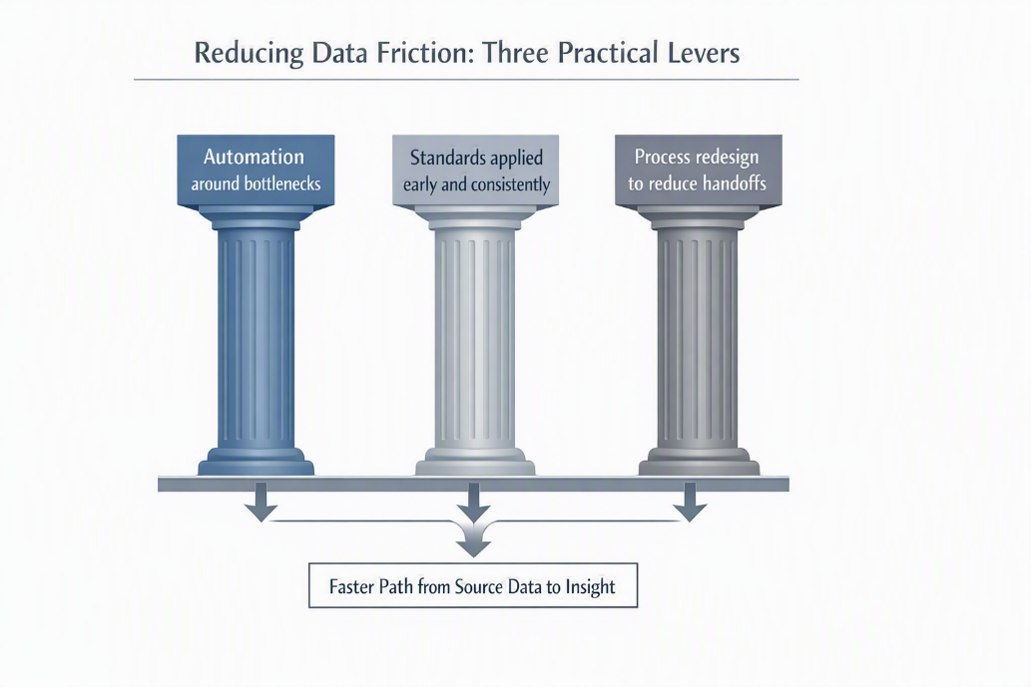
Figure 1: Reducing data friction depends on three coordinated levers: targeted automation, early standards adoption, and process redesign working together to create a faster path from source data to usable insight.
Measuring Data Friction
Organizations cannot improve what they do not measure, including indicators such as data latency, query cycle time, reconciliation turnaround, rework rate, and first-pass data quality. These metrics help teams see where data slows down and where process redesign may deliver the greatest benefit.
A practical measurement framework should include:
- Data latency: time from source data creation to availability for review or analysis.
- Query cycle time: time from query creation to response and closure.
- External reconciliation turnaround: time required to identify, assign, resolve, and document vendor discrepancies.
- First-pass quality: proportion of data or files accepted without rework.
- Manual touchpoints: number of manual transformations, checks, or handoffs before data becomes usable.
- Submission-readiness indicators: completeness of traceability, metadata, coding, reconciliation, and documentation.
These measures should be monitored throughout the study lifecycle so teams can identify friction early, intervene sooner, and prevent small issues from becoming late-stage blockers.
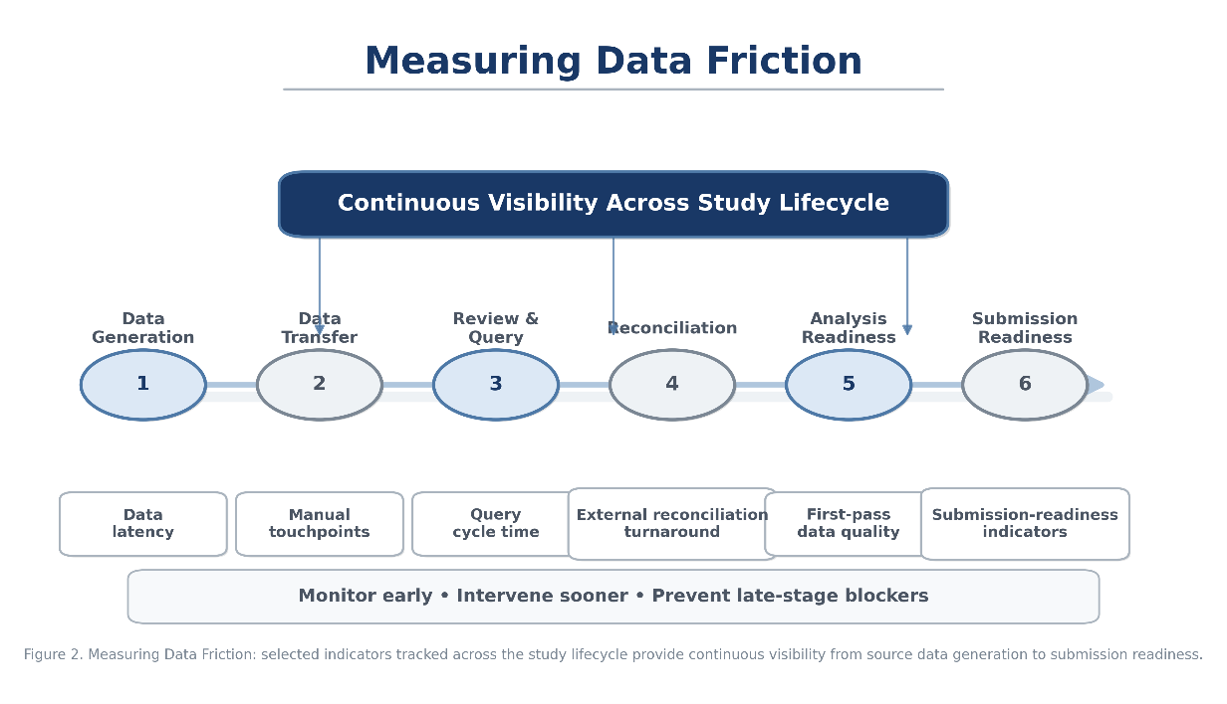
Figure 2. Measuring Data Friction. Continuous monitoring of selected indicators across the study lifecycle helps teams identify where data slows down, intervene earlier, and improve readiness from source data generation through submission preparation.
The Future: From Data Cleaning To Data Flow
The future of clinical data management will be defined less by how well organizations clean data and more by how well they design data flow from the start. As trials incorporate more external, digital, and real-world data sources, data managers will increasingly serve as integrators of standards, processes, technology, and cross-functional decision-making.
This requires teams to view data quality as a design responsibility. Data quality is built through early design, aligned standards, clear ownership, automated controls, and measurable flow. The strongest organizations will not simply ask, “Is the data clean?” They will ask, “How quickly, reliably, and transparently can data move from source to decision?”
Reducing data friction is therefore central to faster and more reliable clinical development. It is a strategic capability for faster, higher-confidence clinical development. Organizations that address friction through disciplined standards adoption, targeted automation, and thoughtful process design will be more able to generate trusted insights at speed and to deliver clinical trial data that is not only complete, but truly usable.
About The Author:
 Shashidar Reddy Abbidi is a MS, PMP, a senior manager, clinical data management, with experience across the clinical trial lifecycle, including study startup, external data integration, data review, database lock, and inspection readiness. His work focuses on improving data quality, operational execution, standards adoption, and delivery of decision-ready clinical trial data across cross-functional teams and vendor partnerships. His professional interests include clinical data standards, external data strategy, process improvement, automation, and practical applications of AI in clinical data management. He is an active research paper and trade article author, with 40+ judging and peer review experiences.