
What's The Role Of HEOR For A Clinical Researcher? A Perspective From ISPOR 2026

By Abby Proch, Executive Editor
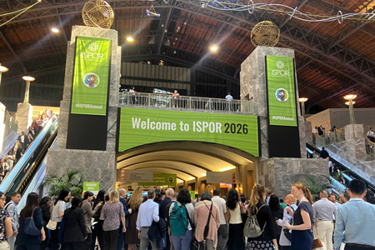
I’ve only been on the clinical research scene for a handful of years, and last week’s ISPOR conference in Philadelphia was my first. It’s a health and economic outcomes research (HEOR) event, with conversations, poster presentations, and vendor booths — much of which pertain to commercialization.
Typically, everything related to commercialization, including market access, pricing, reimbursement, and formulary decisions, is outside my purview. (Phases 1-3 only, please.) But leaning in for a few talks on that part of the process was pretty enlightening. And quite frankly, it’s probably something I should do more often. I typically think about regulatory approval as if it’s a stopping point: Once a drug or device is given the greenlight by the FDA, the story is over.
But there’s a lot to learn from what happens after approval.
RWD, and thereby RWE, are aspects of HEOR and can include medical and pharmacy claims (which yield insight into patient adherence and cost of care), biomarkers and lab data (which convey diagnosis and drug efficacy), and social media and patient-reported outcomes (PROs) (which communicate patient attitudes, experiences, and preferences).
When considered within the context of Phase 1-3 trials, these can help inform clinical activities as patient journey mapping, eCOA strategizing and implementation, and refining trial designs. While HEOR pertains to value, outcomes, cost, and resource use for access and reimbursement decisions, it is also relevant to the FDA’s focus on patient-focused drug development (PFDD). That’s incredibly important to clinical development and operations professionals, given the FDA is now more than ever looking for sponsors to integrate the patient experience in its data collection and include it in regulatory submissions. Case in point, as discussed by FDA Deputy Division Director in the Division of Clinical Outcome Assessment Selena Daniels, BS, MS, PharmD, during a panel conversation on next-generation clinical trials:
“The shift has been intentional. We've had the patient-focused drug development guidance series that lays out a clear road map for collecting and submitting meaningful patient and caregiver input and data, just to formalize expectation that the data can actively inform clinical trial design and endpoint selection through regulatory decision-making. Patients describing how their disease disrupts their sleep, disrupting their ability to carry out daily activities — I don't think that's anecdotal anymore. That's data that is important and meaningful to collect in clinical trials, and it's data that belongs, frankly, in regulatory submissions.…”
Daniels also brought up another point about the patient experience: What’s measured in a trial doesn’t necessarily align with what’s measured — and important to patients — in real life.
“There still remains a true measurement gap — measuring what is technically easy to measure within the context of a trial versus what is meaningful to a patient. We still see that tension as we think about clinical trial design, and likewise, there is an integration gap of evidence. Patient experience data represents a big ecosystem of different outcomes that are meaningful to measure, but they're not systematically incorporated into the decision-making of [health technology assessments]… and sometimes, when you're thinking about the data that you're collecting, that integration is not thought about upstream, and so then it's not as useful when it comes to generating evidence packages.”
In the same conversation, National Organization for Rare Disorders (NORD) Vice President of Research and Clinical Programs Tracey Sikora reminded all that patient advocate groups are excellent for obtaining patient experience data. NORD boasts a membership of over 350 PAGs but cautioned drug developers not to take advantage of or undervalue them.
“When we talk about engagement with patient advocacy organizations, there's often a perception that this is work that they do because it's their lived experience. It's often the families that are running these, and let’s not devalue the level of effort that has to go into that. [Make] sure that you’re… valuing the patient experience partners as true partners in this process; I think it can still go overlooked,” she added.
The conversation enlightened me to two realities:
No matter where your position lies along the drug development continuum, the patient must be part of the process.
No matter where your position lies along the drug development continuum, you cannot work in a silo. (I cringe at that word.)
While well-run companies may have market access and patient services teams that fully support and communicate with clinical development and operations teams, and vice versa, that’s not always the case. And so, this part of the conversation was a healthy and helpful reminder to stay plugged in to what’s happening across the continuum, because early considerations for endpoints and relevant patient subgroups, among other factors, can sizably impact a drug’s success in the marketplace.