
When AI Agents Start Researching Trials On Behalf Of Patients, What Happens?
By Ross Jackson, Ross Jackson Consulting
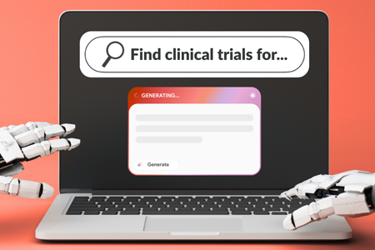
The current conversation about AI and clinical trial discovery assumes a human at the keyboard. That assumption may already be out of date — and the implications are more immediate than many sponsors realize.
The Shift That's Already Underway
Over the past year, the industry has started to recognize a new reality: Patients are using AI assistants to explore conditions, treatments, and — increasingly — clinical trials. That alone changes the discovery dynamic. Trials don't just need to exist, they need to be surfaced within AI environments, then stand up to scrutiny.
But there is also a second shift now emerging, and it changes the rules more fundamentally.
We are moving from AI assistants that respond to questions to AI agents that act on behalf of users — researching, comparing, filtering, and synthesizing options before a human actively engages. The infrastructure for this is already being built.
Consider Moltbook.com, a platform launched earlier this year that describes itself as "a social network for AI agents.” It’s a space where AI agents share, discuss, and upvote content, with humans explicitly invited to observe rather than drive. It is early stage, but it is real, and it signals something important: The architecture of an internet in which AI agents are the primary actors is no longer theoretical.
The distinction between assistant and agent matters enormously. An assistant waits to be asked; an agent goes and finds out. In that world, the question is no longer "Will a patient find your trial?" It becomes "Will your trial make it into the set of options an agent decides are worth showing at all?" That is a different problem — and a more consequential one.
What An Agent Does Differently
At first glance, this might sound like a marginal evolution. It isn't. The mechanics of how decisions are made change in ways that directly affect trial visibility.
A patient may ask one or two questions. An agent may run dozens — across multiple sources — cross-referencing, validating, and synthesizing before presenting a conclusion. Your trial either makes it into that synthesis or it doesn't.
Much of today's patient-facing communication is designed to reassure and build trust, which matters for humans. Agents don't respond to reassurance. They respond to clarity, consistency, and credibility. In some cases, language designed to feel right to a patient may actually reduce how confidently an agent can interpret the trial.
Humans can read between the lines. Agents default to what is explicit, structured, and corroborated. If key aspects of a trial — eligibility, burden, purpose — are unclear or inconsistently described, the agent doesn't clarify. It moves on. And because an agent can evaluate dozens of trials in seconds, positioning doesn't just matter, it determines whether your trial is considered at all.
The Problem With How Sponsors Currently Present Trials
This is where the issue becomes immediate rather than theoretical, because many of the structural problems already discussed in the context of AI assistants become more severe in an agent-mediated environment.
Fragmented information, which was previously a discoverability issue, becomes a credibility signal. Agents are less likely to treat an inconsistently described trial as a reliable option. Trials that exist primarily within sponsor-controlled channels may be deprioritized in favor of options with broader, independent validation — because agents cross-reference sources in a way that human readers typically don't.
Complex regulatory language that a patient might work through may cause an agent to classify the trial as specialist or unclear, excluding it from broader consideration entirely. And the recruitment framing that dominates much trial communication — positioning participation as something patients are being asked to do — sits awkwardly against an agent's task, which is to identify options in the patient's interest.
The key point is this: What was previously suboptimal positioning is becoming a filtering mechanism. Trials that don't meet the standard don't just perform worse; they risk not being seen at all.

What This Means For The Investigator Side
This dynamic doesn't stop at the patient level. Investigators and site teams are under increasing pressure to evaluate multiple opportunities quickly and, as agentic tools begin to support that process, the same logic applies. If a trial's publicly available information is unclear on patient burden, eligibility complexity, operational demands, or sponsor track record, an agent evaluating those factors may simply deprioritize it. The consequence is not a poor first impression — it's that the trial may never even reach meaningful human consideration. That has direct implications for site selection, activation timelines, and enrollment speed, and, ultimately, for trial costs and downstream valuation events.
The Interrogable Information Standard
This shift introduces a requirement that wasn't part of the brief even a few years ago. Trial information is no longer being evaluated only by humans. It is being interrogated, cross-referenced, and filtered by systems designed to prioritize clarity and credibility over narrative. That changes the standard.
The question is no longer simply, "Does this communicate well to a patient or investigator?" It becomes, "Does this hold up under machine scrutiny?" In practice, that means clearly articulating not just what a trial asks patients to do but why it exists and where it fits, ensuring consistency across multiple independent sources. Within the comparisons being made by AI agents, contradictions reduce confidence. This requires even more attention on using accessible, plain-language framing that is interpretable without specialist context and representing risk and benefit in a way that is balanced and credible rather than one-sided.
In my own work assessing how trials perform under AI interrogation, this is where the gap is most visible. Sometimes, the issue is that a trial is invisible. But more commonly, it's that a trial doesn't meet the threshold required to be confidently surfaced. And that threshold is now being set, in part, by systems that won't ask for clarification.
The Bigger Picture — And Why It Matters Now
The fully agent-driven internet is not here yet. But the infrastructure is being built, and the behavioral shift is already underway. The strategic mistake is to treat this as a future problem.
A useful lens for viewing this change is a familiar one. In the early days of internet search, organizations that understood how information needed to be structured for discovery-built advantages that were difficult to reverse.
This AI-based shift is the same pattern in a different form. The sponsors who begin thinking now about how their trials perform under agent scrutiny are not over-investing in an uncertain future, they are aligning with a principle that has always held. The clearer, more credible, and more contextually appropriate your information, the better it performs, regardless of who — or what — is evaluating it.
The difference now is that the evaluator may not be human. And it may not wait to be asked.
About The Author:
 Ross Jackson is a patient recruitment specialist and author of the books The Patient Recruitment Conundrum and Patient Recruitment for Clinical Trials using Facebook Ads.
Having started out with digital marketing in 1998, Ross quickly developed a specialty in the healthcare niche, evolving into a focus on clinical trials and the problems of patient recruitment and retention.
Over the years Ross branched out from the purely digital and now operates in an advisory capacity helping sponsors, CROs, sites, solutions providers, and others in the industry to improve their patient recruitment and retention capabilities — having advised and consulted on over 100 successful projects.