
A Role-Play Conference Session That Reframes The Data Manager's Job

By Dan Schell, Chief Editor, Clinical Leader
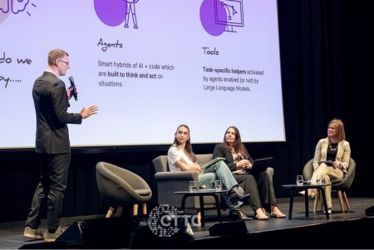
At the Clinical Trials Technology Congress in London, I sat in on a session that turned out to be … well, super memorable. Four clinical trial professionals staged a short theatrical performance rather than delivering slides, and it ended up being the most entertaining and educational hour I’ve spent at a conference in a long time (kudos to Emma Maria Calleja of Von Peach for crafting such a creative session).
The premise: a clinical data manager in 2026 grinds through a typical workday buried in spreadsheets, trackers, and disconnected systems. Then the scene jumps to 2030, where that same data manager works alongside a team of specialized AI agents that flag risks early, pull information together across systems, and hand decisions back to the human instead of paperwork.
A skit like that could have gone for easy laughs or easy applause. It did neither. The presenters weren’t arguing that AI will replace clinical trial professionals; they were making the point that the work AI should take on is work nobody should have been doing by hand in the first place.
A TRACKER MANAGER, NOT A DATA MANAGER
Nicola Götz, head of experimental medicine data & analysis at Boehringer Ingelheim, played the overwhelmed data manager. “Another 175 queries today! And that’s just from two sites,” she said, walking through a day spent reconciling lab values, checking trackers, juggling software platforms, and fixing errors instead of analyzing anything. She wasn’t really complaining about hours; she was upset about what those hours went toward. “I want to spot patterns before they become problems,” she said. “I want to collaborate with study teams to make decisions that matter. I want to make sure we are asking the right questions, not just closing the ones that already failed.”
Her summary of the current state landed hardest: “Sometimes I really wonder if I’m a data manager or maybe a tracker manager.” The room laughed, but I could tell there were plenty of people there who felt her pain.

WHAT THE AI AGENTS ACTUALLY DID
The 2030 half of the skit didn’t hand the data manager a single all-purpose assistant. Instead, a supervisor AI agent (played by Kyiah Howells, junior clinical data manager at Pfizer) fielded requests and routed work across specialists — one watching data integrity across vendors and systems, another modeling operational risk to flag protocol deviations, site issues, and enrollment problems before they escalated (portrayed by Jan Seidel, senior principal therapeutic area & methodology [TAM] statistician, at Boehringer Ingelheim and Liz Walsh, global head of clinical operations, experimental medicine at Boehringer Ingelheim).
The demo moment that landed the best was when one site suddenly produced a spike in adverse event queries. The agents didn’t just flag the discrepancy, they traced it to a staffing change, found the same pattern building at other sites sharing that coordinator’s resources, and projected where similar deviations were likely to show up next. That kind of info changed the data manager’s question from “How do we close these queries?” to “What’s the story behind these queries?”
And during the Q&A, Seidel alluded to this example when he said, “We will always need a human in the loop [i.e., AI will not replace data managers]. What goes away are the redundant side quests that we commonly have to deal with.” When he said “side quests” I looked around and saw a lot of nodding heads from folks who likely have lived through what he was talking about.
AN OLD PROBLEM WEARING A NEW LABEL
Surprisingly, the most interesting stretch of the session had almost nothing to do with AI. Someone in the audience pointed out that the problems in the skit — disconnected systems, duplicate entry, workflows built for paper — aren’t new. EDC “solved” some of it decades ago, but a lot of it never actually went away.
Götz agreed. “When I started at Boehringer Ingelheim, we were still using paper CRFs. Our processes are still quite close to how we saw it in the paper world. So, we just put more or less a PDF into an electronic world and say it’s digital now … but it isn’t.”
Seidel stressed that we need to figure out what’s actually broken, then ask whether AI is the right fix, not the other way around. That same logic came up again when the group debated whether AI should be cleaning up typos and data-entry slips that better system design should have prevented to begin with. The consensus: connect the systems properly first, and a lot of the “AI problem” disappears on its own.
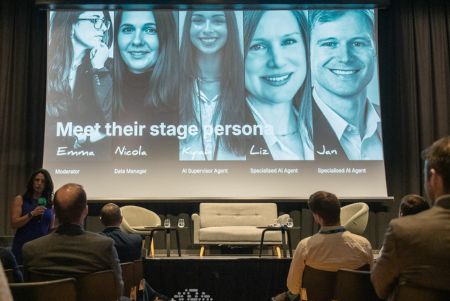
WHAT WILL HAPPEN TO DATA MANAGERS?
During the Q&A, I couldn’t stop thinking about that “human in the loop” phase that we hear all the time. I was wondering if AI agents are gathering information, identifying risks, and coordinating workflows, what exactly does the human become? I asked whether future data managers would need entirely different skills, particularly prompt engineering, and whether AI itself might eventually challenge or refine the decisions humans make along the way rather than simply presenting information at the end.
Götz’s answered by assuring the audience that data managers aren’t going to disappear, but instead, she believes the role will evolve. “I feel it becomes more of a data engineering role,” she said, pointing toward responsibilities involving data pipelines, clinical data foundations, and ensuring information is structured correctly before AI ever analyzes it. She also acknowledged that prompting represents a new skillset, although one she expects younger generations will adopt naturally.
Seidel’s answer went a different direction. He explained that he doesn’t want his AI system to be constantly saying, “Yes, you’re so great.” “I basically created a passive-aggressive ChatGPT that just answers my question and gives me facts and it forces me to start thinking.” The goal, in other words, isn’t a system that thinks for you; it’s one that doesn’t let you stop thinking for yourself. I liked that.
I left thinking less about supervisor agents and orchestration layers and more about the sheer volume of hours clinical trial professionals still lose to work that should have been automated years ago. Give data managers back the time they’re currently spending on trackers and query cleanup, and you’re not just making the existing role more efficient; you’re finally letting it become the role it was supposed to be.