
Clinical Trials Need Fewer Barriers And More Humans

By Dan Schell, Chief Editor, Clinical Leader
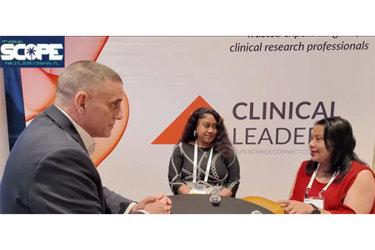
Individually, I always love talking with Tina Karunaratne and Elizabeth Tabor because they are always so positive in an industry rife with … well, problems (and people who want to harp on those problems). I said “individually” because I’ve never encountered them together in a Zoom call or in-person — until this year’s SCOPE.
We chatted about what keeps them coming back to SCOPE — and what still needs to change in clinical research. It was less of a conference discussion and more a candid look at access, connection, and the human side of trials.
Networking, AI, And The Patient Experience
For Karunaratne, who runs her own boutique clinical research and program management organization, the draw of SCOPE goes beyond session titles. For her, the huge advantage is networking with attendees and vendors; she calls the event a relationship engine.
Still, she’s watching one theme closely: AI. Not for operational efficiency, but for patient empowerment. “How can the patient use AI to get to the trials?” she asked. “And who’s educating the patient?” She did caution against over-automation, though. For example, chatbots may help with “triage” types of early interactions, but patients often want a human voice. Recalling a recent discussion, she noted how people repeatedly try to bypass automated systems to reach someone real. The question, she said, isn’t whether AI belongs in clinical research — it’s where it should stop.
That patient-navigation gap helped inspire her new nonprofit, Bridge to Compassionate Care (no website yet), designed to guide patients through trial participation and the broader care journey. The mission includes helping patients understand logistics, reimbursement, and what participation truly entails. “It’s about helping patients navigate the whole system,” she said.
Elizabeth Tabor, who serves on the nonprofit’s board, reinforced the importance of accessibility. “A lot of people think [clinical research] is a last-ditch effort, and it’s not,” she said. “It can be a first choice.”
Building Connections — For Patients And Professionals
Tabor, who can usually be recognized at any industry event as the person with the most badge ribbons (usually about 10+), was attending her second SCOPE, and as usual, came prepared. She said she leveraging LinkedIn ahead of the conference to help her map out who to meet and recognize faces in a crowd of thousands. That digital groundwork translated into multiple real-world connections.
Her Clinical Research Referral Club aims to break down industry silos and help professionals understand the breadth of opportunities available. “There are lots of silos in this industry,” she said. “Most people think life is only about CRO stuff, but coming to SCOPE you see that there’s hundreds of companies you could be a part of.”
The impact of that visibility can be immediate. One attendee told Tabor she landed her job because Tabor reshared a posting online. “What we do does matter,” she said. “Sharing with people is caring.”
Tabor also introduced a concept she calls “professional-centricity.” While patient centricity dominates industry dialogue, she argues the workforce behind trials deserves equal attention. “What about the professionals who make it go around?” she asked. “If nobody in your neighborhood is working in clinical trials, how do you reach them?”
Moving Beyond Talking Points
Both guests acknowledged a familiar conference pattern: the industry excels at identifying problems but often stalls on execution (read “My SCOPE Groundhog Day Experience” article for more color). Karunaratne recalled last year’s MAGI meeting’s “Moving The Needle” sessions where participants were grouped by specialty, tasked with defining problems, and challenged to propose solutions. The exercise stood out because it pushed attendees beyond discussion toward action.
Tabor pointed to hallway conversations as another catalyst for progress. Insights that never make it into formal sessions often spark real solutions. Meanwhile, Karunaratne advocated for more interactive formats, noting that audience members frequently hold valuable ideas that never surface. Smaller sessions, she added, tend to foster the richest dialogue.
Taken together, the conversation underscored a recurring theme: progress in clinical research depends not just on technology or policy shifts, but on connection — between patients and trials, professionals and opportunities, and ideas and execution.