
SCOPE Takeaways On Inclusion And Real Patient-Centricity

By Dan Schell, Chief Editor, Clinical Leader

Last week at SCOPE, I was hustling down the stairs at the Rosen Shingle Creek Conference Center, trying to make it to my next session on time, when Garo Kiledjian, CEO of the SGM Alliance, stopped me mid-stride. “Hey, I’m on a panel later today,” he said, giving me just enough detail to make me pause. I’ve known Garo since he was a panelist on a diversity webinar I hosted in 2024. So, when he told me about the session titled “Access = Acceleration: Why Broadening Recruitment Is The Future Of Clinical Research,” I did what any reasonable conference attendee does when someone you respect makes a strong pitch — I rearranged my schedule.
I’m glad I did.
What unfolded in that room, and later in another session focused on culture and infrastructure, reinforced something I’ve been hearing and writing about for years. We say we want trials that reflect the real world. We say we want faster enrollment, better retention, broader access. But whether we are structurally built to deliver on those ambitions is still an open question.
Access = Acceleration, But Only If We Mean It
Garo opened the session with an announcement: SGM Alliance is evolving into SGMA. As he explained, the shift represents more than a rebrand. It signals a move from awareness to execution, from advocacy to infrastructure, from identifying barriers to building systems that help remove them. That line stuck with me. Because that’s the crux of it. We’ve been very good at identifying barriers.
The panel, moderated by Kemi Williams, Ph.D., quickly grounded the conversation in a reality many in the room already know but still struggle to operationalize: Underrepresentation persists across racial and ethnic minorities, older adults, rural populations, people with disabilities, and sexual and gender minorities. The consequences aren’t abstract. When representation is lacking, patients lose access to potentially life-changing therapies, science is weakened, and enrollment slows — increasing cost and delay.
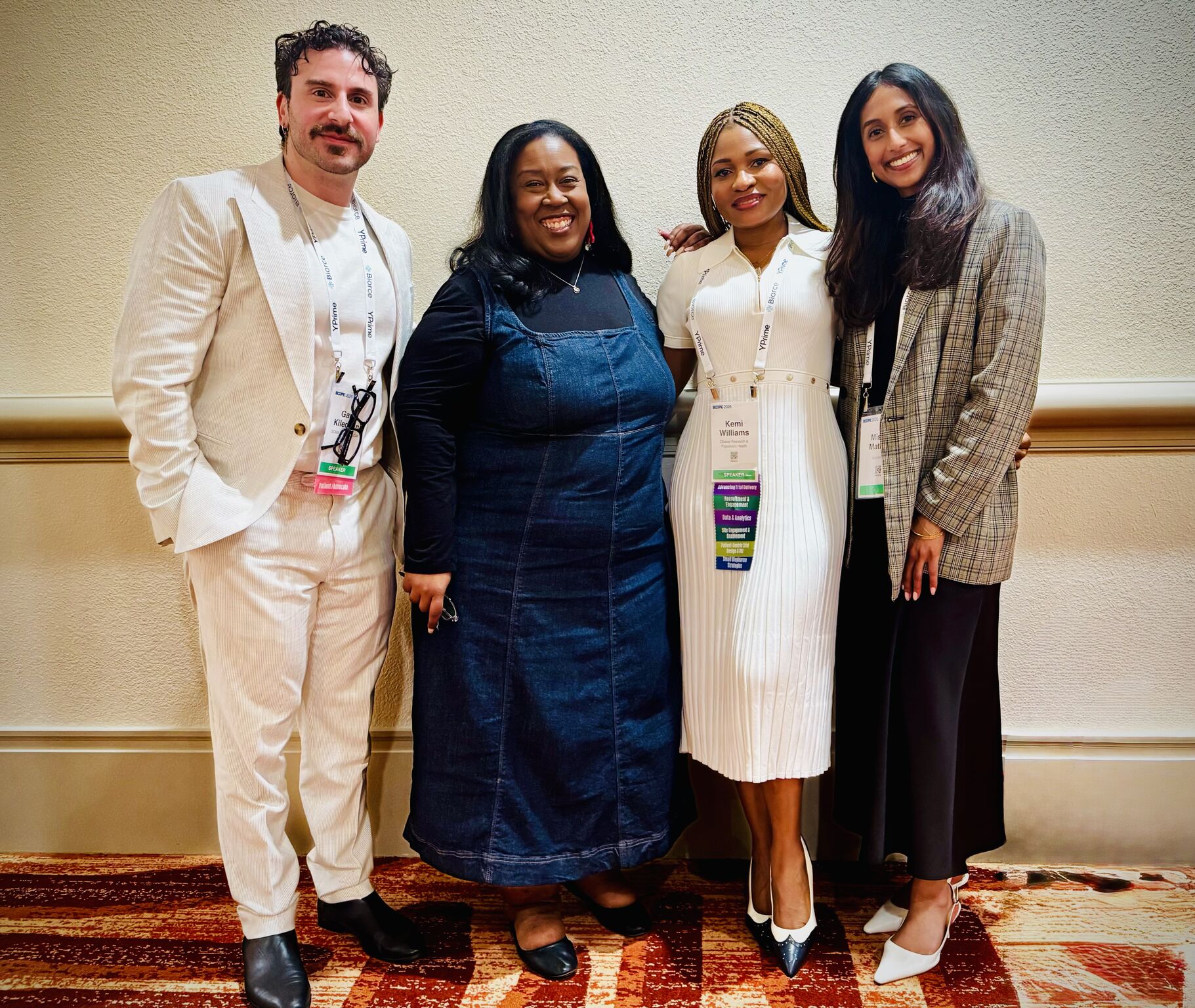
(L-R) Garo Kiledjian, Kamaria Laffrey, Kemi Williams, Misha Mathur
For me, some of the most moving dialogue in this panel came from Kamara Laffrey, a woman living with HIV and longtime advocate. She really brought the human side of this issue into sharp focus. For her, access means not being treated as an afterthought. She talked about invisible exclusion — when trials don’t explicitly say “no,” but are designed in ways that signal from the outset that certain patients were never truly considered. “Invisible exclusion isn’t necessarily being told no,” she said. “It’s being told yes and then realizing that trials … were never designed for us from the jump.” That’s something I’ve never thought about in any discussions I’ve heard regarding “diversity” and “inclusion” in trials.
Because most sponsors in the room would insist — correctly — that they are not intentionally excluding people. But as Laffrey described, the lived experience of patients can feel like fragility assumptions, stigma, and protocol criteria built on outdated science.
Misha Mathur from AbbVie’s Patient Inclusion team pushed the discussion into structural blind spots. She pointed to protocol-level decisions that seem neutral but have disproportionate impact, such as failing to account for benign ethnic neutropenia in patients of African ancestry. That kind of oversight isn’t malicious; it’s operational inertia. When I asked her who actually “owns” that work (i.e., who considers genetic differences during protocol development), her answer was revealing: It depends on how the company is structured. That variability is probably part of the problem. You can’t treat inclusion as a design requirement if ownership is optional.
The panel closed with a clear call to action: Find one point — just one — in your protocol development and governance process where inclusion can be treated as a requirement, and change it.
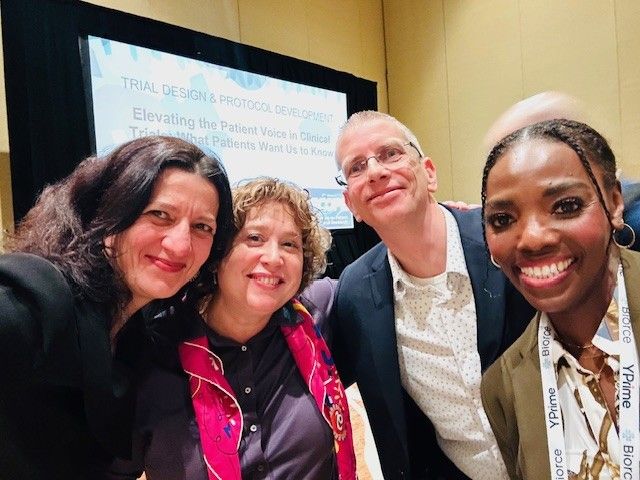
(L-R) Sema Sgaier, Dana Iommazzo, Wouter Daniels, Karen Correa
Patient Centricity Is Bigger Than The Patient
The second session, moderated by Wouter Daniels of BI, took a broader lens, discussing culture change, silos, infrastructure, caregivers, and the role of data. Karen Correa, Ph.D., VP of clinical development operations at BI (and a member of my editorial board), reframed “patient centricity” in a way that made a lot of heads nod. She said we obsess over the patient voice, but we often overlook the ecosystem around the patient, especially caregivers. After all, who reminds patients/trial participants to schedule appointments? Who pushes them to take their medication? Who notices when side effects are worse than the patient is admitting? In many cases, it’s not the patient; it’s the caregiver.
Thus, Correa challenged sponsors to think upstream by including caregivers in recruitment plans, stipends, surveys, and feedback loops. If we’re honest, she suggested, we may be barking up the wrong tree if we focus exclusively on the patient.
Dana Iommazzo, global head, clinical operations program management, at Novartis then described Project Pathfinder, an initiative aimed at breaking down silos and embedding patient and site insights earlier in the lifecycle. Patient input, she emphasized, is no longer a nice-to-have but a must-have from target patient profile through protocol and execution.
In one Phase 3 immunology study, incorporating site and patient feedback led to tangible operational changes, including removing certain patient-reported outcomes and reducing a placebo washout, which resulted in faster site initiation and recruitment running ahead of schedule. That’s the part the industry needs to hear more often. Tangible results. Inclusion and engagement shouldn’t be viewed as moral add-ons; they’re operational accelerators — if implemented systematically.
From Eligibility To Recruitability
Perhaps the most provocative shift in framing came from Sema Sgaier, Ph.D., who argued that we need to move from thinking about eligibility to thinking about “recruitability” and retention. Afterall, we’re not good at converting interested trial participants into actual particpants. And that gap isn’t just about awareness or access; it includes beliefs, trust, perceptions of risk, and lived experiences. Her argument was that claims data and EHRs are now table stakes. The next layer is behavioral data — insights into what patients actually think and feel about participation.
Whether or not every sponsor is ready for that level of data integration, the larger point holds. We often design protocols assuming rational, fully informed actors. Real people make decisions through filters of fear, stigma, finances, community norms, and prior healthcare experiences. If we don’t design for that reality, we shouldn’t be surprised when recruitment stalls.
From Conversation To Commitment
Walking out of both sessions, I couldn’t help thinking about another conversation I had at SCOPE — the one I wrote about in my summary of the Ken Getz sessions. Different speakers. Different slides. Different framing. But the same underlying friction.
At SCOPE, we are surrounded by smart people who understand the enrollment crisis, the trust deficit, the protocol complexity problem, and the site burden. We can articulate the issues clearly. We can point to data. We can even showcase early wins. And yet, the recurring theme across sessions is not ignorance. It’s implementation.
What struck me in these two panels wasn’t that the problems were new, it was that the language felt more operational. There was less talk about why inclusion matters and more talk about governance checkpoints, workflow integration, ownership models, behavioral data layers, and measurable cycle-time impact. In other words, less aspiration and (hopefully) more infrastructure.
I’m not naïve enough to think that means we’ve turned a corner as an industry. But, I do believe it does mean that the pressure is mounting to prove that we can translate insight into execution. Trust me, you and I both will be happy when we can go to SCOPE and hear more stories about real-world solutions that “move the needle” rather than rehashed discourses on the shortcomings of our status quo.