
The 2026 Pharma R&D AI Sourcing Map: Partnerships, Concentration, Inflection
By Mathini Ilancheran, Research Manager, R&D Procurement, Beroe, And Rama Krishna Rao, Clinical Trial Operations And Digital Transformation Expert

In the first quarter of 2026, major pharmaceutical AI partnerships approximately doubled year over year, rising to over 36.1 This shows a shift from isolated pilots to longer-term commitments across discovery, clinical development, and enterprise operations. Publicly disclosed deals show three patterns:
- AI dealmaking is now common across large pharmaceutical companies. However, a smaller group of very active companies still drives much of the activity.
- Investment is still focused mainly on drug discovery. However, it is now also moving into clinical development and enterprisewide platforms.
- The supplier ecosystem is also becoming more concentrated. A few supplier categories account for most AI deal activity, while manufacturing and service categories have limited visible AI deal activity.
This paper analyzes publicly announced AI partnerships in pharma and highlights the key trends shaping deal activity across discovery, clinical development, and enterprise platforms.
Buyer Investment Landscape
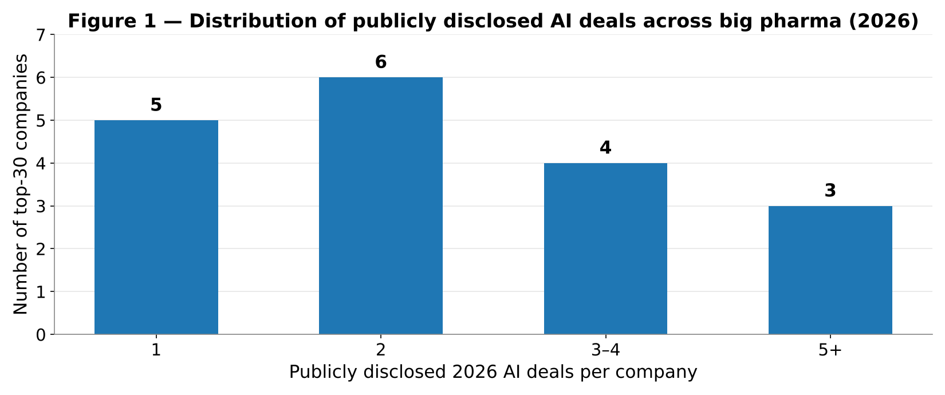
Based on publicly disclosed activity, most of the top 30 pharmaceutical companies show one or two AI deals in 2026. A smaller group is more active across several deals, with seven companies, including Bristol Myers Squibb, Eli Lilly, Boehringer Ingelheim, and Novo Nordisk, at three or more (Figure 1). This matters for sourcing because these active companies often shape how the market buys AI.
Source: Beroe Analysis 1–12, 41
Focus Across The Value Chain
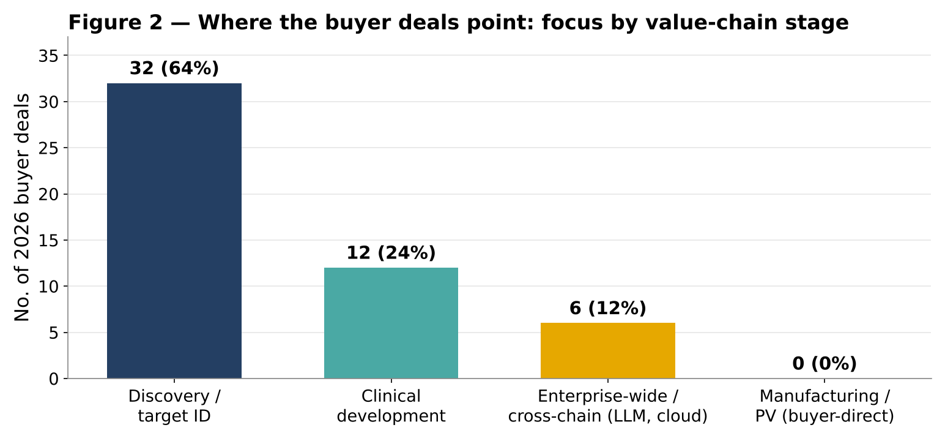
Discovery still accounts for the largest share of disclosed 2026 AI deals: approximately 64% focus on discovery and target identification, 24% on target clinical development, and 12% on enterprisewide platform agreements covering the full value chain. The enterprisewide category includes large-language-model and cloud alliances with Anthropic, OpenAI, Google Cloud, NVIDIA, and Amazon Web Services (Figure 2).10,9,11,6,41 There have been no disclosed deals directly targeting manufacturing or pharmacovigilance. Those capabilities are usually bought as software and services from suppliers rather than through a structured partnership. The market shows a gradual AI expansion beyond discovery, with growing use in clinical operations and enterprise infrastructure.
Source: Beroe Analysis (based on 50 disclosed 2026 buyer deals, Jan. 1 to Oct. 14, 2026)
Largest Disclosed Deals
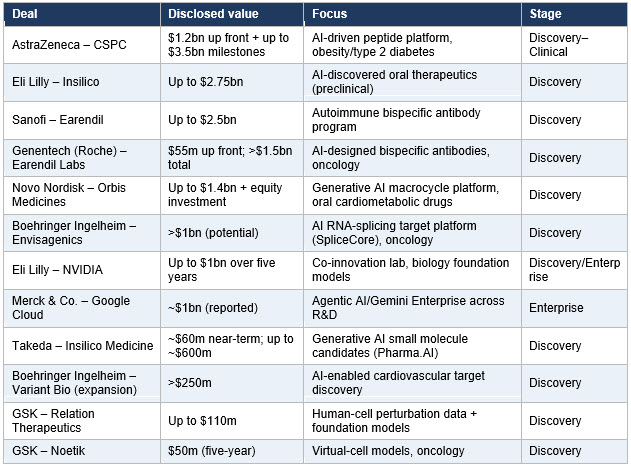
The largest disclosed 2026 commitments are focused on obesity/metabolic and oncology/immunology. These are the therapeutic areas driving wider business development (Table 1). Recent deals reinforce this pattern, with Novo Nordisk’s cardiometabolic partnership with Orbis Medicines and oncology deals by Genentech and Boehringer Ingelheim, each valued at around $1 billion or more. Two points stand out: Most headline deal values depend on future milestones being met, while the largest compute and platform commitments are multiyear infrastructure investments rather than deals tied to a single asset.
This shift changes how such deals should be evaluated. AI pricing is moving away from the older software-as-a-service (SaaS) models of per-seat licenses and milestone-driven payments toward outcome-based pricing. This works for clearly defined processes but is much harder to apply in discovery. Even so, usage-based models are spreading across leading pharmaceutical companies. Each AI provider also has specific strengths, either in a therapeutic area or a particular scientific process, and pharmaceutical companies need to build this into their supplier-selection strategy. Procurement teams and their finance colleagues also need to set aside their existing evaluation models and instead assess the AI’s added value and the right purchase price. From a CFO’s perspective, the benefit is both tactical and strategic: It lowers unit costs per activity, and it positions the organization for future growth through more efficient processes.
Table 1: Largest disclosed 2026 pharmaceutical AI deals
Sources: AstraZeneca 6-K5; BioPharma Dive3; HLTH1; Clinical Trials Arena2; IntuitionLabs11; Pharmaceutical Technology8; BioSpace43; BioBucks4
Concentration Among AI Providers
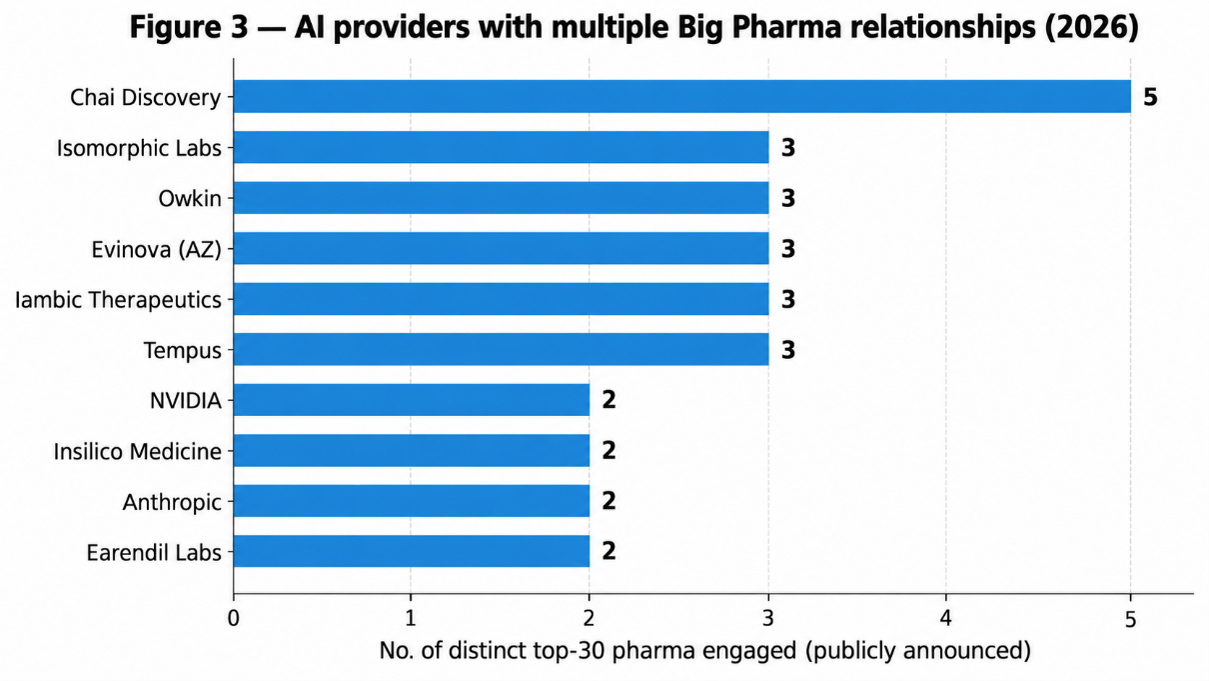
On the supply side, a small set of providers is becoming the common link across pharmaceutical AI. For instance, one discovery platform (Chai Discovery) is engaged with five of the top pharma companies.42 Several others, including Isomorphic Labs, Owkin, Evinova, Iambic Therapeutics, and Tempus, each work with three, while NVIDIA, Insilico Medicine, Anthropic, and Earendil Labs each have two Big Pharma relationships (Figure 3). This concentration of demand into a limited number of platforms creates concentration and lock-in risks for buyers. It also changes the supplier landscape, as service providers now compete with AI platform companies in areas that were earlier served mainly by traditional service providers.
This concentration is partly driven by the evolving AI ecosystem, which can be broadly divided into two categories: global, general-purpose large language models (LLMs) and specialized, industry-specific AI models. While global LLM providers primarily offer generalized solutions across industries, specialized AI platforms are being developed to address the distinct requirements of pharmaceutical R&D. Discovery-focused AI startups, in particular, are building proprietary models capable of processing complex, nontextual data, such as molecular structures, that general-purpose LLMs are not inherently designed to handle. At the same time, major collaborations between leading LLM providers and large pharmaceutical companies are likely to reinforce market concentration, potentially creating affordability challenges for small and midsize R&D organizations. For sourcing teams, this highlights the importance of evaluating general-purpose LLMs and domain-specific discovery platforms as distinct sourcing categories, each with different supplier dependencies, lock-in risks, pricing structures, and negotiating leverage.
Source: Beroe Analysis (distinct top 30 pharma relationships publicly announced in 2026) 4,13,16,18,41–45
How Suppliers Are Responding
The supply ecosystem is responding unevenly (Table 2). Market activity is concentrated in four categories:
- AI/computational discovery
- Clinical trial technology
- Real-world evidence
- Full-service CROs
Other supplier categories, such as contract manufacturing and bioanalytical services, show limited visible AI activity. These areas may still be using AI internally, but they have not yet become major partnership areas. Prominent moves include IQVIA’s launch of the IQVIA.ai agentic platform with NVIDIA and its $145 million acquisition of Charles River discovery assets,13,14 Veeva’s rollout of AI agents on Anthropic and Amazon models15, Owkin’s five-year K Pro license with Sanofi16, and Thermo Fisher’s OpenAI clinical-development collaboration alongside its $9.4 billion acquisition of Clario.17 Other moves include ICON’s multiyear collaboration with Anthropic, Evinova’s agreement with Merck KGaA, and the first manufacturing-side AI alliance between Insilico Medicine and CDMO Bora Pharmaceuticals.44,46,47
Table 2: AI deal activity by supplier category (2026)
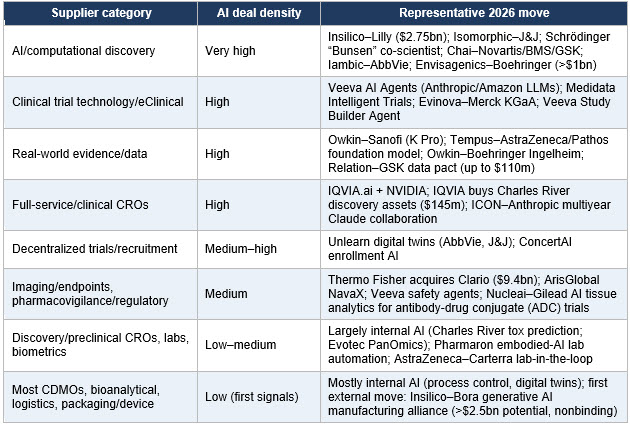
Sources: IQVIA13; Salesmotion14; Veeva15; Crescendo AI16; Clinical Leader17; BioPharmaTrend18; company announcements; Contract Pharma44; Reuters45; ICON46; Tech Times47
The financial market has reacted most sharply in the CRO segment. After the launch of CRO agentic AI agents in February 2026, CRO share prices declined because of concerns over insourcing. IQVIA lost approximately $7.3 billion in market value despite strong results.14
Across suppliers, the strategic response is similar. Companies are:
- buying upstream capabilities
- building AI-enabled platforms
- moving away from headcount-based pricing
- developing AI-embedded, outcome-linked offerings.
AI is starting to change how research and clinical services are packaged, priced, and delivered.
Future AI Penetration Across Clinical Development
Recent publications and company activity suggest that the next phase of AI in clinical development will be workflow-led. The strongest signals are in protocol design, patient recruitment, AI-assisted monitoring, wearable-based endpoints, digital twins, and real-time trial oversight. Table 3 extends this view across the full clinical development and R&D services taxonomy, grouped into five clusters that follow the development cycle so that sourcing teams can see where AI is already operational, where it is emerging, and where it remains internal rather than a distinct partnership category.19-25
Trust in AI outputs will be critical to this shift. Governance and data integrity are expected to become increasingly important as AI moves into clinical data review and trial oversight, particularly for smaller organizations with fewer resources. Three layers of standards will be essential. The first provides general guidance on AI use, while the second establishes guardrails for its ethical and constructive deployment. The third ensures consistent performance of underlying AI systems, requiring updated standards for the systems development life cycle (SDLC). This would enable end-to-end traceability of product requirements, preventing gaps as development increasingly shifts toward AI-assisted practices such as “vibe coding.”
AI in pharmaceutical R&D covers four stages: generative AI, predictive AI, AI agents, and agentic AI. Almost all large firms have already used generative AI to build general question-and-answer tools. Predictive AI is now being applied to selecting suitable trial sites and patients who carry the least risk for a study. Pharma companies and clinical technology providers are increasingly exploring and deploying AI agents to accelerate clinical trial workflows, including study design, monitoring, clinical study report generation, and regulatory documentation, with varying levels of adoption and maturity. At Bio-IT World, discussions raised the possibility of accelerating entire workflows to generate a complete set of regulatory filing documents at the press of a button. Looking ahead, protocol-to-case report form (CRF) processes are expected to transform first, followed by database lock to clinical study report, predictive models for site and patient selection, and broader adoption of copilot-style agents.
Table 3: Potential AI penetration across clinical development functions
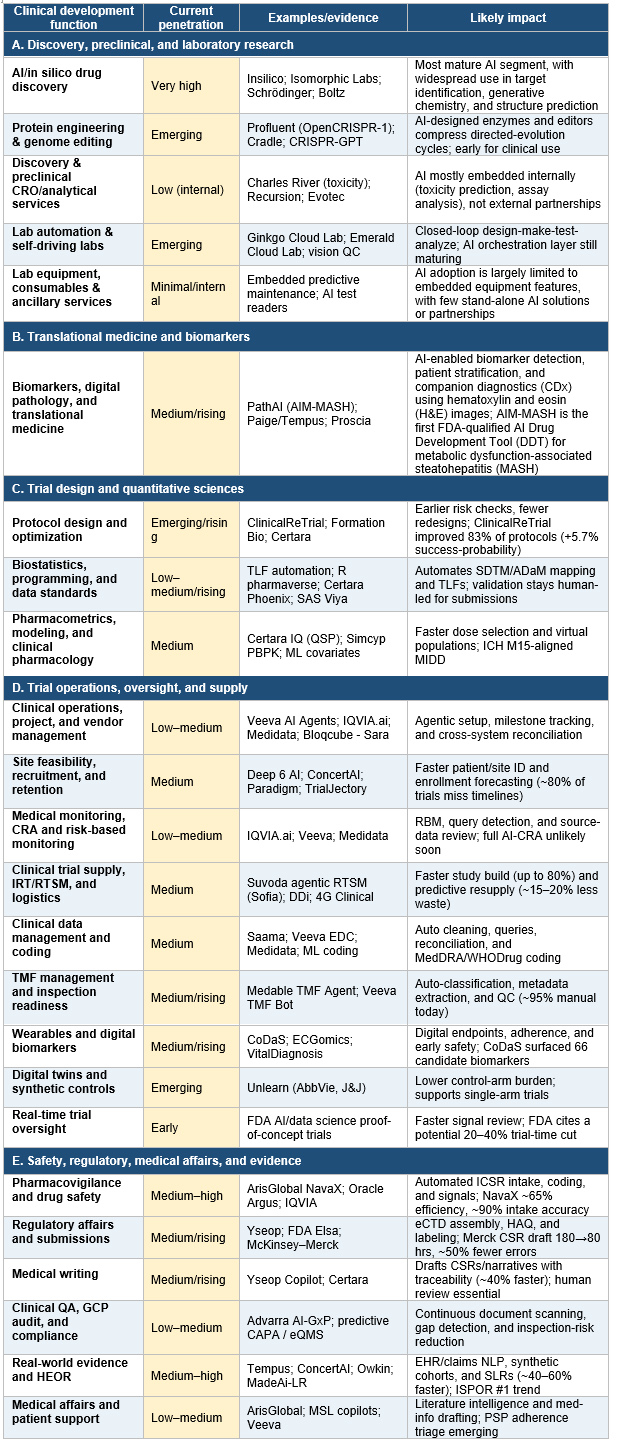
Sources: Supplier news and company announcements19–40; penetration ratings are Beroe analysis.
Conclusion
The 2026 market shows a clear shift in pharma AI. Investment is now visible across Big Pharma, but the most active companies continue to drive much of the deal activity. Discovery remains the main focus, while AI is also moving into clinical development and enterprisewide use. The supplier base is becoming more concentrated. A small group of AI providers is building relationships across multiple pharma companies. At the same time, CROs and technology providers are adding AI capabilities to protect and expand their service models.
Evidence of real returns is starting to appear, but it is uneven. McKinsey research shows that many companies deployed generative AI without generating a return on investment, and that a larger shift in productivity came only with the move to agentic AI.48 A recent Tufts Center for the Study of Drug Development (CSDD) analysis with Medable points to a large return of up to $21 million per drug development program,49 although this is modeled for a Phase 3 oncology trial using Medable’s clinical monitoring agent rather than measured across live trials.
As AI moves deeper into clinical development, new specialist companies are likely to emerge around specific trial workflows, including protocol design, site selection, recruitment, monitoring, wearable data analysis, and trial data review. For buyers and service providers, the focus is now on sourcing, risk management, and value creation as AI moves across more parts of the pharma value chain.
References:
- Gary Monk / HLTH -“Q1 2026: When Pharma AI Partnerships Crossed a Threshold” (36 Q1-2026 deals, double Q1-2025) https://hlth.com/insights/articles/q1-2026-when-pharma-ai-partnerships-crossed-a-threshold
- Clinical Trials Arena -“JPM26: Eli Lilly and NVIDIA deepen ties with $1bn AI partnership” https://www.clinicaltrialsarena.com/news/jpm26-eli-lilly-and-nvidia-deepen-ties-with-1bn-ai-partnership/
- BioPharma Dive -“Lilly’s AI commitment expands through deal with Insilico” (up to $2.75B) https://www.biopharmadive.com/news/eli-lilly-insilico-ai-medicine-drug-discovery/816088/
- Isomorphic Labs -Research collaboration with Johnson & Johnson (20 Jan 2026) https://www.isomorphiclabs.com/articles/isomorphic-labs-enters-into-a-research-collaboration-with-johnson-johnson
- AstraZeneca plc - Form 6-K (CSPC collaboration: $1.2bn upfront + up to $3.5bn milestones) https://www.sec.gov/Archives/edgar/data/0000901832/000165495426001073/a3234s.htm
- Drug Discovery World -“Roche leads AI drug discovery with new NVIDIA deal” (>3,500 GPUs) https://www.ddw-online.com/roche-leads-ai-drug-discovery-with-new-nvidia-deal-41008-202603/
- PRNewswire/BioSpace - “Boltz and Pfizer Announce Strategic Collaboration” (8 Jan 2026) https://www.biospace.com/press-releases/boltz-and-pfizer-announce-strategic-collaboration-to-develop-and-deploy-state-of-the-art-biomolecular-ai-foundation-models
- Pharmaceutical Technology -“JPM26: GSK banks on recent AI deals” (Noetik $50m; Helix) https://www.pharmaceutical-technology.com/news/jpm26-gsk-banks-on-recent-ai-deals-to-offset-patent-expiries/
- Euronews / DDW -“Novo Nordisk joins forces with OpenAI” (enterprise-wide; end-2026 integration) https://www.euronews.com/health/2026/04/14/novo-nordisk-joins-forces-with-openai-to-fast-track-drug-research
- BioPharma Dive / Pharmaceutical Technology -“Bristol Myers deepens AI investment with Anthropic” (20 May 2026) https://www.biopharmadive.com/news/bristol-myers-deepens-ai-investment-anthropic-deal/820697/
- IntuitionLabs -“AI Foundation Models in Pharma: GSK–Noetik” (notes ~$1B Merck–Google Cloud) https://intuitionlabs.ai/articles/ai-foundation-models-pharma-gsk-noetik-oncology
- Contract Pharma - “Orionis Biosciences, Novartis Partner to Advance Molecular Glue Drugs” (10 Jun 2026) https://www.contractpharma.com/breaking-news/orionis-biosciences-novartis-partner-to-advance-molecular-glue-drugs/
- IQVIA - “IQVIA Unveils IQVIA.ai, a Unified Agentic AI Platform Powered by NVIDIA” (16 Mar 2026) https://www.iqvia.com/newsroom/2026/03/iqvia-unveils-iqvia-ai-a-unified-agentic-ai-platform
- Salesmotion - “AI Won’t Replace CROs…” (IQVIA–CRL $145m discovery assets; ~$7.3bn IQVIA cap loss) https://salesmotion.io/blog/ai-cro-transformation-business-development
- Veeva / PRNewswire - “Veeva AI Agents Now Available” (Anthropic & Amazon LLMs; 2026 rollout) https://www.prnewswire.com/news-releases/veeva-ai-agents-now-available-to-increase-productivity-and-customer-centricity-302631260.html
- Crescendo AI - “Sanofi–Owkin multi-year agreement; 5-year K Pro licence” (Jun 2026) https://www.crescendo.ai/news/latest-ai-news-and-updates
- Clinical Leader (Beroe) -“CRO Industry Outlook 2026” (Thermo Fisher–OpenAI; Thermo–Clario $9.4bn) https://www.clinicalleader.com/doc/cro-industry-outlook-the-next-stage-of-clinical-trial-transformation-0001
- BioPharmaTrend - “Companies Applying AI to De-Risk Clinical Trials: 2026 Watchlist” (Unlearn, ConcertAI, Owkin) https://www.biopharmatrend.com/business-intelligence/companies-applying-ai-to-de-risk-clinical-trials-2026-watchlist/
- Xing et al. - “ClinicalReTrial: A Self-Evolving AI Agent for Clinical Trial Protocol Optimization” (Jan 2026) https://arxiv.org/abs/2601.00290
- Bertolini et al. - “Digital Twins as Synthetic Controls in Single-Arm Trials” (May 2026) https://arxiv.org/abs/2605.12832
- Woolley et al. - “Trends in AI and Human-AI Interaction in Clinical Trials -A Hybrid Human-AI Exploration” (May 2026) https://arxiv.org/abs/2605.29096
- Kim et al. - “CoDaS: AI Co-Data-Scientist for Biomarker Discovery via Wearable Sensors” (Apr 2026) https://arxiv.org/abs/2604.14615
- Xue et al. - “VitalDiagnosis: AI-Driven Ecosystem for 24/7 Vital Monitoring and Chronic Disease Management” (Jan 2026) https://arxiv.org/abs/2601.15798
- Axios -“FDA to use AI to track clinical trials in real time” (Apr 2026) https://www.axios.com/2026/04/29/fda-ai-track-clinical-trials-real-time
- TIME - “AI Could Reshape Clinical Trials—and the Business of Pharma” (Feb 2026) https://time.com/7372610/ai-drug-clinical-trials/
- Zhang et al. - “ECGomics: An Open Platform for AI-ECG Digital Biomarker Discovery” (Jan 2026) https://arxiv.org/abs/2601.15326
- medRxiv - “Automation in Clinical Trial Statistical Programming: TLF Generation, Validation Frameworks, and AI/ML Integration (2020–2025)” https://www.medrxiv.org/content/10.64898/2025.12.24.25342988v1
- Certara - “Certara IQ: AI-Enabled QSP Modeling” and PAGE 2026 (ML in pharmacometrics) https://www.certara.com/software/quantitative-systems-pharmacology/
- Suvoda - “Suvoda announces agentic RTSM” (kickoff-to-UAT up to 80% faster; Apr 2026) https://www.suvoda.com/insights/all-news/suvoda-introduces-agentic-rtsm-cutting-clinical-trial-start-times
- IntuitionLabs - “AI Patient Recruitment for Clinical Trials” (Deep 6 AI 28M+ records; ConcertAI) https://intuitionlabs.ai/articles/ai-patient-recruitment-clinical-trials-platforms
- Medable - “Medable Debuts AI Agent for Automating Trial Master File (TMF) Processes” (Jan 2026) https://www.medable.com/newsroom/medable-debuts-ai-agent-for-automating-trial-master-file-tmf-processes
- ArisGlobal - “Strong Q1 2026 Momentum: NavaX pharmacovigilance” (case intake, signal detection) https://www.arisglobal.com/media/press-release/arisglobal-reports-strong-q1-2026-momentum-with-accelerating-enterprise-ai-transformation/
- Yseop - “How Automation is Transforming Regulatory and Medical Writing in Biopharma” https://yseop.com/blog/generative-ai-biopharma-innovation/
- McKinsey - “Rewiring pharma’s regulatory submissions with AI” (Merck CSR 180→80 hrs; ‒50% errors) https://www.mckinsey.com/industries/life-sciences/our-insights/rewiring-pharmas-regulatory-submissions-with-ai-and-zero-based-design
- IntuitionLabs - “AI and the Future of Regulatory Affairs” (FDA Elsa, built on Claude; Jan 2026) https://intuitionlabs.ai/articles/ai-future-regulatory-affairs-pharma
- Signify Research - “Digital Pathology Market Update 2026” (PathAI AIM-MASH first AI DDT; Paige Predict) https://www.signifyresearch.net/insights/biomarkers-qc-ai-and-rising-industry-investment/
- ISPOR - “2026-2027 Top 10 HEOR Trends” (AI ranked #1; SLR acceleration) https://www.ispor.org/heor-resources/top-10-heor-trends
- Advarra - “Good Clinical Practice Solutions: AI-powered GxP” (continuous compliance, inspection readiness) https://www.advarra.com/solutions/review-services/consulting-gxp-services/
- Profluent - “Editing the Human Genome with AI: OpenCRISPR-1” (AI-designed gene editor) https://www.profluent.bio/media/editing-the-human-genome-with-ai
- QPillars - “Self-Driving Labs in 2026: What Works vs. Hype” (Ginkgo Cloud Lab; Emerald Cloud Lab) https://qpillars.com/blog/self-driving-labs-2026-what-works-vs-hype
- BioBucks - “Biotech BD&L Tracker 2026” (2026 licensing and partnering deals, incl. AI deals to Oct 2026) https://www.biobucks.co/biotech-bdl-tracker-2026
- Endpoints News - “AI startup Chai lands GSK deal, its sixth pharma partner in nine months” (9 Oct 2026) https://endpoints.news/chai-discovery-signs-gsk-deal-to-make-biologics-with-ai
- BioSpace - “Genentech makes $1.5B+ deal with AI heavyweight Earendil for cancer bispecifics” (24 Sep 2026) https://www.biospace.com/deals/genentech-makes-1-5b-deal-with-ai-heavyweight-earendil-for-cancer-bispecifics
- Contract Pharma - “Merck KGaA to adopt Evinova AI-native platform to accelerate clinical R&D” (29 Jul 2026) https://www.contractpharma.com/breaking-news/merck-kgaa-to-adopt-evinova-ai-native-platform-to-accelerate-clinical-rd
- Reuters / The Star - “Owkin signs AI drug discovery deal with Boehringer for cancer, immunology” (2 Sep 2026) https://www.thestar.com.my/tech/tech-news/2026/09/02/owkin-signs-ai-drug-discovery-deal-with-boehringer-for-cancer-immunology
- ICON plc - “ICON announces multi-year collaboration with Anthropic to bring frontier AI to clinical trials” (Jul 2026) https://www.iconplc.com/news-events/press-releases/icon-announces-multi-year-collaboration-anthropic-bring-ai-clinical
- Tech Times - “Generative AI moves from drug discovery to drug factories in $2.5B Bora deal” (15 Jul 2026) https://www.techtimes.com/articles/320594/20260715/generative-ai-moves-drug-discovery-drug-factories-25b-bora-deal.htm
- McKinsey & Company - “Seizing the agentic AI advantage” (Jun 2025) https://www.mckinsey.com/capabilities/tech-and-ai/our-insights/seizing-the-agentic-ai-advantage
- Medable - “New Tufts CSDD analysis finds AI agents can deliver up to $21 million in net financial value per drug development program” (12 Aug 2026) https://www.medable.com/newsroom/new-tufts-csdd-analysis-finds-ai-agents-can-deliver-up-to-21-million-in-net-financial-value-per-drug-development-program-and-up-to-82x-roi
Methodology and limitations: Figures reflect 50 publicly disclosed Big Pharma AI deals identified for Jan. 1 to Oct. 14, 2026, across 18 of the top 30 companies. Coverage is a prioritized analysis of disclosed activity, not a full census. An absence in any category means no deal surfaced in the window, not that none exists. Value-chain stage is assigned by primary focus where a deal spans several areas. Provider counts in Figure 3 reflect distinct top 30 pharma relationships publicly announced in 2026. Expansions are counted only where new terms were announced; target nominations and option exercises under existing agreements are not counted. Some deals are drawn from secondary roundups and cross-checked against primary announcements where available. Reported deal values include both milestone-based payments and committed investments, as announced by the companies.
About The Authors:
 Mathini Ilancheran is a research manager, R&D, at Beroe. She is an expert in procurement intelligence and industry analysis, specializing in strategic insights that help Fortune 500 companies make informed decisions. With a focus on global pharma, biotech, and medical devices, she brings deep expertise in value chain analysis, industry and technology trends, competitive intelligence, and strategy. Ilancheran has authored 37+ publications on R&D outsourcing, offering actionable perspectives that guide global enterprises in optimizing outsourcing practices, category management, and long-term planning.
 Rama Krishna Rao brings over 28 years of pharmaceutical leadership experience, including senior roles at Eli Lilly and Novartis. He co-leads the IEEE Global Standards Initiative for AI in Clinical Research and specializes in clinical R&D, AI governance, and digital transformation.