
What I Heard When I Crashed Three ING Dive Teams

By Dan Schell, Chief Editor, Clinical Leader

The Innovation Network Gathering (ING) is one of my favorite industry events for several reasons, not the least of which are its Dive Teams. These small, collaborative groups bring together people from across clinical research to tackle some of the industry's more persistent challenges.
Last year, I participated in one Dive Team. This year, the conference organizers gave me permission to pop in and out of three different teams. My big idea was to bring along our editorial department's fancy video camera, capture some of the conversations, and share short videos that would give Clinical Leader readers a sense of what each group was discussing.
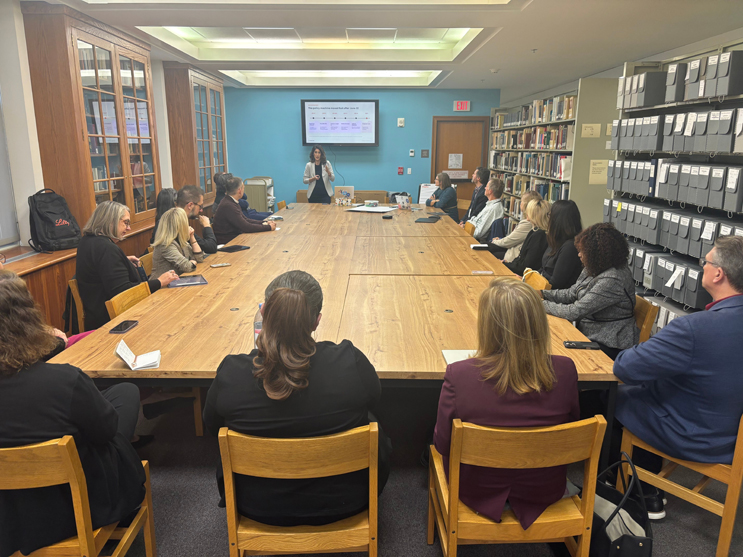
Well, that didn't quite work out as planned.
After reviewing the footage from my first session, “Operation TrialBlazer: Making The Vision Real,” I realized that capturing a few random clips wasn't going to adequately convey the conversations or the ideas being developed. I'd probably need three hours of footage to do that justice.
So, if you're interested in watching some random video clips of Catherine Gregor and Andrea Bastek of Florence helping guide 19 people through a discussion about Operation TrialBlazer, complete with less-than-stellar audio, send me an email. I'm happy to share.
I will, however, share one observation from that discussion that stuck with me.
An attendee from an AMC described the challenges of trying to accelerate study startup while navigating numerous review committees, regulatory applications, and IRB requirements. One particularly frustrating example involved the subtle differences in how IRBs phrase essentially similar questions. Those differences force experienced regulatory coordinators to repeatedly interpret questions, adapt responses, and complete applications that often request much of the same information.
The attendee liked the idea of a digital protocol that could allow information to flow more easily between systems, along with greater standardization of regulatory requirements. There was no illusion that interoperability would magically solve everything, but even incremental improvements could reduce some of the repetitive administrative work that slows study startup.
Fortunately, I also attended portions of two other Dive Teams: “Investigator Meetings: Did We All Fly Here To Watch Slides?” and “Leading Through The AI Revolution: Human Leadership For The Future Of Clinical Research.” Below, I share some of the ideas and conversations that caught my attention. Keep in mind, though, these aren't comprehensive summaries or official conclusions from either team, just a few observations from the discussions I was able to hear.
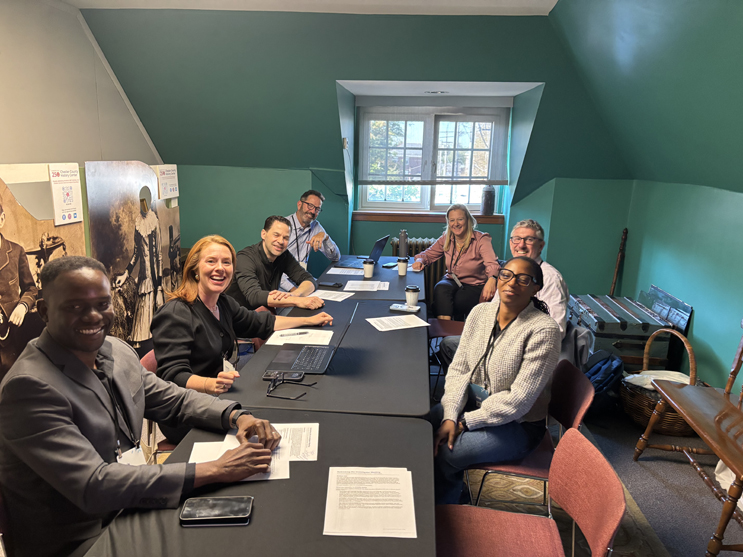
Investigator Meetings Need More Than Better Slides
The title of this Dive Team is … well, a fair question. Sponsors spend considerable time and money bringing investigators and site personnel together, often to deliver information that could have been communicated through other means. Certainly, some of that information is essential, but does the traditional investigator meeting actually prepare sites to conduct a study more effectively?
The discussion I observed centered on transforming investigator meetings from standalone training events into part of a continuous site-engagement experience. For example, one idea was to move much of the foundational protocol training ahead of the meeting. Rather than spending valuable face-to-face time reviewing information everyone needs to hear, sponsors could use preparatory training to identify where sites are struggling or where additional clarification is needed. That information could then shape the actual meeting, allowing participants to spend more time in interactive workshops, addressing practical challenges, and learning from one another.
Importantly, the engagement wouldn't end when everyone boarded their flights home. The group discussed using feedback collected during the meeting to develop follow-up training, refreshers, and opportunities for sites to share solutions as the study progresses. Hence, the use of the word continuous used earlier.
The group also explored a more ambitious idea: bringing together organizations with complementary capabilities to develop and pilot a more integrated investigator meeting experience. The proposed approach would combine premeeting education, meeting design, assessment of site understanding, and ongoing engagement.
During my time there, they discussed testing the model with two to four sponsor-supported pilots, collecting meaningful data, and eventually creating a practical guide that trial managers could use to advocate for change within their organizations. Of course, that raises an important question: How would we know the new approach actually works?
Participants suggested measuring improvements in site preparedness, activation timelines, protocol deviations, and potentially enrollment. They also acknowledged the need to demonstrate value to sponsors without sacrificing compliance expectations.
An investigator meeting that participants find more enjoyable isn't necessarily one that produces better trial execution. The group has a reasonable hypothesis, but it still needs evidence.
Another concern surfaced during the discussion: the group recognized that it needed more direct input from sites and sponsors before defining the solution. That's an important admission, especially when the entire exercise is intended to improve the site experience. I look forward to seeing what this group, moderated by Laura O’Donnell of GSK, comes up with post conference.
AI Adoption Is Becoming A Leadership Problem
There were two AI-focused Dive teams (no surprise to anyone, I’m sure), and the one I attended was focused on how clinical leaders should approach and adapt to AI deployments in their organizations. So, as you can imagine, a lot of talk about change management.
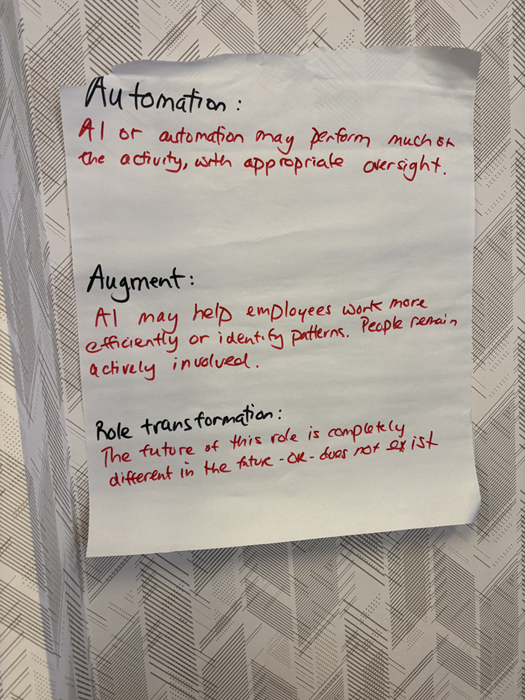
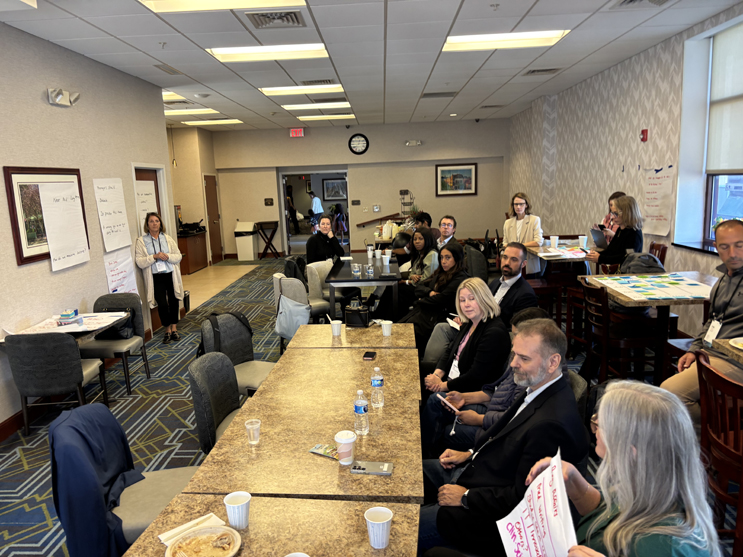
This team had broken into two groups and littered the walls of the space with flip chart paper filled with notes (see photos). One of the strongest themes was the need for managers to explain why AI is being introduced in the first place. That may sound obvious, but the discussion suggested that organizations may be moving faster to introduce AI tools than to explain what those tools are supposed to accomplish.
Team members examined how AI might augment, automate, or transform different clinical research roles. Medical writing, clinical science, regulatory affairs, study startup, and quality were among the functions discussed.
The takeaway wasn't that every role needs the same technology or training. Quite the opposite. Managers need to understand how AI could affect the specific work their employees perform and communicate what those changes might mean for their responsibilities and careers.
One participant described an internal digital innovation group that meets weekly to demonstrate actual AI use cases. Employees share prompts, explain the value they received, and discuss how they validated the information. Kim Buchanan, a self-described “veteran” of clinical trials and an associate director of quality at Merck, gave some great examples of a problem that doesn't always get enough attention: employees who are interested in AI but aren't confident using it.
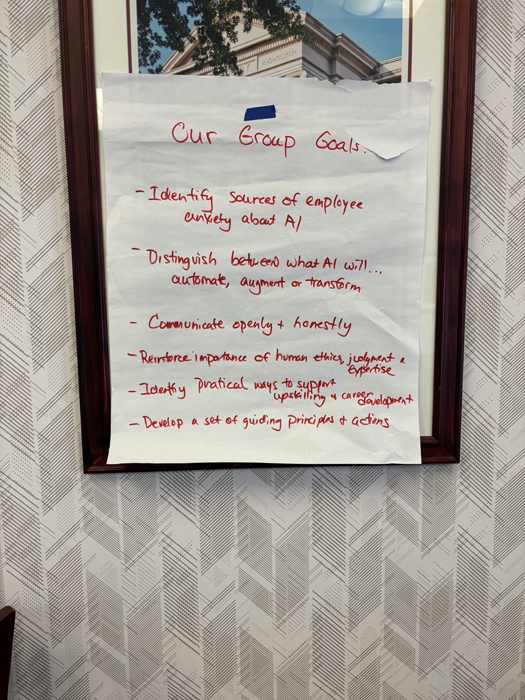
The group also discussed the possibility that employees who haven't embraced AI might become increasingly reluctant to admit they're falling behind. Organizations may need recurring opportunities for basic training rather than assuming everyone is progressing at the same pace.
And training itself presents another challenge. How do you establish a formal curriculum for technology that may change significantly before the curriculum is completed? Participants suggested frequent feedback, open forums, practical demonstrations, and opportunities for employees to identify where AI could improve their own work.
There was also a broader conversation about career development. If automation changes someone's responsibilities, employers should consider how that individual can transition into a different role. That requires more than teaching someone to write better prompts. Companies need to consider if their employees are being given time to learn these new skills while continuing to perform their existing jobs. After all, it's difficult to imagine successful “organizational transformation” when learning and adaptation become additional responsibilities piled onto already demanding workloads.
When Efficiency Creates More Work
Perhaps the most interesting moment in the AI discussion came when someone questioned whether AI-generated efficiencies could actually create more work for other people. The example involved automated data queries sent to CRCs. Technology might generate queries quickly and inexpensively, but a coordinator still has to investigate and respond to them, even when some of those queries make little sense. I thought this was a really good example of how productivity gains in one department don't necessarily translate into greater efficiency across an entire clinical trial.
Good Ideas Still Need To Survive Reality
Although these Dive Teams addressed very different subjects, I heard a similar challenge running through both discussions. In the investigator meeting group, participants wanted to rethink an established practice but recognized that they needed stakeholder input, sponsor support, and measurable evidence before declaring their approach successful. In the AI group, participants acknowledged that technological capabilities alone won't determine whether adoption succeeds. Leadership, communication, employee confidence, and the ability to manage change will play substantial roles.
Neither group solved its respective problem during the conversations I observed, but I didn’t expect that they would. What I appreciated was the willingness to question familiar assumptions and, occasionally, challenge the proposed solutions themselves.
Can the investigator meeting group find sponsors willing to test a different approach? Can organizations introducing AI translate their enthusiasm into meaningful support for employees? At the very least, I believe these Dive Teams plant seeds that something needs to change in their respective topic areas. There’s value in that, indeed, but I’ll be more interested to see how — or if — these teams can keep their momentum moving after they return home from ING.