
What Sponsors Don't See: The Systems Behind Clinical Trial Delivery
By Jim Kremidas, executive director, Association Multisite Research Corporations (AMRC)

Ask any sponsor what they need from a site network, and they'll tell you quality, speed, consistency, and predictability. Ask them how they assess whether a network can deliver those things, and the answer is usually a feasibility questionnaire, an investigator's resume, and prior enrollment history.
It's a pretty thin basis to judge the quality of a trial by, and it sits oddly against the reality of what site operations actually look like in a modern multisite clinical research corporation (MCRC). MCRCs are networks of sites specializing exclusively in clinical trial delivery, with centralized functions, standardized processes, and technology infrastructure that generate detailed operational data across every active study. Most of it never reaches sponsors, because the systems sponsors deploy aren't connected to the platforms sites use.
Two Systems, One Trial
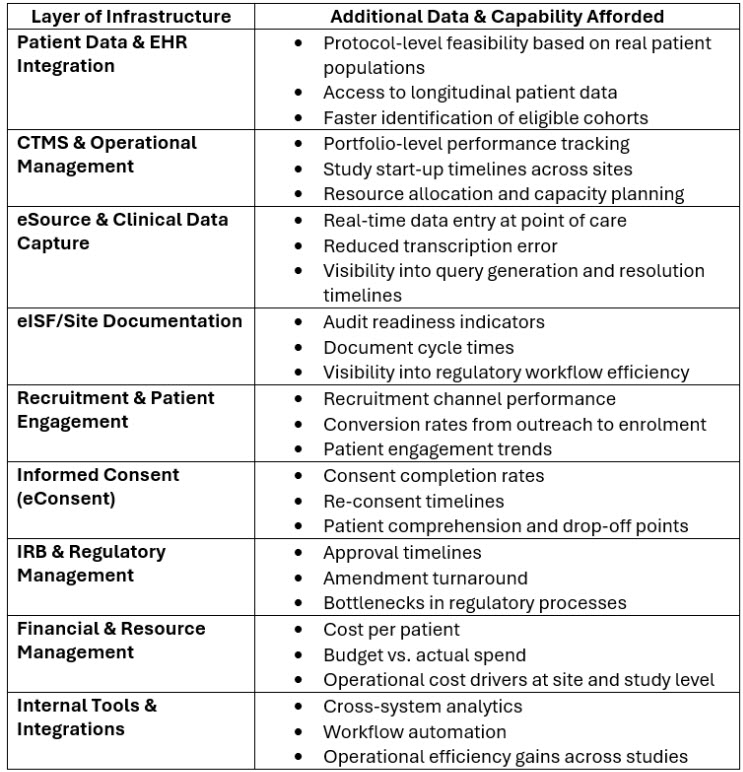
The technology stack within an MCRC is built around the operational realities of running trials at scale and generates substantial performance data.
Sponsors see almost none of it. For each study, they deploy their own EDC, IRT, and eCOA platforms, none of which connect to site-owned infrastructure. Site staff end up entering much of the same data twice, and the operational picture that could fundamentally change how sponsors plan and manage trials is rarely, if ever, surfaced.
Table 1: The MCRC Operating System
A Missed Opportunity
Site networks are recording a wealth of metrics, from cost per patient acquisition to recruitment channel performance, screen failure and dropout rates to query turnaround.
These platforms routinely capture operational and quality data, like document timelines, task sequencing, and audit activity. None of this is routinely available to sponsors, who could use it to better access process variability across sites, or patterns in start-up timelines. Since they don’t routinely have access to these insights, sponsors have no choice but to base feasibility, budgeting, and oversight targets on projections rather than evidence, with little or no indication as to where the gap between the two might surface. Yet, if they sponsors were to gain visibility of real-time operational readiness data, they’d be able to transition into a more strategic, partnership-driven engagement with their trial delivery partners, potentially speeding up study execution and reducing monitoring-related costs.
What’s held this back? How sponsor and site technology evolved.

New Ways Of Working
Sponsor and site technology evolved separately, built around different priorities. Sponsor platforms were designed to standardize data collection across a study, regardless of which sites were running it. Site-owned infrastructure came later with the development of networks that had the resources to invest in a sophisticated tech stack and a need to support multiple studies across multiple sites. The infrastructure MCRCs have built over the past decade has outpaced the engagement model sponsors rely on to work with them, and that mismatch is taking its toll. Sites are overburdened by running parallel systems, and sponsors are making planning and oversight decisions without access to existing data.
Redefining Strategic Partnerships
The fix is less complicated than the problem. Site networks generate a significant amount of operational data on a daily basis; accessing it will mean connecting to site-owned platforms rather than enforcing a parallel workflow that requires sites to upload the same data twice. Ideally, that means sponsor and CRO platforms connecting directly to the CTMS, eISF, and eSource systems already in place at site level, so that data is entered once and is available to both parties.
Strategic partnerships rely on a clear understanding of how trials are actually delivered, and both sides have a role to play. Sites must take more responsibility for communicating the systems they have in place and the capabilities they facilitate, while sponsors need to reframe their MCRC relationships and engage with site networks as operational partners rather than delivery vehicles. Those who do could quickly gain access to data that supports more accurate feasibility, more realistic budgeting, and earlier visibility into performance.
The data already exists. What's needed now is the will to change how we work and connect it.
About The Author:
 Jim Kremidas, executive director of the Association of Multisite Research Corporations (AMRC), has over 35 years of experience in the healthcare industry. Most recently, he has served as the executive director for the Association of Clinical Research Professionals (ACRP). He has over seven years of experience in management at CROs and spent more than two decades at Eli Lilly and Company, where he started the first patient recruitment department in the industry.