
Why Dr. Robert Califf Isn't Pulling His Punches Anymore

By Dan Schell, Chief Editor, Clinical Leader
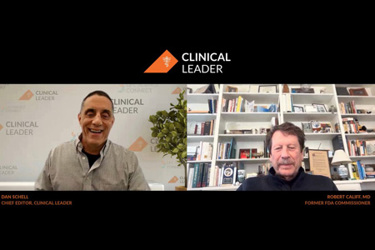
I first heard Robert Califf, MD speak last year at Florence’s Research Revolution conference
It was one of those moments where you stop half-listening for soundbites and start actually paying attention. Califf wasn’t giving a greatest-hits recap of his time at the FDA. He was challenging some of the industry’s most comfortable assumptions about quality, risk, data, and how badly we’ve overcomplicated clinical trials.
After that talk, I fired off a cold email asking for an interview. We didn’t meet at the conference. He didn’t know who I was. To my surprise, he said yes!
That conversation became the video interview you’ll find embedded here.
Early on, Califf explained why he’s willing to be more direct than most former commissioners. “I’m 74 years old,” he said, “And I’m not looking for a job or an NIH grant, so I’m going to say what I think — and you’re welcome to disagree with it.”
That mindset frames everything that follows.
When Quality Becomes Fear-Driven
A significant portion of our discussion focused on FDA Form 483s and how they’ve evolved from a tool for improvement into something closer to an industry boogeyman. Califf has seen inspections from nearly every angle; as a clinical trialist, an institutional official, a board member, and eventually as FDA commissioner. What troubles him most is not accountability itself, but how fear distorts behavior.
When inspections become existential threats, organizations respond by pouring resources into what Califf calls “the last mile” — obsessing over details that may have little bearing on patient outcomes or regulatory decisions. That fear, he argues, pulls attention away from what actually matters.
This is where his long-standing advocacy for QbD comes in. Rather than treating quality as a box-checking exercise, Califf argues it should be a strategic choice about focus. Decide what truly affects risk, benefit, and interpretability, then execute those elements exceptionally well. Everything else should be proportionate, not automatic.
He illustrated this with a story from a cardiovascular trial involving a safety-net hospital that served large numbers of minority and undocumented patients. The study measured a hard endpoint — mortality — yet administrative shortcomings led to a 483 and temporary disqualification of the investigator. For Califf, that episode still stings because it highlights how procedural rigidity can actively undermine inclusion and generalizability.
Simplicity As A Strategic Advantage
From there, the conversation widened to protocol complexity and the industry’s habit of collecting enormous volumes of data that rarely influence decisions. Califf cited examples where upward of 90% of submitted data was never meaningfully reviewed, not because regulators were negligent, but because trials were designed around caution rather than clarity.
Technology, Califf believes, finally gives the industry a way out of this cycle. He sees AI, EHRs, and automation as opportunities to reduce manual burden while improving traceability and auditability. Some tasks, he argues, don’t need a “human in the loop” at all. Others absolutely do, and distinguishing between the two is a matter of regulatory science, not guesswork.
We also spent time on informed consent, which Califf views less as a document problem and more as a communication failure. Expecting patients to meaningfully absorb dozens of pages during a clinic visit makes little sense, especially when digital tools could support asynchronous, personalized understanding instead.
The interview closes with a discussion on misinformation, an area where Califf is blunt about the FDA’s limitations. The agency was never built to compete with social media at scale, and facts alone don’t win attention. His proposed solution isn’t louder regulators, but broader participation — particularly from students and clinicians willing to meet people where they actually get information.
If you want a deeper look at Califf’s thinking on leadership and regulatory risk, you may also want to read my earlier piece, “Two Former FDA Chiefs, Two Very Different Warnings.”
This article only scratches the surface. The full conversation is where Califf’s perspective really comes into focus — unfiltered, occasionally provocative, and very much informed by decades of seeing how good intentions can go sideways in practice.
Watch the video. It’s worth the time.
Editor’s Note: Since 2025, Dr. Califf has been writing regularly on clinical trial design, regulation, misinformation, and evidence generation on his Substack. We encourage readers to follow his work at https://robcaliff272993.substack.com/.